Press Release
Johns Hopkins APL Hosts Government and Industry Leaders to Discuss Urgent Biodefense Issues
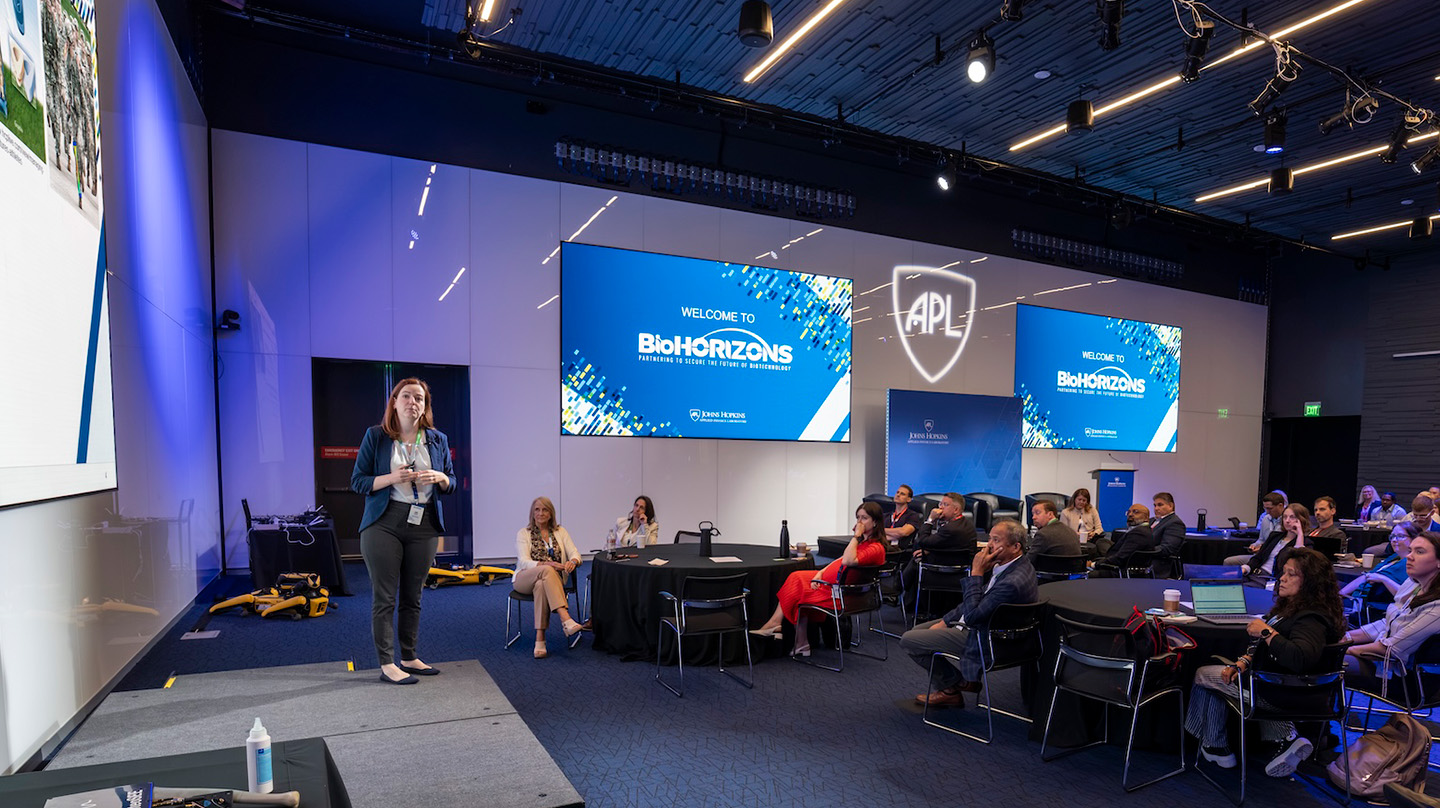
Anna Knight, far left, a senior biomechanical engineer at Johns Hopkins APL, delivers a presentation on OsteoSEE during the BioHorizons conference held in APL’s Semmel Center for Innovation.
Credit: Johns Hopkins APL/Craig Weiman
Audio generated using AI voice technology.
The Johns Hopkins Applied Physics Laboratory (APL) in Laurel, Maryland, hosted a leadership conference to keep the U.S. at the forefront of biotechnology research and development.
Held in August at APL’s Ralph Semmel Center for Innovation, BioHorizons convened experts from across the biotechnology industry to explore how to best transition critical capabilities from the lab to the field. The conference aligns with key priorities from the National Security Commission on Emerging Biotechnology (NSCEB), which is examining how emerging biotechnology and related technologies will shape future investment by the U.S. Department of War.
“This event was designed to advance a shared understanding of where biotechnology is heading, how it can address national priorities, and what it will take to get there responsibly and at speed,” said APL Director Dave Van Wie. “The ultimate goal is to bring that expertise and those insights together as we work to deliver bold new biotechnology capabilities for our nation.”
“Enduring U.S. leadership in biotechnology depends on how effectively we connect research, industry, and government to accelerate real-world impact. BioHorizons brings together the perspectives needed to identify opportunities, address barriers, and strengthen the nation’s biotechnology ecosystem,” said Libby Hart-Wells, a technology manager in APL’s Legal and Commercialization Branch who helped organize the event.
Averting the Next Catastrophe
Jason Matheny, CEO and president of nonprofit research organization RAND Corporation and former director of the Intelligence Advanced Research Projects Activity (IARPA), warned in his keynote address that the world remains “highly vulnerable” to biological threats. Several adversaries continue to invest in biological weapons, while cutting-edge tools such as artificial intelligence and laboratory automation have accelerated development and lowered the technical barriers to conducting the research needed to drive meaningful advancements.
“The world has done too little to ensure that the next pandemic will be less catastrophic than COVID,” Matheny said. “There’s a lot that all of you in this room can do to fix that.”
Matheny outlined steps key stakeholders can take to hone the nation’s edge in biotechnology, while considering risk, prioritizing strong cybersecurity, and ensuring powerful AI tools are accessible to vetted users.
Furthering Collaboration
In a panel moderated by APL Deputy Global Health Mission Area Executive Sheri Lewis, experts from government, industry, and the investment community convened to discuss how they can collaborate on biotechnology to accelerate progress.
“The biggest opportunity we’ve seen is the traditional strengths of our innovation ecosystem coupled with our capital markets,” said Dennis Mayo, a National Security Commission on Emerging Biotechnology senior adviser. “That has developed really incredible biotechnology to this point. If we can bring it all together and have a coordinated effort, we think there’s incredible potential.”
The panel, which also featured Kelly Schulz, CEO of the Maryland Tech Council, and Ryan Granché, a senior biotech engineer and analyst with Capra Biosciences, identified China gaining leadership influence in the sector as a critical risk, citing pharmaceutical drug manufacturing as a particular area of concern and the need to decrease dependence on foreign imports by hosting more production processes domestically.
Delivering Critical APL Innovations
BioHorizons provided an opportunity for APL to share the Lab’s full range of expertise in biotech with industry and government leaders. The event featured demonstrations of award-winning APL-developed technologies, including Augmented Reality for Lifesaving Trauma Care, which combines augmented reality, AI, and predictive anatomy modeling to help emergency responders more quickly identify internal injuries and deliver appropriate care. Also showcased was R&D 100 winner OsteoSEE (Surface Echo Evaluation), an ultrasound-based platform that uses surface acoustic waves for early detection of stress fractures.
“Biotechnology is poised to transform how we strengthen our defenses and equip our forces to be ready and resilient,” said Tim Lippa, APL’s mission area executive for Global Health. “There’s an urgency to adopt and get technology into the hands of operators now, which we can only do by partnering with industry to effectively scale the groundbreaking research and development happening in our labs in direct response to government priorities.”