News

Johns Hopkins APL Breakthrough Puts Heat-Resistant Materials on a Faster Track

A novel approach for making carbon-carbon composites could replace the slow, labor-intensive manufacturing process that has constrained the material’s availability and driven up its cost.

Developed by engineers at the Johns Hopkins Applied Physics Laboratory (APL) in Laurel, Maryland, the Field-Assisted Sintering Technique for Carbon-Carbon, or FAST CAR2, uses a single-step densification process to compress production timelines from months to days. While still in early development, the technique could transform one of the slowest steps in advanced materials manufacturing into one of the fastest.

“That speed is what makes FAST CAR2 so compelling,” said Sal Nimer, assistant manager of APL’s Science of Extreme and Multifunctional Materials program. “It has the potential to enable faster and more efficient production of advanced materials for high-performance applications, whether for rocket nozzles or hypersonic vehicles.”
CT scans compare two carbon-carbon composites. Shown on the left is a commercially manufactured sample made with conventional processes after 36 weeks, with dark specks indicating relatively large microscopic pores; shown on the right is a sample made using FAST CAR2, with much smaller pores, giving it a noticeably more uniform structure.

Credit: Johns Hopkins APL/William Fahy and Wes Chapkin

The Manufacturing Bottleneck

Carbon-carbon composites are elite-tier materials, combining low weight, exceptional mechanical performance, and the ability to remain strong and structurally stable at temperatures exceeding 5,000 degrees Fahrenheit (around 2,800 degrees Celsius).

These qualities have made carbon-carbon crucial to the aerospace and defense industries, where such composites have found use in rocket nozzles, missile nose cones, and — of particular interest to the APL team — hypersonic vehicle designs.

“Carbon-carbon is one of the most important materials available for the thermal protection systems that help high-speed flight vehicles survive extreme heat,” said William Fahy, an APL materials engineer who co-led the FAST CAR2 project. “It was crucial for the heat shield on NASA’s Parker Solar Probe — the spacecraft flying closer to the Sun than any human-made object. It’s indispensable.”

Consequently, demand for carbon-carbon has surged over the past two decades, but supply has struggled to keep pace, largely because of how long the material takes to manufacture.

Carbon-carbon composites combine microscopic carbon fibers with a graphitic matrix. The fibers improve resistance to thermal shock but need additional carbon to remain stable. Engineers typically add that carbon by either bathing the material in a carbon vapor or infiltrating carbon-rich resins into the fibers and then burning off any non-carbon material. Either approach requires multiple cycles over many months to reach a usable density.

Wes Chapkin, a materials scientist and co-investigator on FAST CAR2, has run into those limitations firsthand during his time in commercial industry. There, he said, a common workaround is to build more furnaces and run them in parallel; that boosts output but doesn’t address the underlying bottleneck.

“We’re aiming for something revolutionary — to change the mechanism itself so we can get there orders of magnitude faster,” Chapkin said.

A Single-Step Alternative

Inspired by NASA efforts to create adaptable materials for spacecraft heat shields, Fahy and Chapkin won internal funding to develop FAST CAR2, which replaces the multicycle densification process of current methods with a once-and-done procedure.

Rather than relying on gas infiltration or repeated resin infusion, FAST CAR2 introduces a carbon-bearing material into the fiber scaffold and uses a field-assisted sintering technology (FAST) — essentially a rapid, high-current pressing method — to consolidate it into a final, dense form in minutes.

In just three months, the team had built the system and made its first carbon-carbon sample. While Fahy noted it wasn’t exactly high quality, it was nevertheless a solid piece of carbon-carbon, and they had made it in less than a week. “That was when I thought, ‘Hey, this might actually work,’” Fahy said.

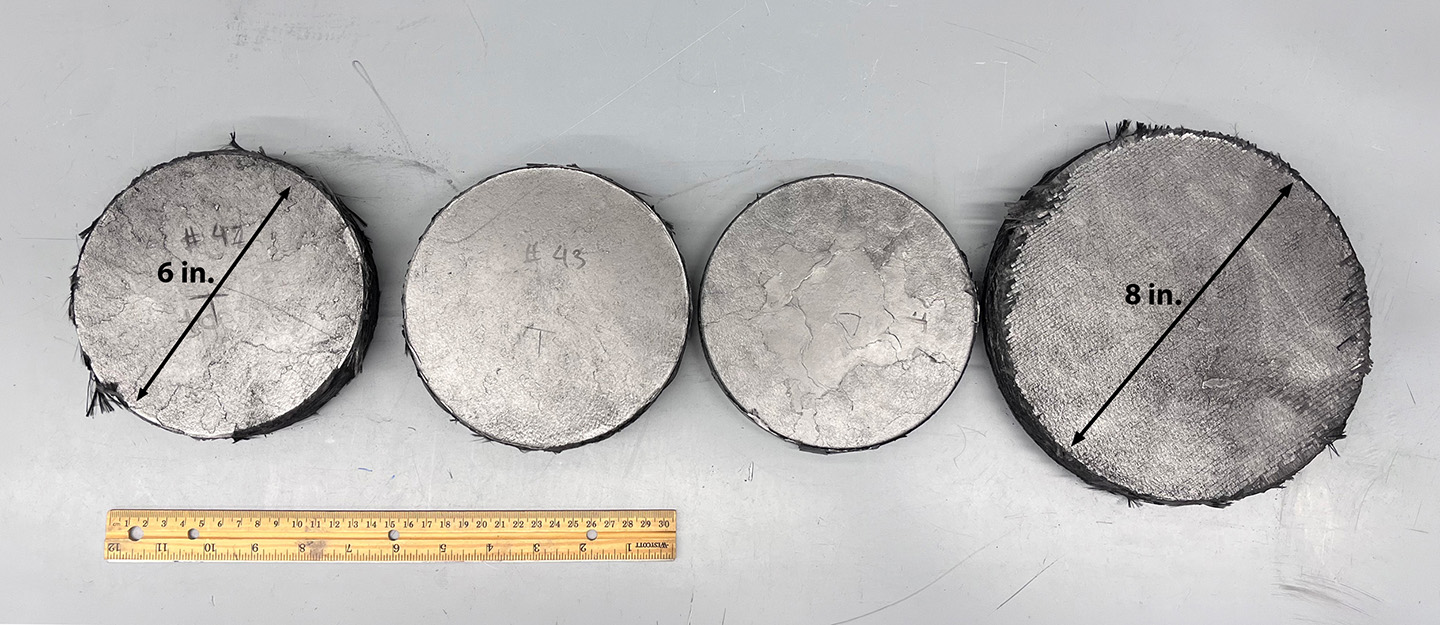
Using this approach, the team first produced a 1-inch-wide carbon-carbon cylinder in just a few days — less than a tenth of the time required by conventional methods. With access to larger presses, they went on to create several 6-inch cylinders and later an 8-inch one, demonstrating the technique’s scalability.

Microscale analysis revealed their method was capable of creating comparable, if not superior, densities.

“You want to see a lot of gray because that means the material is fairly uniform — no cracks or pores,” Chapkin explained. The FAST CAR2 samples appeared nearly uniform, with pores just micrometers wide. By comparison, industry-produced carbon-carbon often contains pores up to a millimeter (1,000 micrometers) wide. The samples also passed high-velocity oxygen fuel tests — essentially exposing them to extreme heat through a supersonic jet of hot gas — indicating performance on par with industry products, achieved at a fraction of the manufacturing time.

Looking Ahead

For Fahy and Chapkin, the results exceeded all expectations.

“When we started, the theory was there, but we didn’t even know if the material would hold together,” Chapkin said. “We’ve been surprised every step of the way.”

The team is now working with external partners to access larger presses that will allow them to scale the process to even larger sample production, and open the door to more applications.

“Scaling is always the hard part,” Fahy acknowledged, “but seeing how quickly this all came together and how successful it has already been, we feel optimistic about where it can go.”