News
Encapsulation Research Advances Mission-Critical Materials
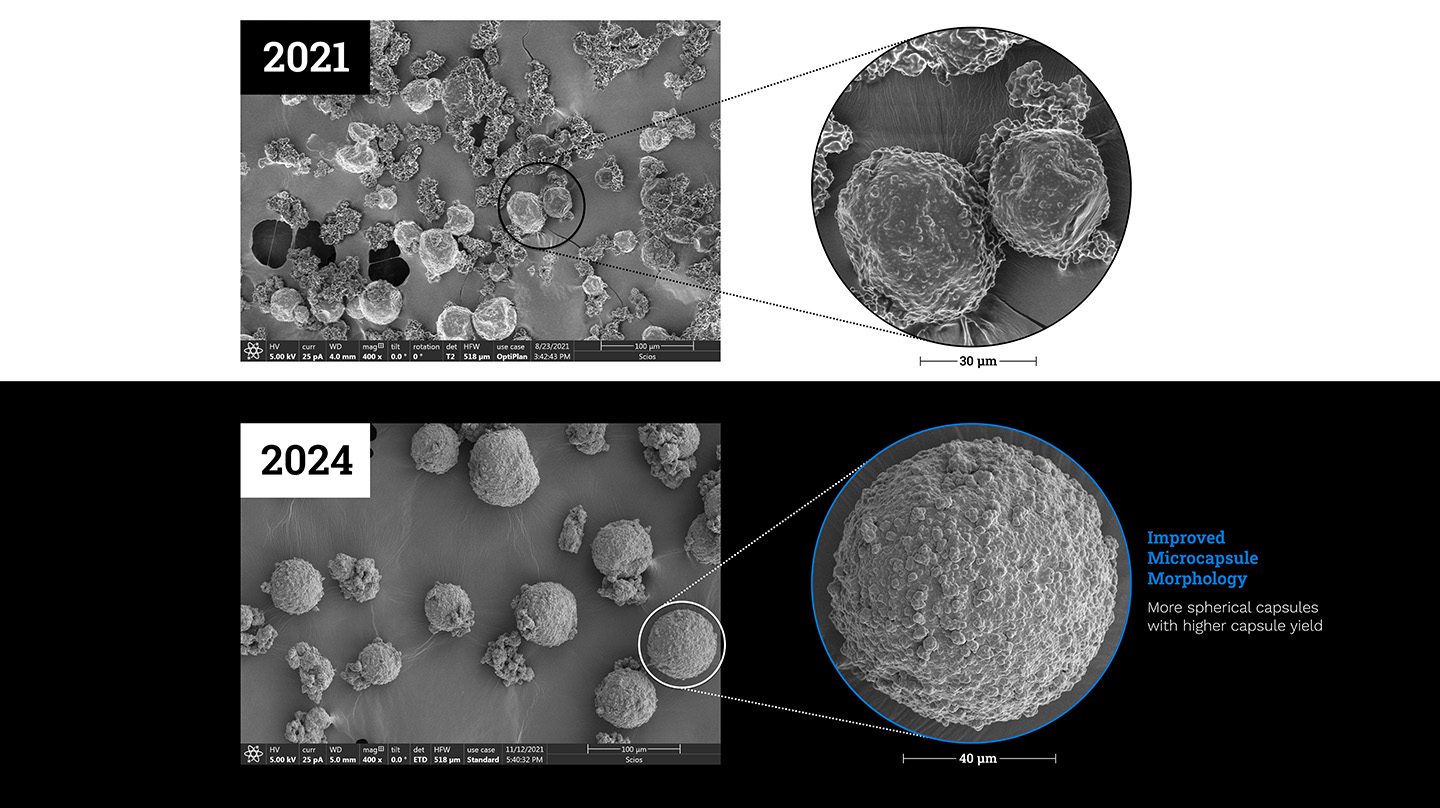
APL’s optimized synthesis system generated cleaner, more robust microcapsules with improved shell integrity and fewer non-capsule byproducts, enhancing overall material performance.
Credit: Johns Hopkins APL
Audio generated using AI voice technology.
Ask Reid Messersmith, a senior chemist at the Johns Hopkins Applied Physics Laboratory (APL), in Laurel, Maryland, how a microcapsule works, and he’ll start with what you’d see under microscope: a tiny, ruptured capsule resembling an egg, with its contents leaking like a yolk from within a cracked shell.
“We like to think of them as special agents — they’re operatives that go in and release at exactly the right moment,” said Messersmith.
Messersmith isn’t describing a new covert operation at the Lab. He’s talking about encapsulation, a materials science technique that surrounds microscopic droplets of a substance with solid capsule shells. In encapsulated systems, the inner material remains protected until a specific trigger, such as pressure, heat, or a chemical change, sets off its release, usually by degrading or changing the encapsulating shell. The approach allows scientists to precisely control when and where chemical reactions occur.
Encapsulation is widely used in products such as time-release medications and controlled-delivery pesticides. At APL, researchers are advancing the concept further, developing new encapsulation techniques for potential use in innovative materials and processes for national security applications, ranging from advanced adhesives to secure manufacturing technologies.
“Encapsulation gives us a powerful way to control chemical reactions in complex environments,” said Leslie Hamilton, who manages APL’s Science of Extreme and Multifunctional Materials program. “By designing systems where critical ingredients are protected until the exact moment they’re needed, we can create materials that are more reliable, more efficient, and better suited for mission-driven applications.”
One area where this approach could have significant impact is underwater adhesives, a field where APL is building a growing portfolio of materials research focused on controlled chemical activation through encapsulation. Reliable underwater adhesives play a significant role in repairing equipment and attaching payloads to target surfaces.
In 2021, APL researchers demonstrated a polyurethane adhesive system in which catalysts and crosslinkers are contained within mechanically responsive microcapsules. When pressure is applied between two surfaces, the capsules rupture and release their contents, triggering rapid curing and enabling strong bonding even in challenging environments such as under water. This initial work established the feasibility of using encapsulated chemical components to create adhesives that remain stable during storage but activate precisely when needed.
Building on that foundation, the team is now making the adhesive system more reliable and practical. Researchers investigated how processing conditions such as mixing time and temperature influence the integrity of the polymer shells that surround the capsules. By optimizing these parameters, they produced microcapsules with improved shell robustness and reduced leaking of encapsulated components, maintaining adhesive pot life, which is the usable working time before thickening, while still allowing rapid activation when the capsules rupture.
“We found that small changes in how the capsules are made can have a big impact on performance,” said Allison Moyer, an APL research chemist and lead author of the study. “By optimizing the shell formation process, we created microcapsules with improved shell integrity and reduced leakage in the resin while still enabling rapid release of their contents upon rupture. This improvement led to adhesive bonds more than 500% stronger than the base resin in our tests, demonstrating a promising strategy for enhancing polymer adhesive performance.”
A related line of research applies the same encapsulation strategy to the intaglio printing inks used in secure document production. Intaglio inks, which are used to print currency and other high-security materials, are extremely viscous and traditionally require long drying times that can slow production and increase the risk of ink transfer between sheets. In research published in ACS Omega, Moyer, Messersmith, and several APL colleagues demonstrated that incorporating microcapsules containing curing accelerants into the ink formulation isolates the additives during storage and printing but releases them under the mechanical pressures of the printing process. This approach accelerates curing while preserving the stability and quality required for precision security applications.
“By encapsulating the curing accelerants, we’re able to significantly speed up how quickly the ink dries without changing the way it’s printed,” said Messersmith. “In our tests, the approach reduced drying time by about 50%, and because the microcapsules can simply be mixed into the ink, the technology could be incorporated into existing printing infrastructure with minimal changes.”
The Lab is also exploring ways to accelerate encapsulation research, including the recently developed artificial intelligence (AI)-enabled Microcapsule ATLAS project, which uses a generative AI “co-investigator” to accelerate the microcapsule synthesis and testing pipeline, reducing hands-on researcher time from nine hours per experiment to less than 90 minutes.