News
‘ATLAS’ System Lifts Johns Hopkins APL Leadership in Automated Experimentation
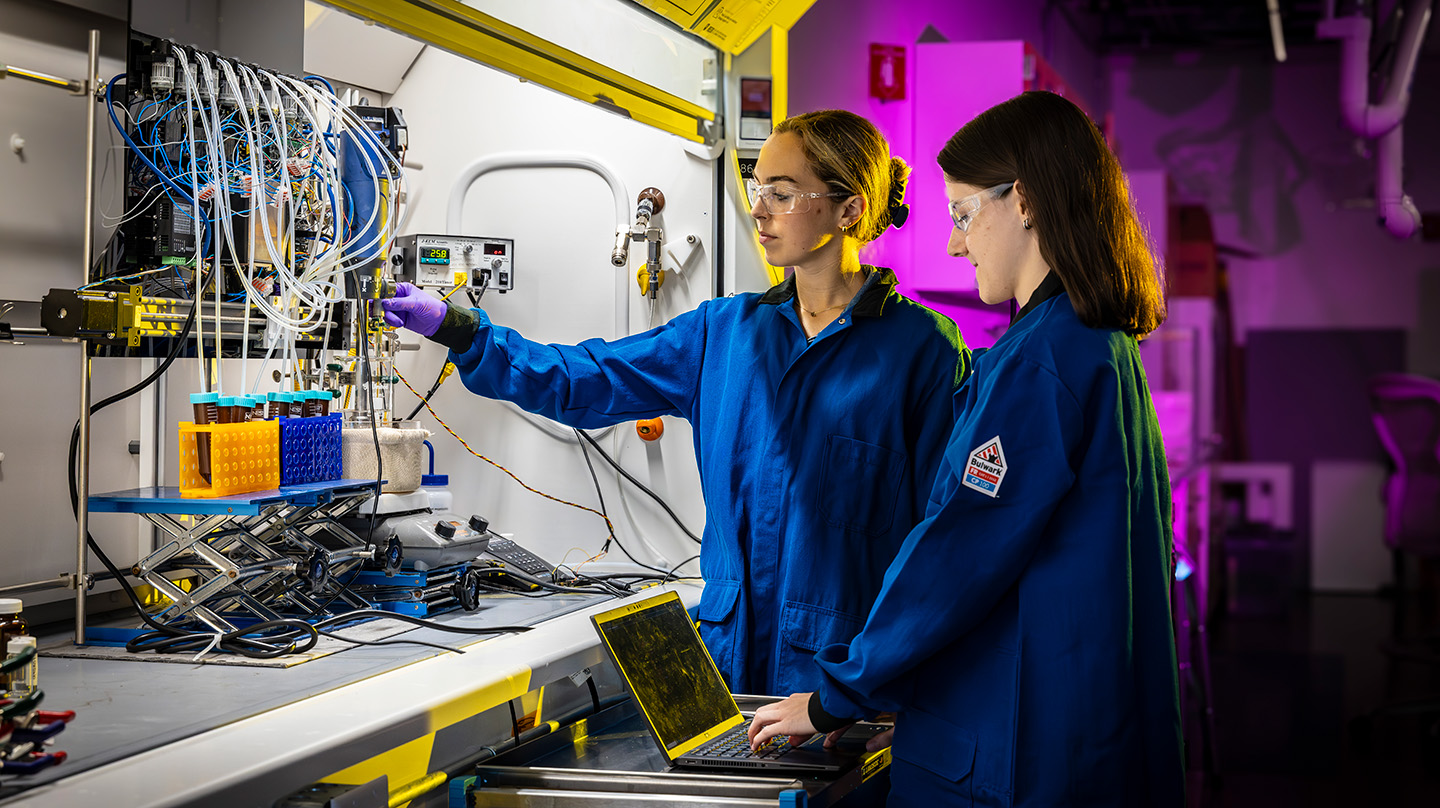
Allison Moyer (left) and Jenelle Millison (right) demonstrate how to use the ATLAS system as a co-investigator in microcapsule development.
Credit: Johns Hopkins APL/Ed Whitman
Audio generated using AI voice technology.
An interdisciplinary team at the Johns Hopkins Applied Physics Laboratory (APL) in Laurel, Maryland, has applied artificial intelligence to automate microcapsule experimentation. This has reduced the time per person on each experiment by more than 80%, enabling more experiments per human researcher.
Researchers have previously leveraged AI to accelerate the discovery of novel superconductors and advanced robotics controls. This project — Microcapsule AI-driven Testing, Learning, and Accelerated Synthesis (ATLAS) — continues the exploration of AI in materials science research. ATLAS uses generative AI as a “co-investigator” to accelerate the microcapsule synthesis and testing pipeline. As a result, the human hands-on time required per experiment decreased from nine hours to less than 90 minutes, freeing researchers to support additional experiments and analyses.
Microcapsules — tiny particles that carry an active substance, or payload, inside a shell that controls the timing of the payload’s release — have applications across the military, agriculture, health, and materials sectors. Microcapsules can be used to protect payloads from harsh environments, modulate delivery of pain-relief drugs, or control the activation time of self-healing paints.
“What makes microcapsules so powerful is their versatility — the same core technology can extend performance and durability of a critical system, or serve as the foundational technology for adaptive materials,” said Leslie Hamilton, program manager for Science of Extreme and Multifunctional Materials in APL’s Research and Exploratory Development Mission Area. “But that versatility depends on exquisitely controlled chemistry. Engineering a capsule that releases the right payload, at the right time, under the right conditions, requires precision at the molecular scale — which is exactly why accelerating their design and fabrication is so transformative.”
Microcapsules: The Perfect Pilot
Led by materials chemist Allison Moyer and AI researcher Jenelle Millison, the ATLAS team chose microcapsules as an ideal pilot for AI co-investigation. Traditional microcapsule research and development is manual and slow, involving myriad physical and chemical variables with nonlinear relationships. Additionally, there is currently no other available literature on developing an agentic co-investigator for microcapsules, presenting an opportunity for APL to make advancements in the field.
“Microcapsules are a very challenging system to work with because there are so many variables with complex relationships,” Moyer said. “This has direct mission impact in a variety of fields — whether imparting self-healing functionalities to smart coatings or enabling underwater adhesives for maritime applications.”
ATLAS leverages APL expertise in modeling and simulation, robotics and autonomy, generative AI, and materials science to automate microcapsule development and experimentation. The team created a reaction model that describes the rates at which the chemical reactions occur during microcapsule formation, enabling researchers to simulate reactions step by step. These simulations allow them to automate selecting conditions for future experiments. The ATLAS system then validates these conditions in the laboratory. So far, the team has automated stirring, heating, pH adjustment, and reagent addition. The robotics team built an automation server that can take in commands and disperse them to those different pieces of equipment, which range from custom-built to commercial off the shelf. This allows ATLAS to automatically conduct physical parts of the experiment within a modular lab environment.
The team has also developed a literature agent that automatically searches for relevant publications to help guide their research throughout the experiment.
“APL is unique in that we have roboticists, modeling experts, AI researchers, and chemists all in the same building,” Millison said. “This collaboration enables us to redefine the scientific process to create next-generation materials for sponsors.”
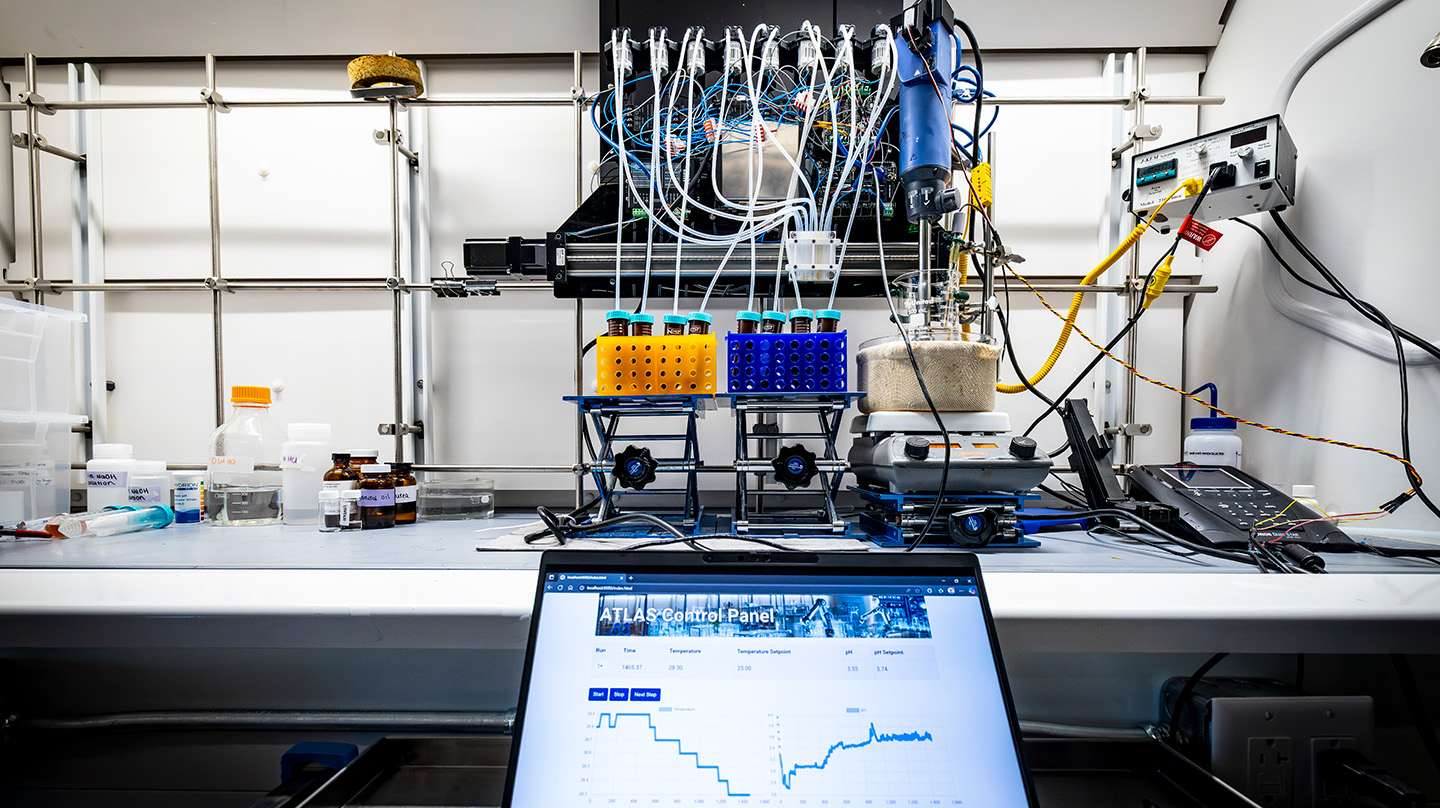
The ATLAS control panel (bottom) allows for real-time remote monitoring of the ATLAS lab system (top).
Credit: Johns Hopkins APL/Ed Whitman