Press Release
Wienhold Honored for Materials Engineering Excellence
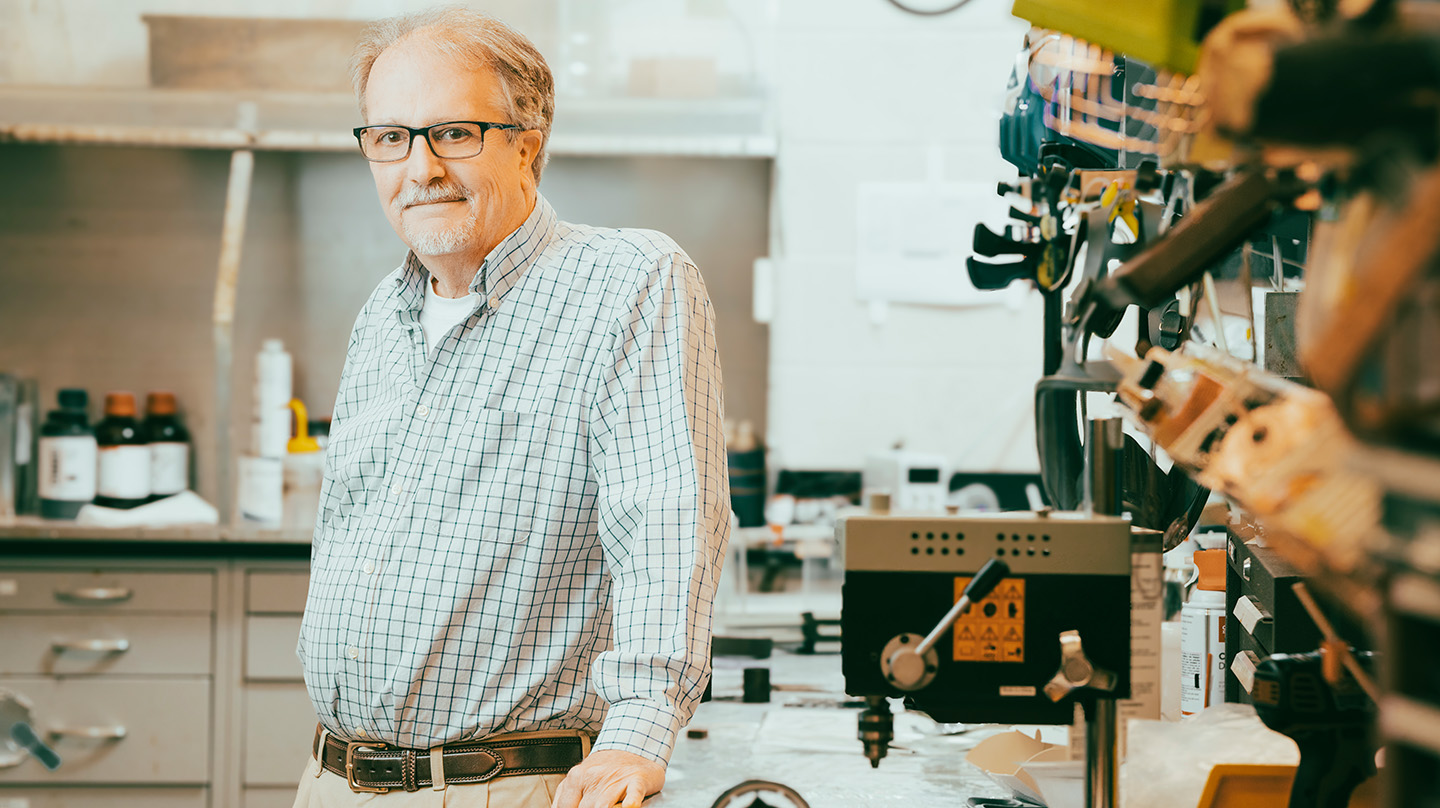
Paul Wienhold’s Johns Hopkins APL career reflects decades of materials innovation, technical leadership, and mentorship.
Credit: Johns Hopkins APL/Craig Weiman
Audio generated using AI voice technology.
Paul Wienhold, a materials and process engineer at the Johns Hopkins Applied Physics Laboratory (APL) in Laurel, Maryland, has received the Society for the Advancement of Material and Process Engineering (SAMPE) Global Fellow Award.
One of SAMPE’s highest honors, the Global Fellow Award recognizes individuals who have demonstrated sustained leadership in materials and process engineering, achieved significant accomplishments over the course of their careers, and made impactful contributions across areas such as manufacturing, design, research, development, and education.
“It is a significant honor to be included among the recipients of the SAMPE Global Fellow Award,” Wienhold said. “SAMPE has played an important role in my career, and it is meaningful to be recognized alongside others who have made sustained contributions to the field.”
Wienhold has contributed to numerous space missions, including: Dragonfly, Europa Clipper, Parker Solar Probe, New Horizons, TIMED, Van Allen Probes, STEREO, and MESSENGER, in addition to work on numerous other spacecraft and instruments. From solar array substrates to critical structural components, Wienhold's work has helped ensure that advanced designs translate to material survival in the harsh environments of space. He played a pivotal role in developing, processing, and testing the composite materials used for the MESSENGER solar array. He holds four patents and has authored more than 40 technical papers.
In addition to his space contributions, Wienhold has supported Navy systems, missile programs, shipboard radars, antennas, and other defense applications. He is frequently called upon as a materials authority when systems are pushed into new or demanding environments. More recently, his work has focused on hypersonic systems, where he has led material development and testing efforts while overseeing design and manufacturing activities.
“I've long been interested in the complexities of composite materials and have valued the opportunity to contribute to these missions over the years,” Wienhold said. “The work has taken me to field test sites across the United States and overseas, and it’s particularly rewarding to see these systems perform in real-world conditions.”