News
Johns Hopkins APL Pioneering Digital Calibration to Create ‘Born-Qualified’ Parts
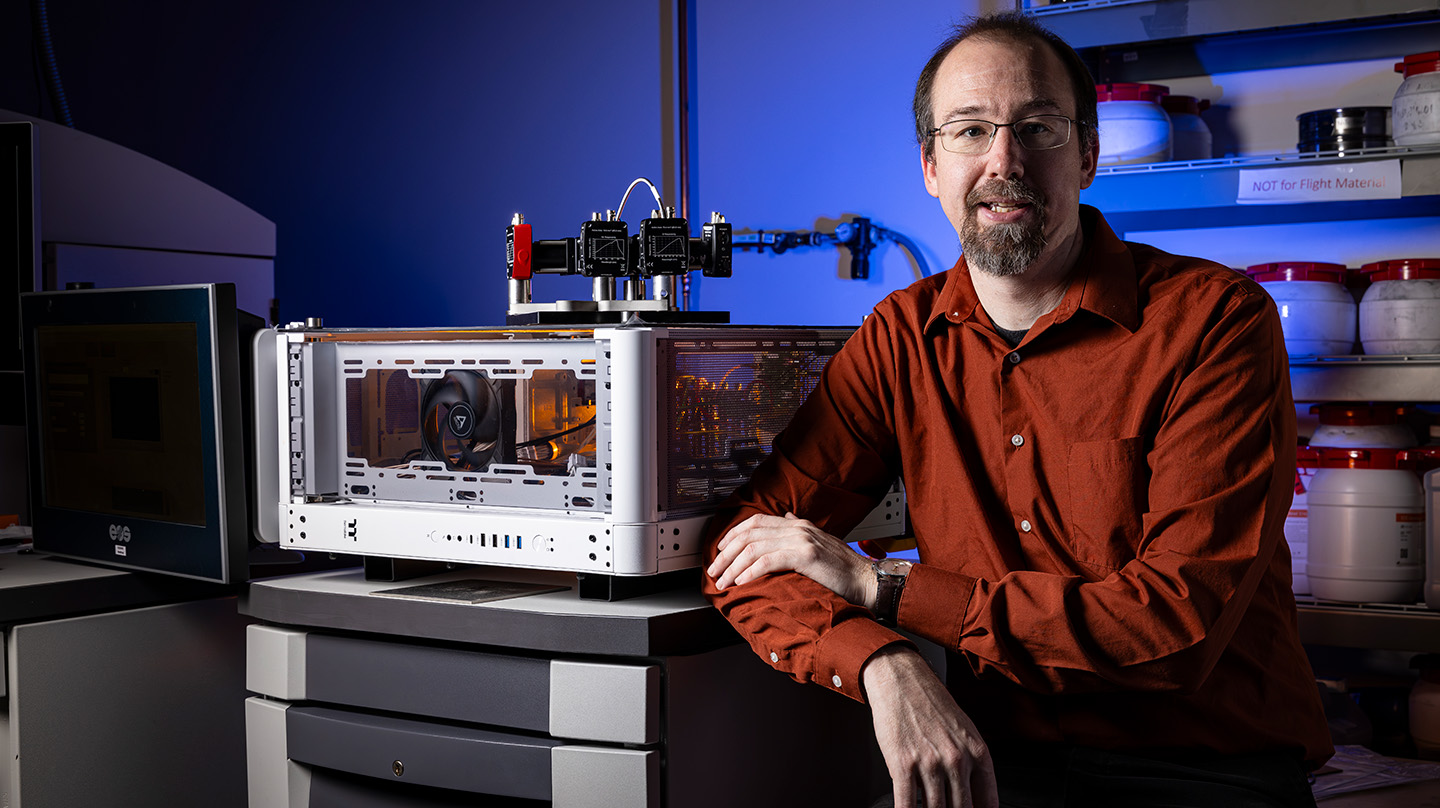
Steve Storck with the Spectrally Augmented Thermal Understanding Reducing Nonconformance (SATURN) sensor and Process Optimized Laser Adjustments Regulated by Integral Sensors (POLARIS) control system used to augment the performance of the additive manufacturing systems.
Credit: Johns Hopkins APL
Audio generated using AI voice technology.
The Johns Hopkins Applied Physics Laboratory (APL) in Laurel, Maryland, is developing a comprehensive suite of capabilities to ensure that additively manufactured parts can perform predictably in mission-critical applications — no matter where, when, or on what machines they’re manufactured. This work is poised to revolutionize additive manufacturing (AM) in multiple ways in coming years.
When precisely controlled, AM is capable of producing materials of a high quality for even the most rigorous of defense applications. But currently, AM suffers from a consistency problem.
“Today, AM relies on what I call a ‘guess-and-check’ methodology,” said Steve Storck, chief AM scientist in APL’s Research and Exploratory Development Department. “The engineer doesn’t have data for each new part due to sensor limitations and the complex physics involved, so each build is slightly different. And there are multiple vendors, each with numerous different machines. The problem quickly gets chaotic — it’s a challenge to be sure that parts will survive in a mission scenario.”
As a result, it can take years to design, develop, certify, and begin manufacturing a new part for critical applications like rocket nozzles and aerospace control components. That’s simply not good enough, Storck said.
“We envision a future in which all AM systems produce the same high-quality part based on physical sensor data, independent of the fabrication location and the machine selected for the job,” he said. “To do that, we have to link part quality to fundamental physics.”
Driving Machine Behavior With Thermodynamics
Achieving this level of consistency requires attaining precise control of the heat on the build plates of AM machines — in this case, machines for laser powder bed fusion (LPBF), in which layers of metal powder are fused to create 3D objects with a high-powered laser.
“You could compare the consistency problem with baking a cake in different ovens, in that it’s easy to end up with a product that looks good on the surface but doesn’t function as intended,” Storck explained. “You can end up with a cake that looks delicious but is completely inedible — and you can’t know until you take a bite.”
The APL team realized that the technical challenge is similar to one that’s been solved — achieving consistent image quality on smartphones. Smartphone cameras compensate for variable optical hardware by using software to enhance image quality in real time. Variability in LPBF builds is due to subtle optical discontinuities that affect lasers’ energy input to powders, Storck said.
Correcting for this variability is a major challenge. The optical aberrations involved are incredibly subtle and spatially dependent, requiring measurement and adjustment several orders of magnitude finer than state-of-the-art commercial sensors can provide. This capability seemed so far out of reach that when APL proposed digital calibration using in situ sensing as a solution, some experts in the field said it couldn’t be done. But APL was ready with an answer — an in-house suite of capabilities and facilities designed to address this very problem.
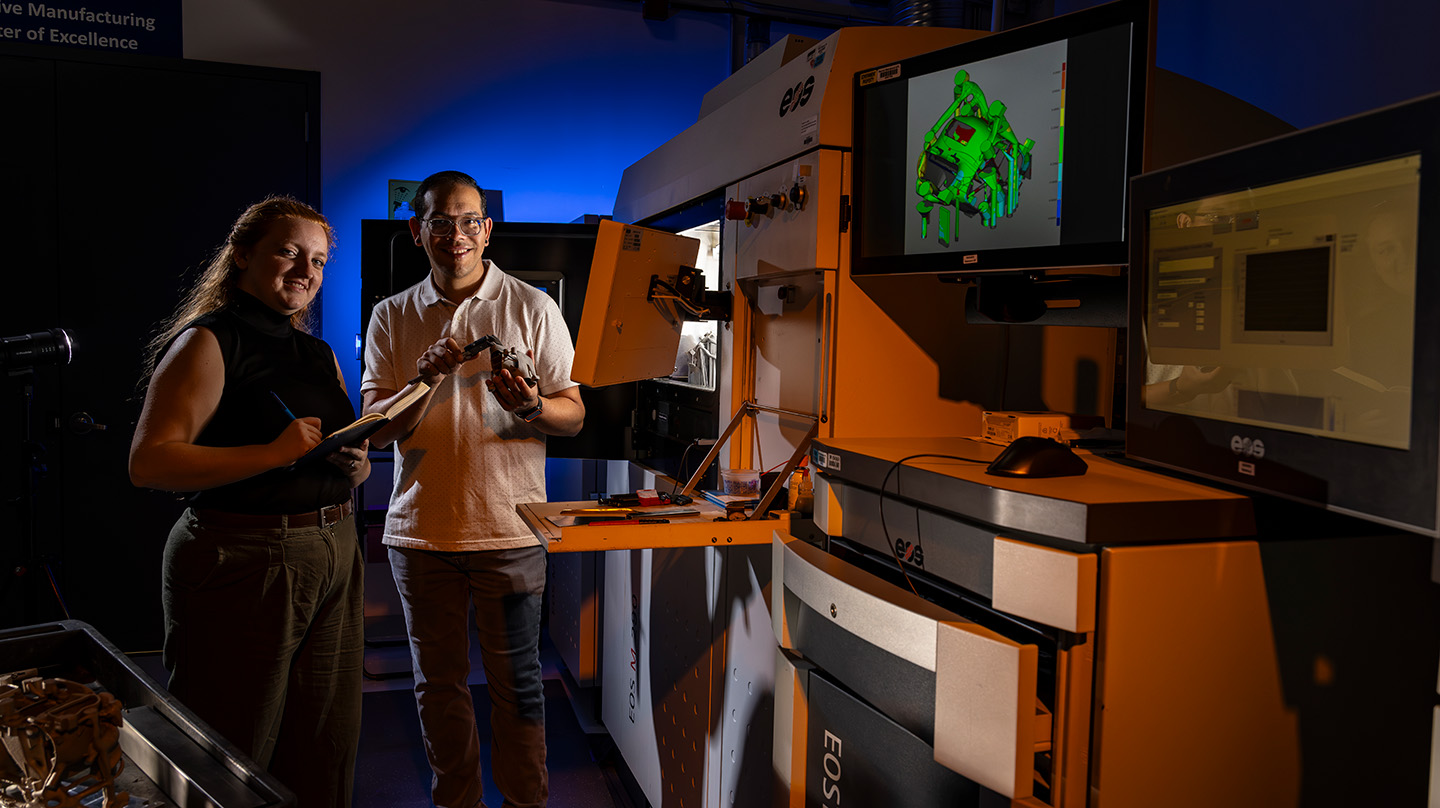
Mary Daffron and Sam Gonzalez inspect a part after fabrication on the EOS M 290 metal 3D printer, augmented with advanced control and sensing tools, in the APL Advanced Manufacturing Lab.
Credit: Johns Hopkins APL
Access APL Innovation
Tech Transfer
APL technology can address industry needs that benefit our sponsors, the public, and the university and may foster economic development.
Explore APL technologies and patents.