News
Researchers Engineer Cold-Tolerant Proteins to Give U.S. an Arctic Edge
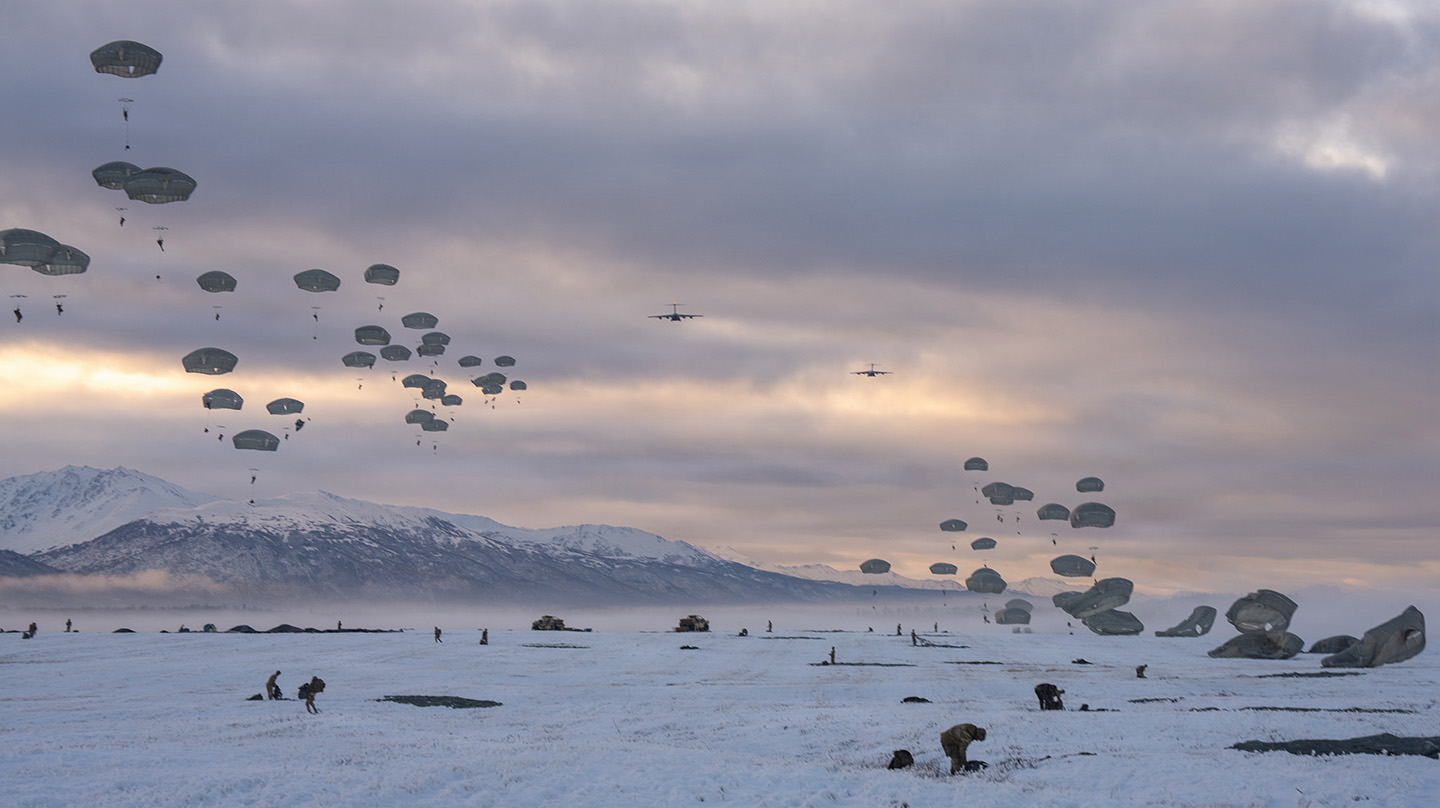
U.S. Army paratroopers assigned to 2nd Infantry Brigade Combat Team (Airborne), 11th Airborne Division, descend during an airborne insertion concluding their part of Arctic Aloha 26 on Malemute Drop Zone at Joint Base Elmendorf-Richardson, Alaska, Nov. 14, 2025.
Credit: U.S. Army/Correy Mathews
Audio generated using AI voice technology.
As the Arctic region becomes increasingly contested, the U.S. military faces a new era of challenges in one of the world’s most inhospitable environments. Researchers at the Johns Hopkins Applied Physics Laboratory (APL) in Laurel, Maryland, are tapping into the unique properties of ice-affecting biomolecules to develop novel materials and technologies that could give the nation a critical strategic and operational edge.
The effort is part of the Defense Advanced Research Projects Agency’s (DARPA) Ice Control for cold Environments (ICE) program, which seeks to harness nature’s cold-weather adaptations to develop solutions to the operational challenges of extreme cold.
APL plays a key role in the program through a project called BOREAS, for Bio-Optimized Regulation of Environmental Ice for Arctic Supremacy. The project team’s goal is to build a toolkit of ice-manipulating technologies and protein formulations to help the Department of War operate in the harshest cold environments.
APL started developing ice-manipulating technologies in 2020 through internally funded opportunities, and subsequent demonstration of those capabilities helped secure a role in the DARPA program. “It’s a great story of APL investing resources to build capabilities in anticipation of a sponsor need,” said Joel Sarapas, a polymer chemist in APL’s Research and Exploratory Development Department.
Libraries of Molecules
Sarapas and his team have built a physical library containing hundreds of bioinspired synthetic polymers — chain-like molecules with branches containing chemical side groups. Those branches can alter the behavior of the polymer and how the system interacts with the surrounding environment.
The team has uncovered dozens of molecules that alter ice formation, including a surprising find: a derivative of a sugar additive commonly used in cosmetics. When attached to a polymer, the compound proved unusually effective at encouraging ice to grow.
“That was a big surprise for us,” Sarapas said. “Based on its structure, we assumed it would inhibit ice, like similar molecules do. But when we applied it to a chilled surface and passed humid air over it, ice appeared exactly where the polymers were placed.”
To illustrate the effect, the team used a formulation with these molecules to paint letters on a surface and placed it within a cold, humid environment. Within minutes, “APL” appeared in ice.
Keep Exploring
Operational Resilience
APL is bringing all of its core competencies to bear on this critical challenge area, assembling top experts from a variety of scientific fields and partners to explore strategic opportunities to protect our operations in a changing world.