News
Johns Hopkins APL Establishes AI Wargaming Lab to Boost Strategic National Security Analysis and Planning

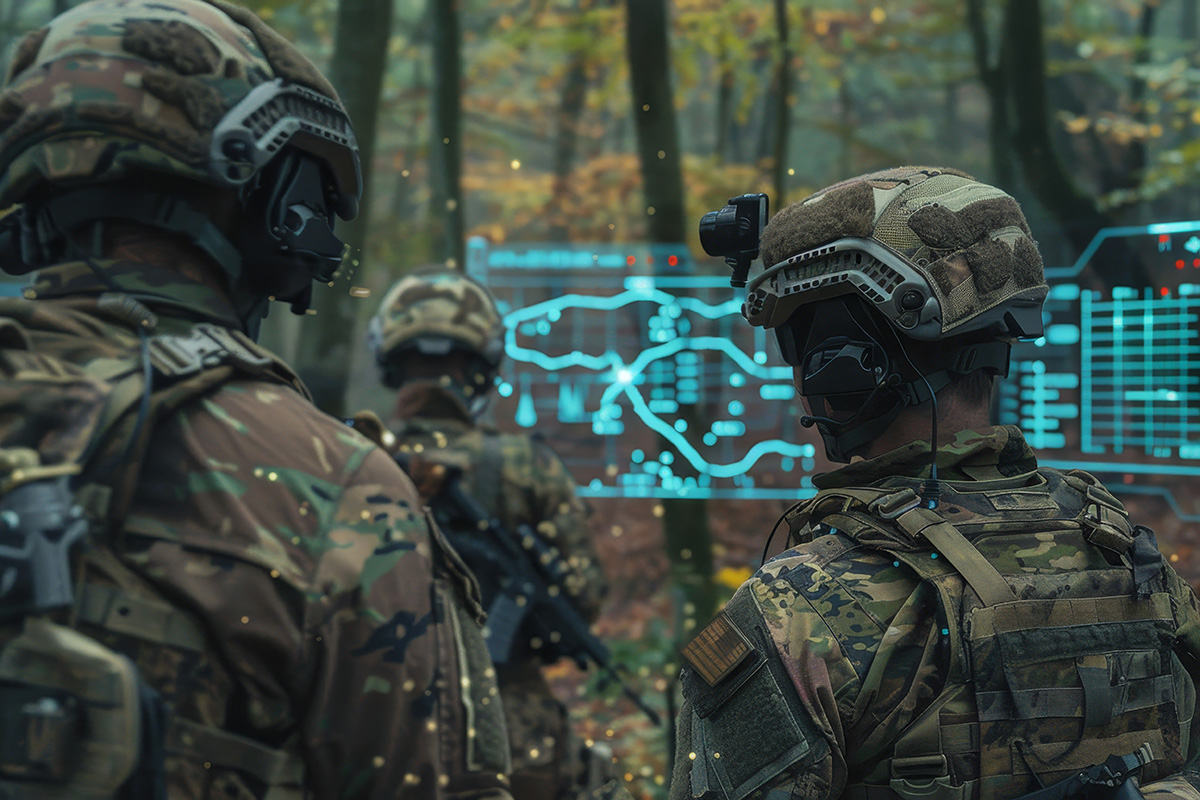
APL’s GenWar Lab leverages advanced AI and large language model capabilities to support the wargames and tabletop exercises that enable military decision-makers to explore dynamic and wide-ranging mission scenarios.
Credit: Adobe Stock
Audio generated using AI voice technology.
The Johns Hopkins Applied Physics Laboratory (APL) in Laurel, Maryland, is fusing its analytic and cutting-edge artificial intelligence capabilities into a forward-leaning incubator known as GenWar Lab.
GenWar Lab leverages advanced AI and large language model (LLM) capabilities to support the wargames and tabletop exercises (TTXs) that enable military decision-makers to explore dynamic and wide-ranging mission scenarios. Kevin Mather, who is leading this effort, described GenWar Lab as “an innovation cell that is building on the expertise in wargaming, generative artificial intelligence, and modeling and simulation that APL has identified as a critical intersection for analysis.”
“This new initiative will radically accelerate our ability to harness the power of AI and advanced analytics to augment traditional wargaming methods,” said James Miller, APL’s assistant director for policy and analysis. “GenWar Lab reflects APL’s continued commitment to create tools and infrastructure and, most importantly, to create the right team, to leverage AI to find innovative solutions to the nation’s toughest security challenges.”
Kelly Diaz, program manager for GenWar Lab at APL, added that the team is specifically designing GenWar Lab to provide a structured, analytical environment for exploring complex national security challenges. “Rather than replacing expert judgment, it will amplify it, allowing teams to explore a much broader landscape of possibilities, stress-test assumptions, and expose decision inflection points that human teams can then interrogate in depth,” Diaz said.
“We’re taking advantage of commercial LLMs that industry has heavily invested in and pointing them at our sponsors’ problem sets,” Mather said.
GenWar Lab integrates and builds on two existing development efforts — GenWar TTX and GenWar Sim — and establishes an exploratory effort known as GenWar X.
GenWar TTX: Getting AI Into the Game
GenWar TTX is a digital environment for senior military commanders and civilian leaders to engage in tabletop exercises that are enabled by a diverse set of AI agents that serve variously as advisers and adversary leaders. The TTX platform is intended to accelerate and expand the use of wargaming, to enable innovative intelligence analysis, and to explore the behavior of AI agents in complex scenarios.
To achieve this goal, the team has been focused on developing an environment where human players can interact with AI counterparts, asking them questions and giving them requests, and engage with AI agents modeled after senior decision-makers, adversary leaders and advisory staff.
“We see a real demand for a safe, repeatable way to explore high-consequence national security scenarios,” said Edward White, GenWar TTX lead at APL. “The idea is that you could run potentially hundreds of wargames in a matter of days and then look for patterns in the results, exploring a far wider range of potential scenarios than with conventional methods.”
GenWar Sim: Accelerated Modeling and Simulation Wargaming
GenWar Sim bridges the gap between wargaming and modeling, combining human judgment with machine speed. Built on the Advanced Framework for Simulation, Integration and Modeling (AFSIM), GenWar Sim allows wargamers and analysts to explore the consequences of their decisions in data-driven environments, with the goal of bringing greater rigor and repeatability to every game and analytical excursion.
The team has also prioritized human-machine teaming as part of the capability. Players can describe their intended actions in natural language, and the system translates it into an executable simulation. AI players in GenWar Sim will also be able to propose and test their own moves, working alongside analysts to explore a much broader set of options and outcomes. This collaborative dynamic will enable teams to move quickly from ideas to evidence, uncovering insights that would take much longer to surface through manual play alone.
“The idea behind GenWar Sim is to provide a truly intuitive tool,” said Benjamin Gien, APL’s GenWar Sim lead. “The AFSIM outputs are grounded in physics-based models, enabling collection of results that are both traceable and actionable. Building on that framework will really give us the best of both worlds — human accessibility combined with machine speed and precision.”
GenWar X: Efforts at the Edge
Along with its flagship capabilities, APL’s GenWar Lab is poised to evolve further with a program known as GenWar X, an experimental cell for developing advanced concepts that cut across existing tools and creating new tools in support of the lab’s vision. This will include efforts to game out various alternative future scenarios and to create adversary personas to model how future conflicts might play out based on adversary decisions.
Another effort under this umbrella is a dedicated GenWar Lab facility at APL’s Laurel campus, expected to open in 2026.
“The challenges we face, and the opportunities arising from generative wargaming, are bigger than any one organization,” Miller said, stressing the importance of cultivating approaches across government, industry and academia. “We hope that GenWar Lab will be not just a resource for APL but a hub for collaboration and innovation for the whole national security community.”
Connect With Us
Let’s Solve the Nation’s Challenges Together
APL meets critical national challenges through the innovative application of science and technology.
Contact us to learn more about our work or explore career opportunities at APL.
Related Work