Our Contribution
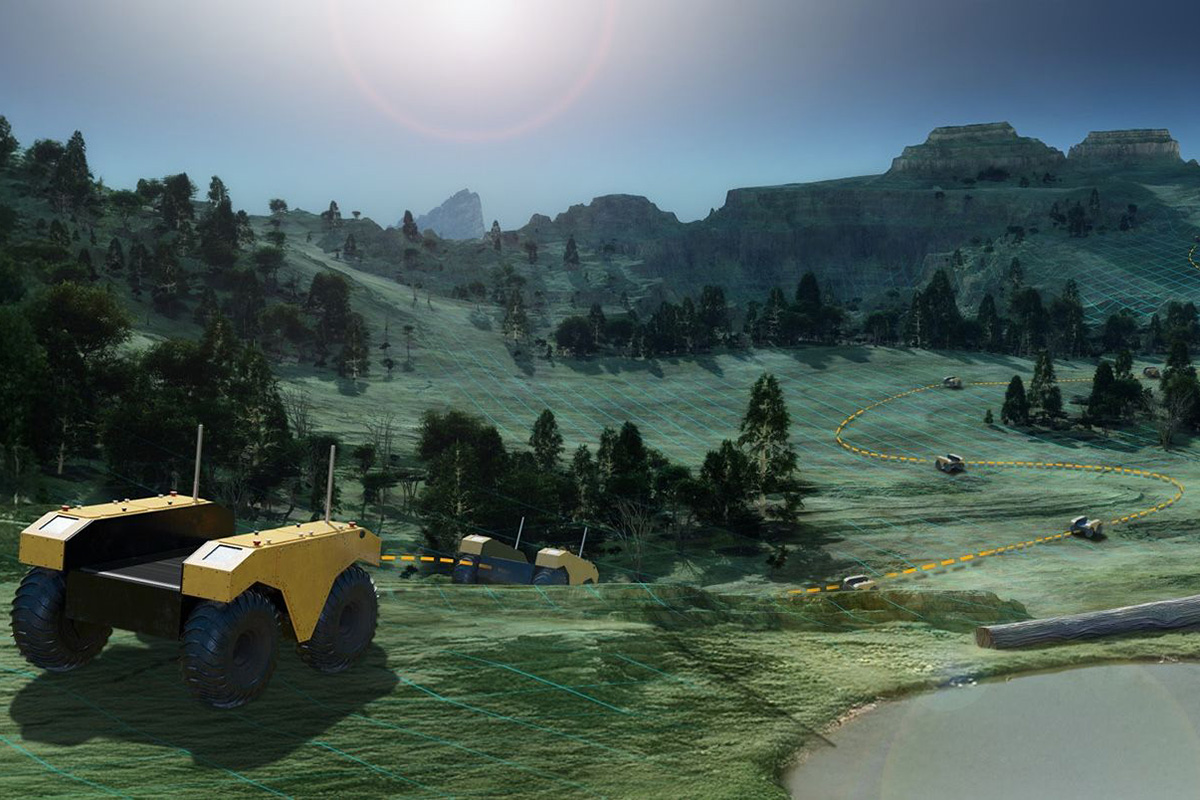
Coordinating multiple autonomous agents to work as a team remains a hard problem in robotics. Each robot has to navigate an unpredictable environment and perform tasks while coordinating with teammates in response to dynamic situations. A team of APL researchers approached this problem using topological graphs, which are commonly used to represent environments in robot pathfinding and collision avoidance. By representing important landscape features as nodes and the connections between them as edges, these graphs simplify the environment and enable efficient computation. However, when considering numerous robots traversing throughout the environment, the problem space can quickly become computationally intractable—especially in dynamic environments where the risks associated with any given move can change from one instant to the next. To address this issue, the team designed a new dynamic topological graph structure for capturing the critical features of the problem space and relationship between the robots. This compact representation allowed the researchers to leverage a technique called mixed-integer programming to rapidly compute solutions to complicated problems on the fly regardless of how many robots are involved, allowing multi-robot teams to coordinate their actions with manageable complexity. The team has gotten this framework—dubbed Stratified Topological Autonomy for Long-Range Coordination (STALC)—running effectively in simulations of real-world missions, handling the problem from high-level planning all the way down to the individual robot level. It then demonstrated the algorithms on live robots in an exercise held in Texas in June 2024 in collaboration with the Army Research Laboratory (ARL), which funded this work.