News
Johns Hopkins APL Expands Maritime Research Capabilities With New Test Vessel
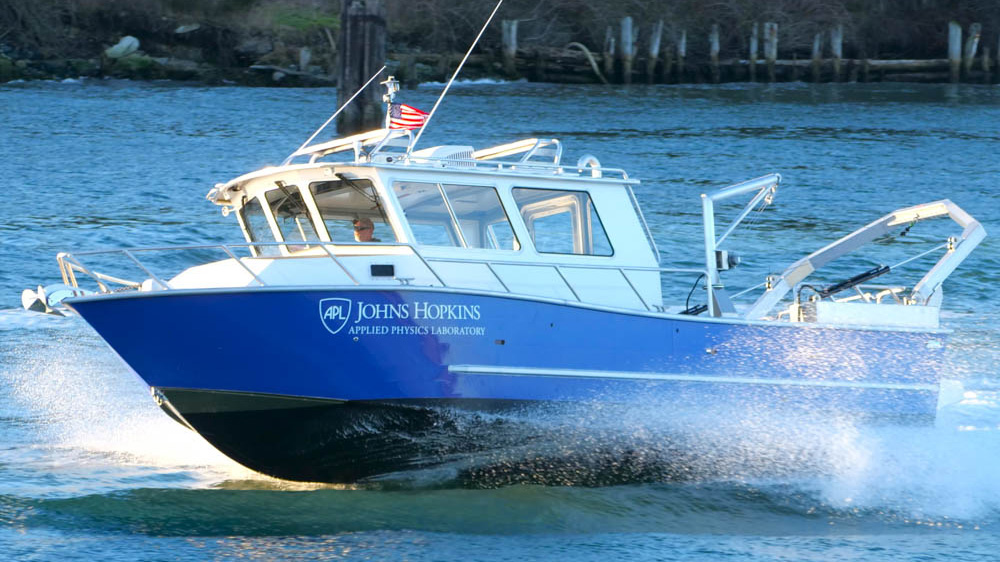
APL’s new 36-foot research vessel expands the Laboratory’s ability to test and evaluate emerging maritime technologies in realistic operational environments. Designed as a flexible, modular platform, the vessel supports autonomous systems, sensors, communications, and other mission-critical capabilities, helping researchers move innovations from the lab to the water faster.
Credit: Munson Boats
Audio generated using AI voice technology.
Deploying the next generation of technologies for warfighters requires more than innovative ideas — it requires the opportunities to evaluate those ideas in realistic operational environments.
To accelerate the development and transition of emerging capabilities, the Johns Hopkins Applied Physics Laboratory (APL) in Laurel, Maryland, has expanded its maritime testing capabilities with the addition of the Sea++, a dedicated test boat that provides researchers with a flexible platform for on-water experimentation, demonstrations, and prototype evaluation.
The custom-designed 36-foot utility vessel, christened Sea++ in a nod to the foundational programming language C++, is based near Annapolis, Maryland, and serves as a configurable research platform for testing maritime technologies across a broad range of applications. In addition to enabling rapid experimentation, the vessel reduces many of the logistical constraints associated with chartering commercial vessels, allowing research teams to move from concept to on-water testing in weeks rather than months.
“Maintaining our maritime advantage depends on our ability to learn and adapt faster than emerging threats,” said Vernon Parks, who leads APL’s Sea Control Mission Area. “The Sea++ gives us a flexible environment to rapidly evaluate new ideas, reduce technical risk, and deliver more mature capabilities to our sponsors.”
Designed with adaptability in mind, the vessel is equipped with a modular electronics rack, internet connectivity, integrated lifting systems including an A-frame and movable davit (boat crane) for deploying and recovering equipment, and dedicated mounting points that allow it to be quickly configured for a wide range of experiments, testing everything from autonomous surface vessels and advanced sensors to communications systems, robotics, and other emerging maritime capabilities.
In one demonstration, the vessel showcased how unmanned systems, including unmanned aerial and surface vessels (UAVs and USVs, respectively), could be used to enable agile logistics for resupplying platforms deployed far from sea. In the demonstration, UAVs landed on the Sea++ as it was transiting in the water, allowing engineers to fine-tune the perception, guidance, and control required for UAVs to land on a moving target.