News
Simulating the Seas to Make Additive Manufacturing Fleet-Ready
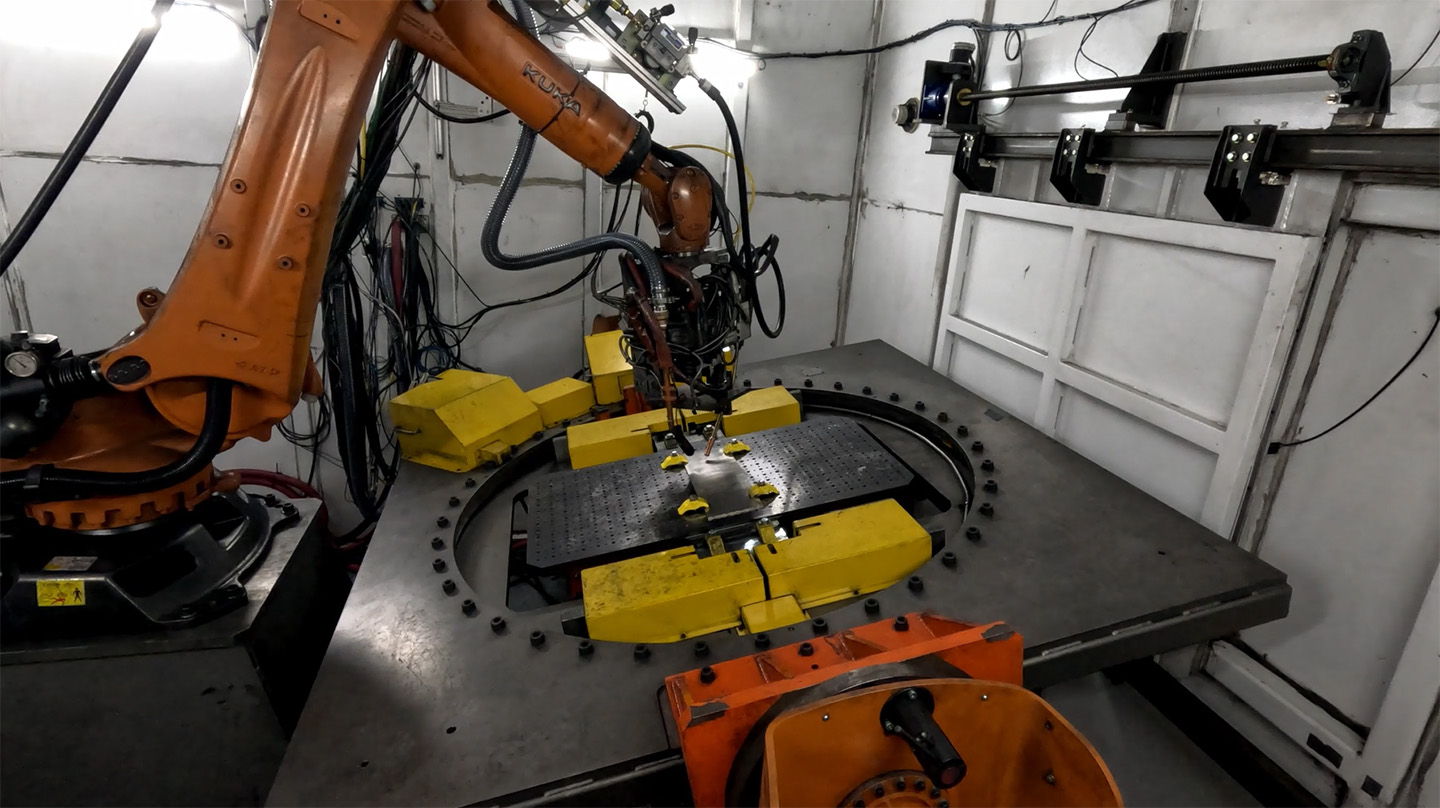
A motion simulation platform, developed by GKN Aerospace and APL, with support from Naval Sea Systems Command, replicates shipboard movement to advance additive manufacturing at sea.
Credit: GKN Aerospace
Audio generated using AI voice technology.
The Johns Hopkins Applied Physics Laboratory (APL) in Laurel, Maryland, has partnered with GKN Aerospace to develop a novel capability that simulates shipboard motion for additive manufacturing. This innovative effort, which is funded by the Naval Sea Systems Command’s Technology Office (NAVSEA 05T), supports the U.S. Navy’s goal of resilient, on-demand logistics by enabling reliable 3D printing operations aboard naval vessels.
As defense operations become more distributed and expeditionary, the ability to produce mission-critical parts at sea is increasingly important. To meet this need, NAVSEA is deploying and integrating advanced manufacturing equipment and capabilities on ships through its Afloat Additive Manufacturing Program.
This specific collaboration between NAVSEA, APL, and GKN aims to address one of the unique challenges that printing aboard a moving ship presents — the constant motion caused by waves and maneuvering — by developing a motion-simulation platform that replicates the dynamic environment of a ship at sea.
“Additive manufacturing at sea could fundamentally change how the Navy maintains and sustains its fleet,” said James Borghardt, APL’s Maritime Expeditionary Logistics program manager. “With a proven history of industry collaboration and a continued commitment to partnership, APL is positioned to accelerate this future by uniting commercial manufacturing expertise with our applied research to deliver mission-ready capabilities.”
While placing a printer on a motion platform might seem like the simplest way to mimic a ship’s rocking, the size and fragility of industrial-grade 3D printers make that approach impractical. Instead, the team developed a more nuanced solution: synchronizing motion between the print head and the substrate to simulate shipboard movement. GKN’s additive manufacturing platform includes advanced controls that coordinate both elements during printing.
“We approached this challenge by combining our understanding of additive materials behavior with practical experience in manufacturing process control,” said David Bond, head of Engineering and Technology at GKN Aerospace. “That integration has been key to developing a solution that can print quality representative samples under the motion conditions expected in shipboard environments.”
To evaluate the system’s performance, the team has conducted controlled test prints using triple line trace patterns on metal coupons. They printed six-inch test blocks under different motion profiles analogous to ship motion in calm and rough sea states to study how dynamic conditions affect the quality of the deposited material and, ultimately, to better understand how motion affects the ability to ensure repeatable, structurally sound parts.
“This effort is giving us the data we need to move from concept to capability,” said Bianca Sciandra, the project manager and a metallic materials researcher at APL. “We’re now able to quantify how motion influences build integrity and use that insight to refine system controls, bringing us closer to producing critical, mission-relevant parts directly aboard ships.”
The work builds on APL’s contributions to NAVSEA’s Afloat Additive Manufacturing Program. In 2023, the Lab supported the installation of the Navy’s first hybrid metal 3D printer aboard a ship, the USS Bataan (LHD 5), and then guided sailors through production of a replacement part at sea.
“The USS Bataan deployment proved that additive manufacturing can work at sea,” said Michael Presley, APL additive manufacturing engineer and lead on the Navy collaboration. “Now, we’re taking the next step, shifting from noncritical parts to mission-essential components like valve housings and structural mounts. This capability enhances the fleet’s ability to maintain readiness and adapt in real time, even in challenging environments.”
APL has also played a central role in the Navy’s adoption of metal additive manufacturing, demonstrating that precise process control can deliver consistent, high-quality materials for demanding naval applications. Through all of these efforts, the Laboratory aims to further validate onboard printing techniques that are resilient to motion, ensuring that critical repairs and part replacements can be carried out at sea, reducing downtime and bolstering ship self-sustainment abilities.
Shipboard Printing System at a Glance
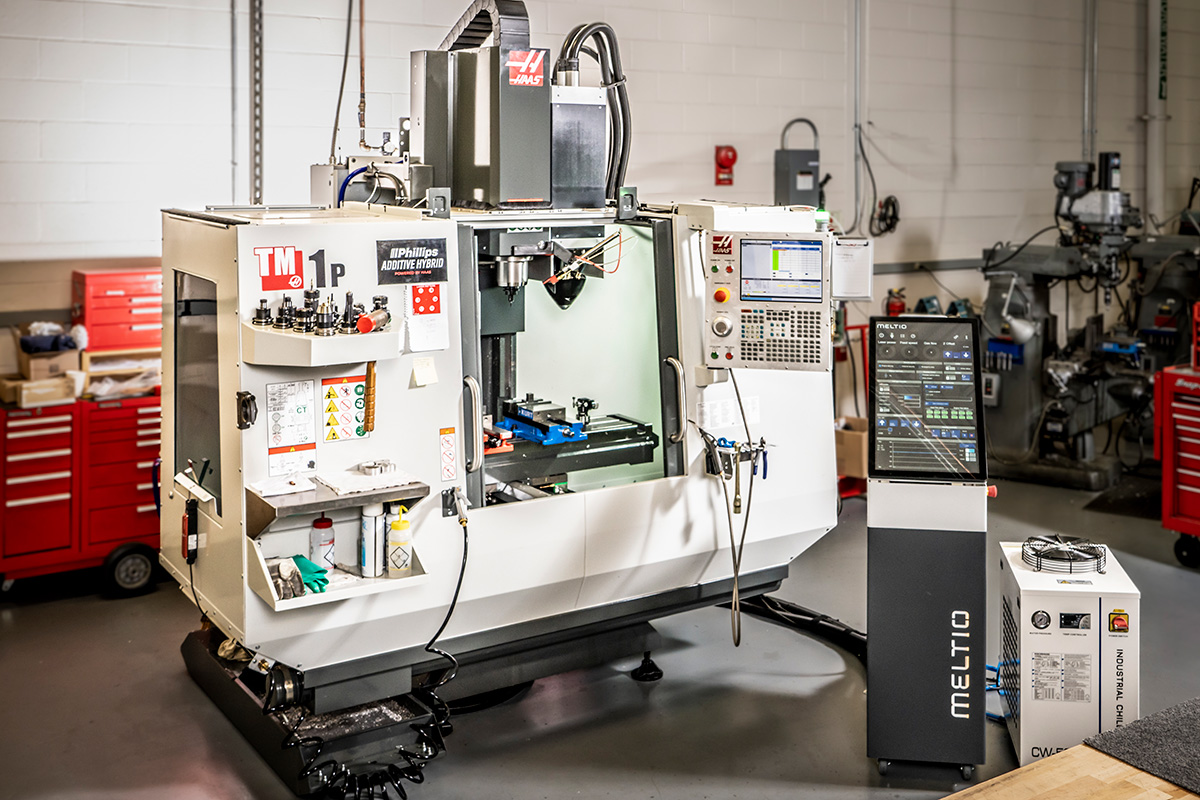
One of the systems used onboard is a Haas TM 1 CNC mill paired with a Meltio laser wire print head — a hybrid machine capable of both additive and subtractive manufacturing.
The unit measures roughly 9 feet, 8 inches long, 6 feet, 10 inches wide, and over 7 feet tall and weighs up to 5,600 pounds — making motion simulation a critical step without risking damage to the full system.
Credit: Johns Hopkins APL/Craig Weiman
Related Work