News
Hopkins Collaboration Expands Access to Maritime Testing and Advanced Sensing
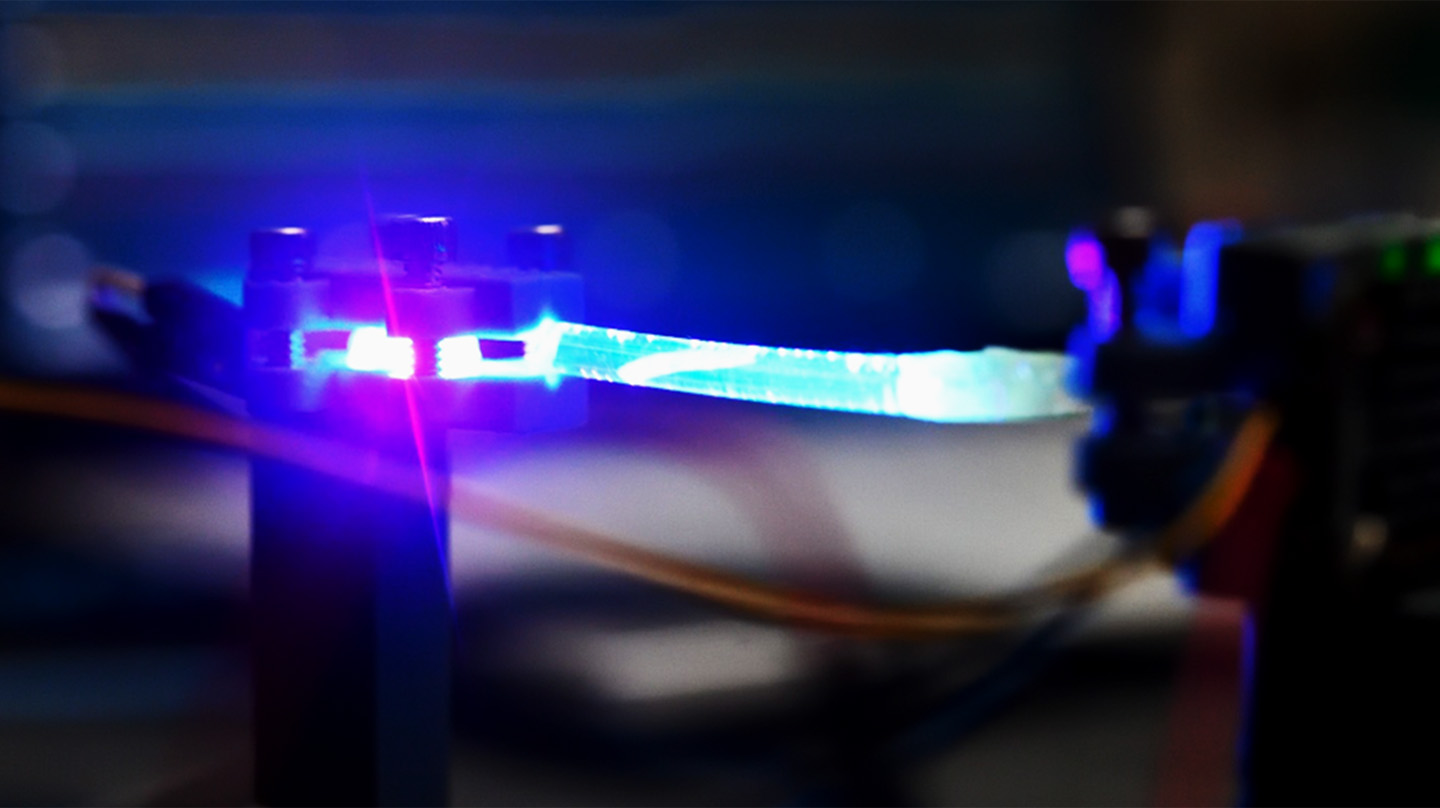
Students from the Johns Hopkins Whiting School of Engineering collaborated with researchers at Johns Hopkins APL to make maritime testing and optical sensing more accessible and cost-effective. This image shows the students’ successful additively manufactured quantum dot waveguide sensor prototype. On the left side, an ultraviolet light-emitting diode is exciting light into the waveguide filled with quantum dots, whose emission is collected by a photodiode array at the end of the waveguide (right side) to be processed to sense temperature and strain.
Credit: Johns Hopkins APL/Michael Sherburne
Audio generated using AI voice technology.
Students from the Johns Hopkins Whiting School of Engineering (WSE) collaborated with researchers at the Johns Hopkins Applied Physics Laboratory (APL) in Laurel, Maryland, to make maritime testing and optical sensing more accessible and cost-effective. Their work, part of WSE’s senior design mechanical engineering capstone, has various national security applications.
“We gave the students a very difficult and open-ended problem, and what they designed in two short semesters exceeded all expectations,” said Noah Corbitt, a mechanical engineer at APL and one of the students’ mentors.
“Their research will help us iterate quickly, reduce risk, and ultimately deliver robust, low-cost solutions to the government faster,” added Brendan McNelly, an assistant program manager at APL and another mentor to the WSE students.
Making Unmanned Vessels More Accessible
Unmanned surface vessels (USVs) are often used for maritime experimentation and data collection for the U.S. Navy, but many models are heavy, expensive, and specialized. A team of students — Aaron Lefkowitz, Alexander Kim, Gabriella Goytizolo, Matthew Roesler, and Shivam Dixit — was challenged by APL researchers McNelly, Corbitt, Jason Reid, and Alan Huang to design and build a low-cost, versatile, and portable USV that could be employed for various scientific applications.
The students evaluated the most cost-effective off-the-shelf options for each USV subsystem — such as the power system, sensors, and command and control electronics — and integrated them on a small-scale prototype to verify overall system functionality. They then tested the prototypes in WSE professor Louis Whitcomb’s hydrodynamics tank on Johns Hopkins University’s campus.
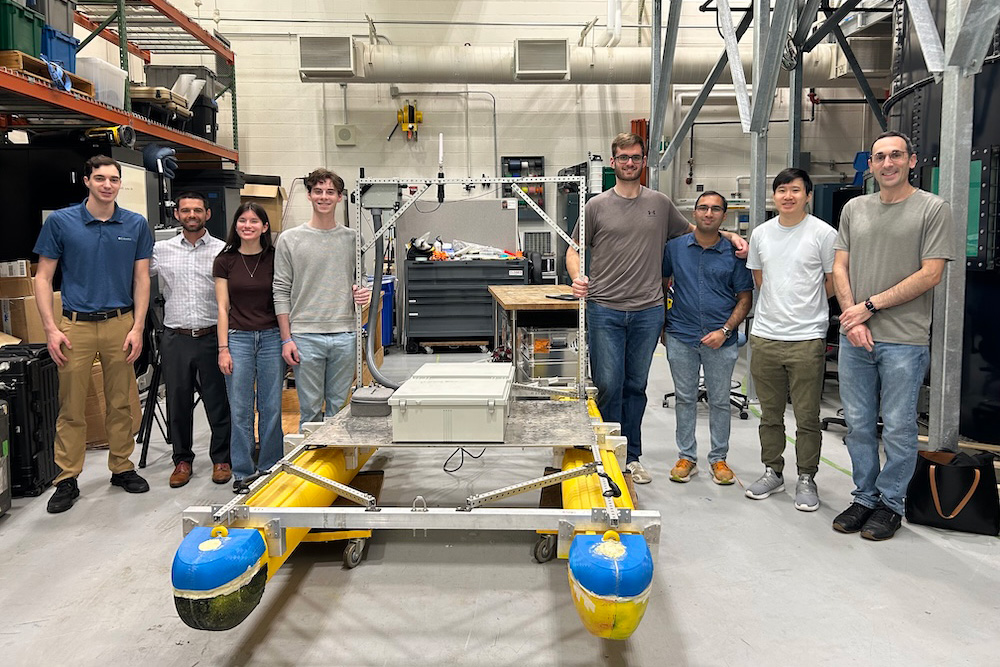
From left, APL’s Noah Corbitt and Brendan McNelly; WSE students Gabriella Goytizolo, Aaron Lefkowitz, Matthew Roesler, and Shivam Dixit; and APL’s Alan Huang and Jason Reid stand with the student team’s operational prototype of an inexpensive, modular, and lightweight USV that can be deployed for maritime testing. WSE student Alexander Kim is not pictured.
Credit: Johns Hopkins APL/Christiana Littrell
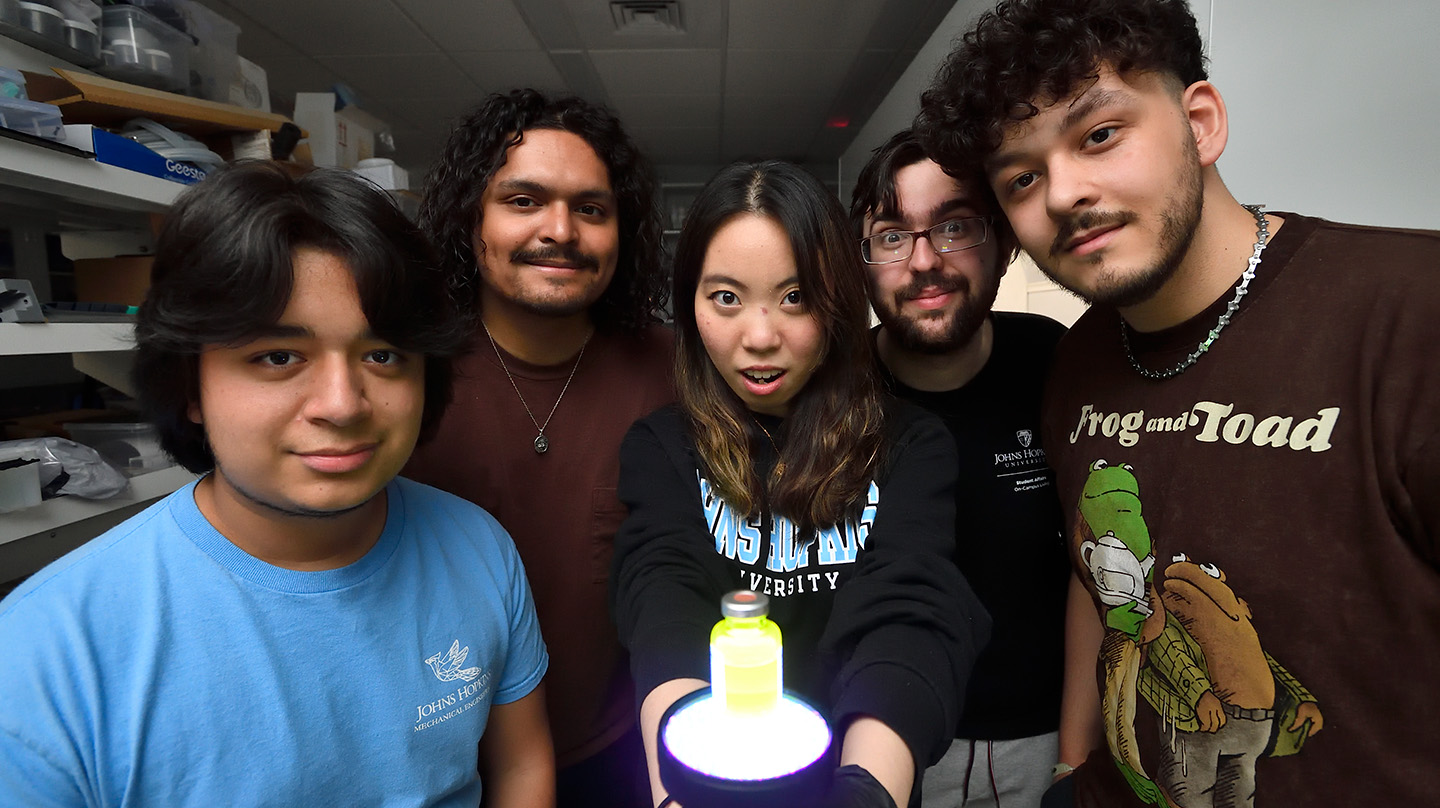
From left, WSE students Joshua Sic, Patrick Dass, Casey Shi, Ronald Garcia, and Joel Rentas-Velez hold their multimodal optical sensor made from quantum dots and silicon. Their prototype costs just $36, compared to similar existing sensors costing $5,000, and has been submitted for a patent and paper publication.
Credit: Johns Hopkins University/Will Kirk