Doing NMR at Nanoscale
NMR exploits a quantum property intrinsic to atomic nuclei, resulting from the angular momentum of their constituent protons and neutrons: spin. When subjected to magnetic fields, nuclear spins yield spectral data that allows scientists to determine what kind of molecules they’re looking at. With NMR, scientists can tell the difference between a harmless insecticide and a chemical nerve agent, or between an innocuous bacterial species and a deadly one, to name two examples.
The same principle can be applied on a much smaller scale. Specifically, diamonds can be engineered at the atomic level to have what are known as nitrogen-vacancy (NV) centers. NV centers occur where one carbon atom in the diamond is replaced by a nitrogen atom and a neighboring carbon atom is missing, creating a charged system that’s sensitive to surrounding magnetic fields. When green laser light is shined on these NV centers, they emit red light. By measuring that red light, scientists can read the spin state of the NV center, which in turn allows them to infer the molecular structures of fluid samples nearby. And unlike conventional NMR, those samples can be incredibly small — on the order of tens or hundreds of atoms.
While NV-based NMR is well established in the scientific community, it has so far been difficult to achieve the sensitivity required to identify and distinguish molecules in fluid samples. One major challenge is keeping the nuclear spins on the surface of the diamond long enough for the measurement to take place. Gray’s team came up with an idea to confine the spins in “nano-containers” directly on the diamond surface. His team predicted through simulation that this confinement could lead to an order-of-magnitude improvement in NMR sensitivity and accuracy.
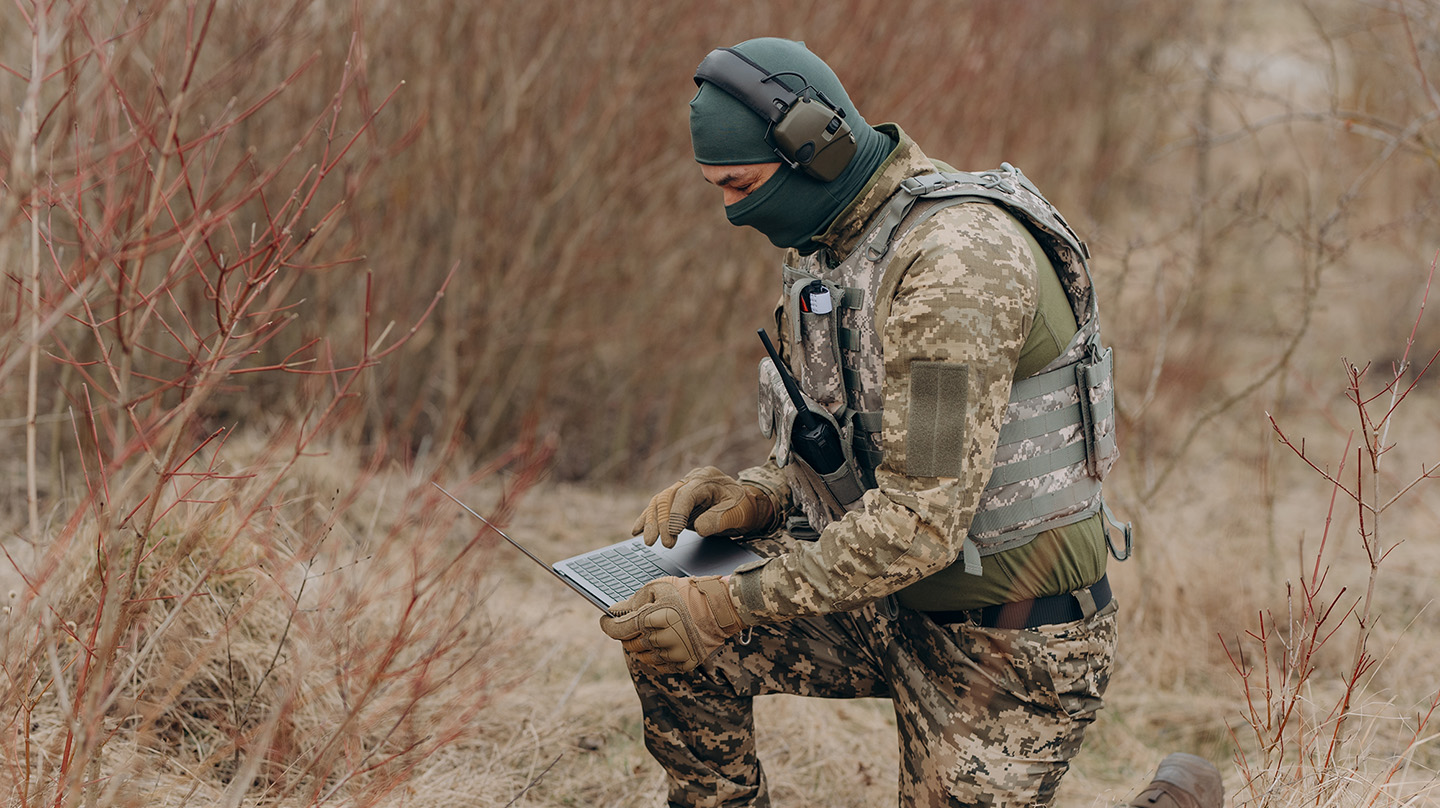
“In the field, you don’t need to achieve the level of accuracy that you do in a chemistry lab,” Gray said. “You just need to be able to answer a couple of critical questions: Is the substance a threat? Do you need to be wearing standard personal protective equipment or a hazmat suit? We think that’s achievable with a device that could fit in a backpack.”
Toward a Proof of Concept
Using internal funding, Gray and his team — which includes Andrew Bennett-Jackson, David Flay, Prashant Ramesh, Bryan Brensinger, and Andrea Timm — have devised a proof-of-concept demonstration and begun steps toward prototyping a fieldable NMR that can detect small volumes of biological and chemical threats. The team has successfully constructed a working prototype that measures magnetic fields by reading out the spin states of the NV.
The challenge now is achieving sufficient resolution to successfully identify chemicals in a tiny sample. The team has simulated a variety of geometries for confining the nuclear spins on the diamond surface and has found one with the potential to achieve the required sensitivity. They’re currently in the process of fabricating the “nano-container” for holding the fluid sample.
Broader Applications
Gray noted that NV-driven quantum magnetometers have uses well beyond fieldable NMR, including environmental monitoring, local magnetic field mapping for GPS-denied navigation, and low-frequency radio communications.
“We’ve already had several conversations with colleagues across the Lab about different applications — can the sensor be placed on a satellite? Or inside a cryostat? The answer is generally ‘yes,’” he said. “The better we get at building these, the more we can integrate them in creative ways to address all kinds of mission-specific challenges.”
Sarah Adams, program manager for Alternative Computing Paradigms in APL’s Research and Exploratory Development Mission Area, said this work demonstrates a unique combination of expertise rarely brought together outside of APL.
“The concept here — an exquisite blend of clever engineering, physics, microfabrication, and mission-focused research — is exactly what APL does best,” Adams said. “Creating this capability requires the ability to not only conceptualize it but to then execute and integrate all the disparate pieces — quantum sensing, microfluidics, the physics and chemistry of NMR, and microfabrication. The Laboratory has the multidisciplinary expertise to combine all of these to demonstrate a critical advancement in bio-chem threat detection.”