Press Release
Johns Hopkins APL Researchers Developing New Heatsink Using Additive Manufacturing
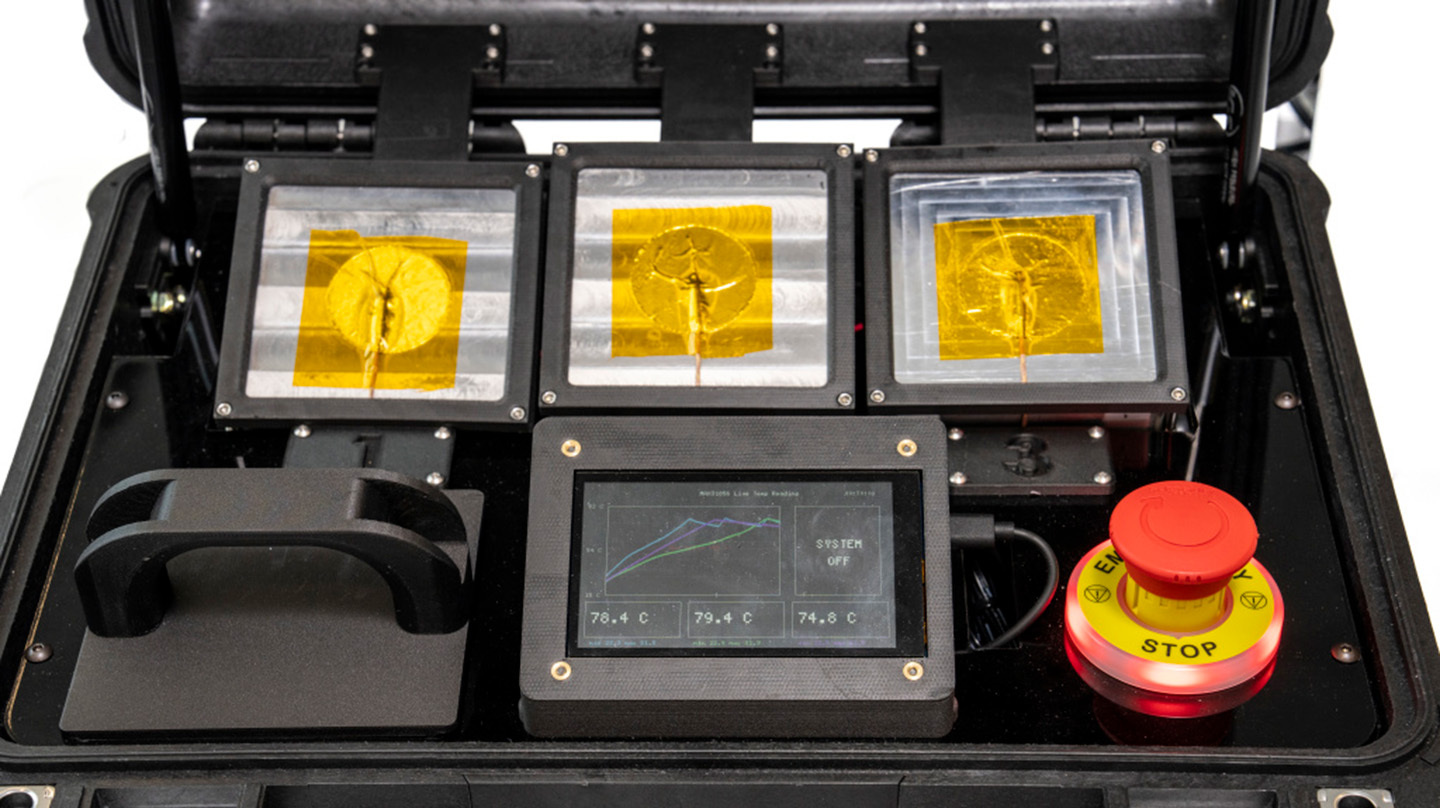
Smart Phase-change Enhanced Re-entry (SPEAR) heatsinks, shown in a retrofitted Pelican case alongside traditional metallic heatsinks, help manage heat in size- and weight-constrained systems.
Credit: Johns Hopkins APL/Craig Weiman
Audio generated using AI voice technology.
Engineers at the Johns Hopkins Applied Physics Laboratory (APL) in Laurel, Maryland, are developing a new thermal-management capability to help manage heat in systems where space and weight are limited.
SPEAR, derived from Smart Phase-change Enhanced Re-entry, combines phase-change materials (PCMs) with additive manufacturing to create compact, high-capacity heatsinks. PCMs absorb and store heat as they change from one physical state to another, allowing them to hold more heat without rising in temperature as quickly as traditional materials. The approach is designed for systems where electronics generate heat but have limited ways to release it, while still needing to meet strict size, weight, and power (SWaP) constraints.
“PCM heatsinks can be useful anywhere you have electronics that generate a lot of heat over a short period of time,” said Yoni Ferneau, a mechanical engineer at APL. “That could include hypersonics, space systems, radio-frequency electronics, transmitters, interceptors, and other transient or low-duty-cycle systems.”
A phase-change heatsink uses the melting of a material to store heat, similar to how ice melting in a drink keeps it cool, said Greg Merboth, a senior mechanical engineer at APL.
As the material changes from solid to liquid, it can absorb and store heat more efficiently than a traditional metallic heatsink, enabling a more than 50% reduction in size and weight while maintaining thermal capacity.
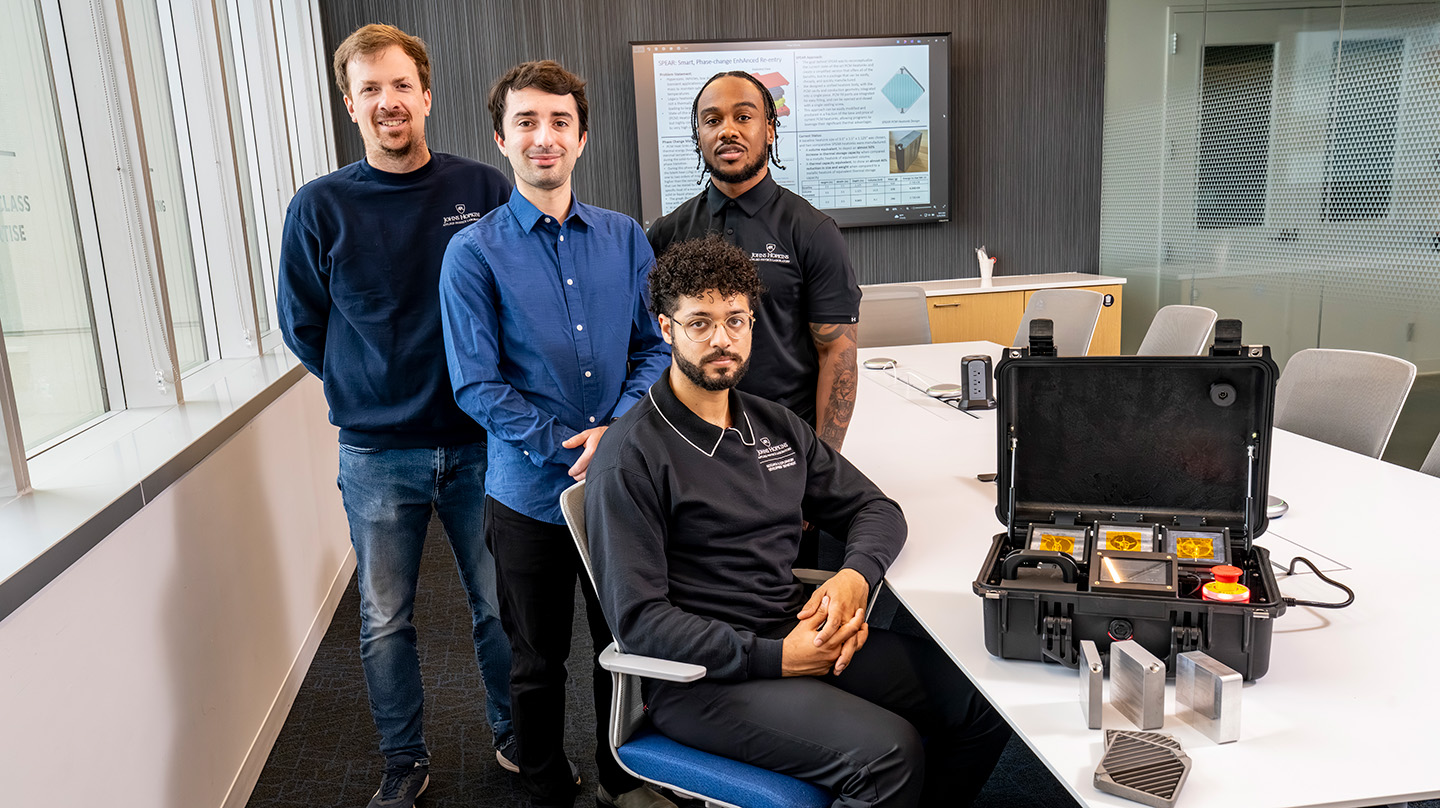
The APL team designed and fabricated single-piece phase-change heatsinks and developed the integrated test unit shown here. The unit applies heat to multiple heatsinks, enabling researchers to compare how each design performs.
Credit: Johns Hopkins APL/Craig Weiman