News
Johns Hopkins APL Makes Sure Fans Get Soccer, Not Sicker

At the single biggest sporting event in U.S. history, drawing 5 million international visitors to 11 U.S. cities for 78 matches over the course of 39 days, the Johns Hopkins Applied Physics Laboratory is playing a central role in ensuring that illnesses will not spread and become major incidents.
Credit: Adobe Stock
Audio generated using AI voice technology.
At the single biggest sporting event in U.S. history, drawing 5 million international visitors to 11 U.S. cities for 78 matches over the course of 39 days, the Johns Hopkins Applied Physics Laboratory (APL) in Laurel, Maryland, is playing a central role in ensuring that illnesses will not spread and become major incidents.
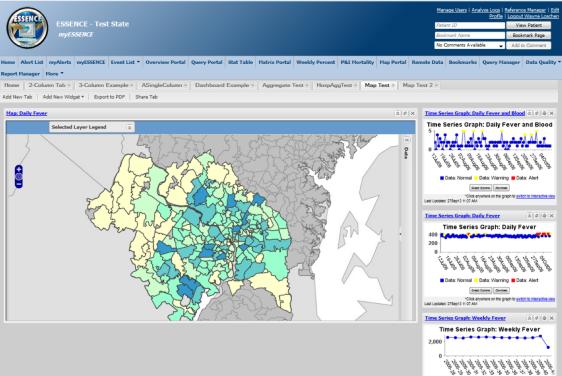
As it has for many large public events for more than two decades, the APL-developed Electronic Surveillance System for the Early Notification of Community-based Epidemics (ESSENCE) data visualization and analysis tool — which the Laboratory operates in collaboration with the U.S. Centers for Disease Control and Prevention (CDC) — has entered “enhanced surveillance” mode to ensure maximum stability and responsiveness for the duration of the major sporting event.
“Emergency department data, clinical lab data, news headlines, and many other data streams are continuously flowing into ESSENCE,” said Zahra Chaudhry, who manages the Prevention, Preparedness, and Response program in APL’s Global Health Mission Area. “But during enhanced surveillance mode, our focus is on maintaining a stable and reliable platform for public health decision-makers. We limit routine updates, closely monitor system performance, and proactively support users while remaining ready to rapidly address any critical issues that could affect operations.”
Syndromic Surveillance
The essence of ESSENCE is syndromic surveillance: affording its users the ability to track, by means of a wide range of data streams, the spread of disease symptoms through the civilian population. Focusing on symptoms allows the system to be flexible and adaptable to outbreaks of known diseases such as the flu, as well as new and emerging illnesses.
The APL ESSENCE team is continuously optimizing the system for stability and responsiveness, while keeping it technologically ahead of the curve. Most recently, the team has been working on several artificial intelligence and large language model (LLM) integrations to make the user experience even more seamless and powerful. One, a data fusion tool called FUSE (Flexible Unified Surveillance Engine), which is on track for a full rollout in the coming months, is designed to automate the alignment and correlation of information from different data streams to help users spot patterns and anomalies more quickly, with the goal of increasing the potential of early warning and intervention.
The incorporation of new capabilities is managed to ensure that innovation is balanced with reliable performance. APL learned key lessons from ESSENCE surveillance during the Army’s 250th birthday last year that provided data critical to improving syndromic surveillance. In turn, data collected now will inform future enhanced surveillance deployments.
“Twenty-five years ago, ESSENCE fundamentally changed how our nation approached disease surveillance — but the longevity and effectiveness of ESSENCE for major events is because it was built to be flexible, adaptable, and scalable as new data sources and novel analytics were developed,” said Sheri Lewis, deputy executive for the Global Health Mission Area at APL. “Large sporting events are an example of scale and significance, but we need our surveillance systems working 24/7 to anticipate and be prepared for evolving and dynamic threats. APL is committed to continuing to adapt and transform the system to increase impact and enable decision-making to protect our military and civilian populations.”
Related Work