News
Master Inventor Hoffman Turns Chemistry Into Capability
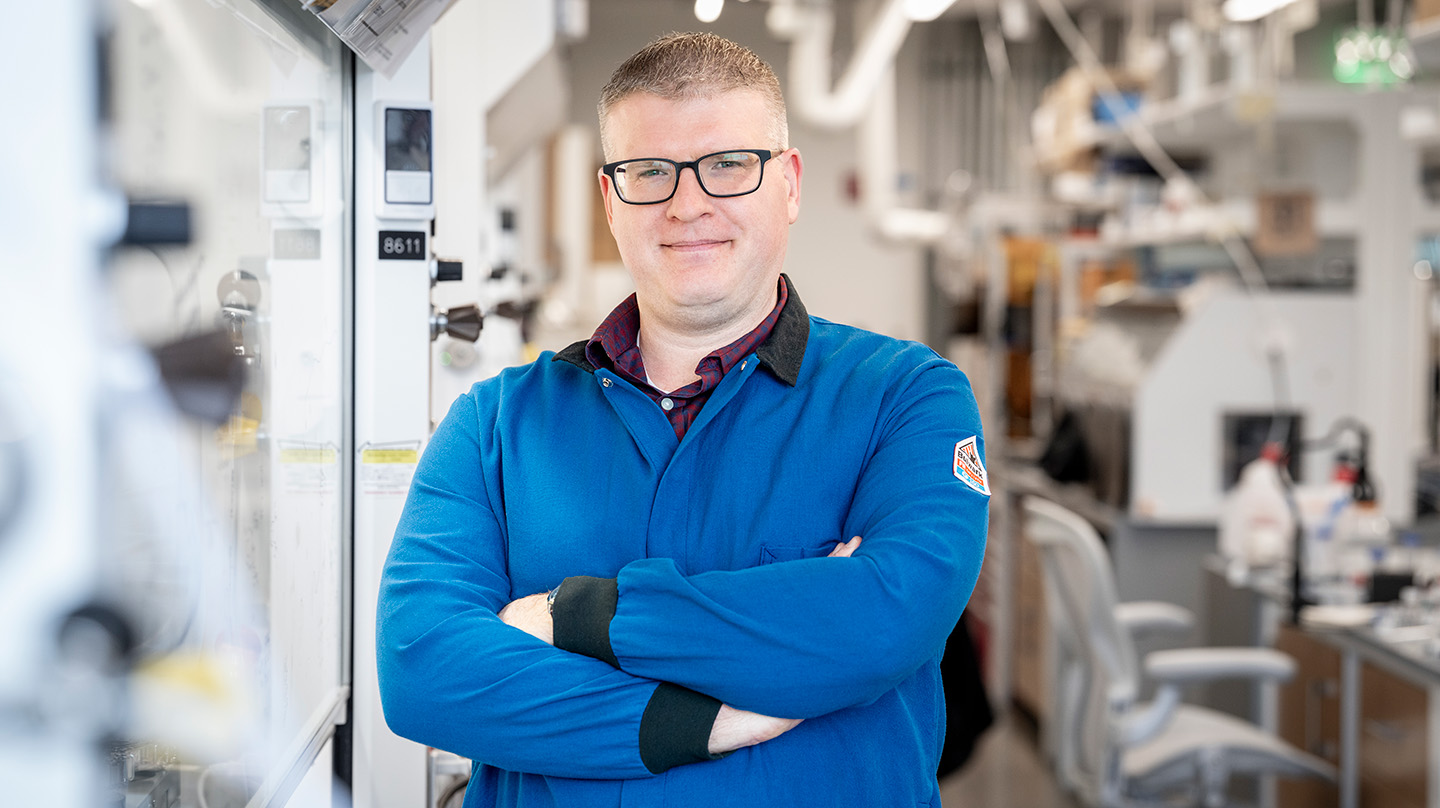
Christopher Hoffman has been recognized for his contributions to advanced materials, holding 12 patents spanning applications from antimicrobial coatings to environmental filtration systems.
Credit: Johns Hopkins APL/Craig Weiman
Audio generated using AI voice technology.
For Christopher Hoffman, an organic chemist at the Johns Hopkins Applied Physics Laboratory (APL) in Laurel, Maryland, innovation often starts with a simple question: What can chemistry do to solve this problem that nothing else can?
That curiosity has guided more than a decade of work at APL, where Hoffman, who leads the Lab’s Chemical Sciences Group, develops materials for demanding, real-world environments. His patents include a nontoxic antimicrobial coating that helps prevent bacterial biofilms from growing on surfaces and a hybrid coating system that protects aluminum-magnesium alloys from corrosion while reducing solar heating.
Those contributions have earned Hoffman recognition as an APL Master Inventor, a designation that honors staff members whose careers are defined by innovation. To be named a Master Inventor, a person must be granted at least 10 U.S. patents during their time at APL. Hoffman holds 12 issued patents, with more in progress.
But for him, patents were never the goal.
“My work has always been rooted in what chemistry can do to solve a problem,” he said. “Can we make something new that’s never been made before to solve a very specific challenge?”
That perspective took shape early in his career. After briefly working in the pharmaceutical industry, Hoffman came to APL for the opportunity to apply chemistry to real-world problems.
“Being able to come here and work on such a wide range of problems, and have them make an immediate impact, has been amazing,” he said.
An Early Lesson in Collaboration
Early in his time at APL, Hoffman was pulled into a challenging effort to develop Kevlar nanofibers for lightweight armor. The team had been working to replicate results from an academic paper but struggled to translate them into a usable material as the project timeline was winding down. Hoffman approached the problem from a molecular perspective while partnering with a chemical engineer who looked at it from a process viewpoint. Together, the duo found a way to stabilize the material and successfully produce the fibers after a late-night push in the lab.
The discovery extended the project and ultimately led to some of Hoffman’s first patents at APL. More importantly, the experience underscored a principle that has shaped his work ever since. “The biggest breakthroughs often happen at the boundaries between disciplines,” he said.
Expanding Chemical Science Capabilities at APL
Over time, Hoffman’s impact has expanded beyond his own technical contributions. He helped build and grow the Laboratory’s chemical sciences capability into a team of more than 20 scientists tackling a wide range of national security challenges.
Helping others pursue new ideas and take on complex problems has become one of the most rewarding parts of this phase of his career, he shared.
“All the easy science has already been done,” Hoffman said, recalling advice from his graduate school adviser. “Innovation comes from challenging yourself and your colleagues to go after the hard problems. Those are the real game changers.”