Press Release
Johns Hopkins APL Battlefield Care Innovation Named a Fast Company ‘World Changing Idea’
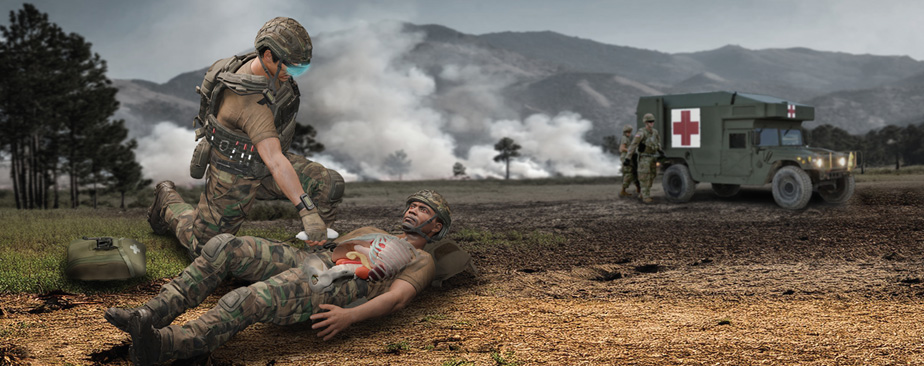
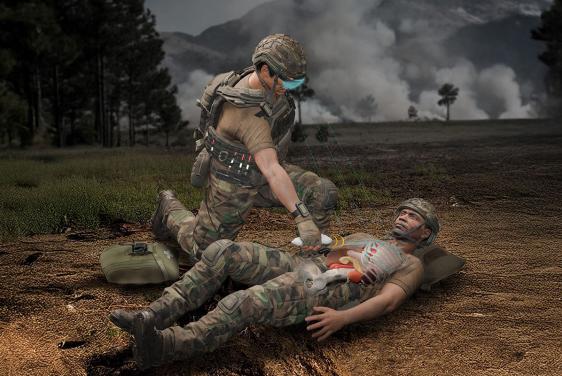
APL researchers are using a statistical shape atlas — a detailed map of variations in human anatomy — to predict the likely location of internal organs based on external body landmarks. This predictive modeling is aided by augmented reality technology, allowing medics to view an overlay of the patient’s internal anatomy directly on their body.
Credit: Johns Hopkins APL/Kevin McCafferty
Audio generated using AI voice technology.
Augmented Reality Capability Aims to Improve Trauma Care in Remote, High-Risk Environments
An augmented-reality-enabled medical guidance system developed at the Johns Hopkins Applied Physics Laboratory (APL) in Laurel, Maryland, has been recognized by Fast Company as a “World Changing Idea” for its potential to improve trauma care where advanced medical expertise and imaging tools are not readily available. The World Changing Ideas Awards recognize organizations and projects developing innovative solutions to critical global challenges. APL was named a winner in the health care and general excellence categories.
APL’s Augmented Reality for Lifesaving Trauma Care blends augmented reality (AR), predictive anatomy modeling, and artificial intelligence to help users identify internal injuries and offer lifesaving care in the field. It’s designed for military medics, emergency responders, and disaster relief personnel who need to make critical decisions in remote or high-stress situations without access to hospital-grade imaging technologies such as CT scanners or advanced ultrasound systems.
“This multidisciplinary project demonstrates the Laboratory’s ability to bring deep technical expertise to bear for the warfighter and first responders in innovative ways,” said APL Director Dave Van Wie. “Recognition like this highlights the promise of the technology and the team’s commitment to developing tools for complex operational challenges and advancing battlefield and disaster response capabilities.”
The system uses a statistical shape atlas, a data-driven model that captures variations in human anatomy, to estimate the location and shape of internal organs based on a few external body landmarks. Enhanced with deep-learning techniques and data from hundreds of CT scans, it can predict 66 anatomical structures within the chest and abdomen. With results displayed on an AR headset, users get a real-time view of likely organ positions during patient assessments.
To support trauma diagnostics, the team also developed a prototype AR-based ultrasound interface with voice-activated commands and step-by-step visual cues that guide probe placement for rapidly detecting internal bleeding or collapsed lungs.
“Too often, the people who need trauma care most urgently are farthest from the equipment and expertise that can save their lives,” said Suzy Kennedy, APL’s program area manager for Warfighter Health and Readiness. “A key part of our work is developing capabilities that improve outcomes when access to care is limited. This technology can bring more informed decision-making closer to the patient in resource-limited, time-constrained settings.”
Future work will focus on characterizing how the system performs in more realistic trauma scenarios as the team continues refining the technology for field use, added Bobby Armiger, the project’s principal investigator and managing executive of APL’s Research and Exploratory Development Department.
“By integrating predictive anatomy, AR, AI, and portable ultrasound, we are exploring how to make advanced medical guidance more intuitive and usable in the field,” Armiger said.
A panel of Fast Company editors and reporters selected this year’s honorees from a competitive pool of more than 1,500 entries spanning health care, technology, artificial intelligence, education, energy, and more. The listing is the latest in a line of Fast Company awards for APL innovations and is the fifth World Changing Ideas honor the Lab has received in the past seven years. APL has also earned seven consecutive placements on Fast Company’s Best Workplaces for Innovators list and has been recognized as one of their Most Innovative Companies five out of the past 10 years.
Related Work