News
Johns Hopkins APL Collaborates With U.S. Navy and Army to Advance Autonomous UXO Clearance Capabilities
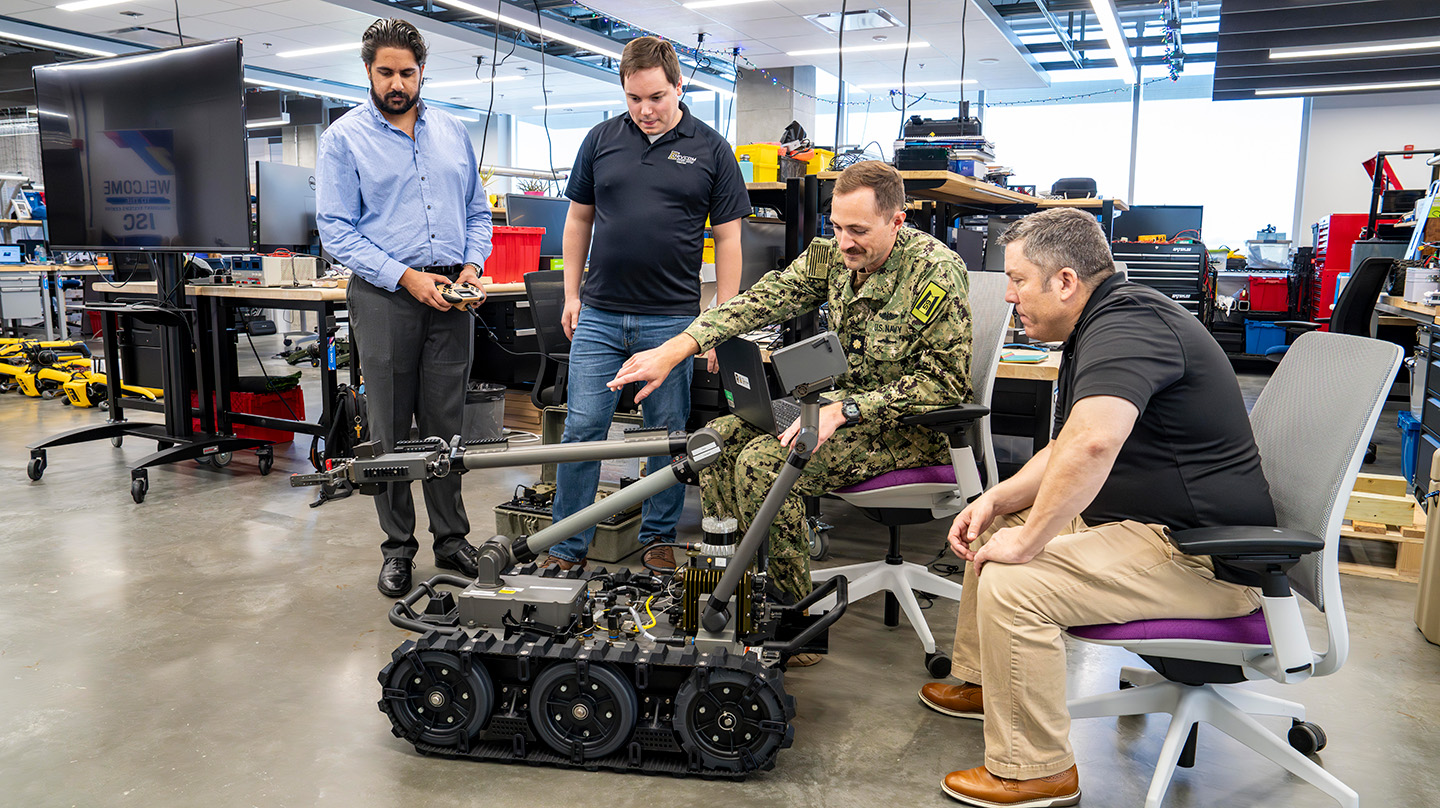
Asher Anand (APL), Tim Pietrzyk (U.S. Army Ground Vehicle Systems Center), Ty Howell (U.S. Army Ground Vehicle Systems Center), and Christopher Korpela (APL) collaborate in APL’s Intelligent Systems Center to integrate autonomous functionality into the Man Transportable Robotic System Increment II (MTRS INC II) platform, a fielded system widely used for explosive hazard mitigation.
Credit: Johns Hopkins APL/Craig Weiman
Audio generated using AI voice technology.
The Johns Hopkins Applied Physics Laboratory (APL) in Laurel, Maryland, is collaborating with the U.S. Army and Navy to develop and prototype autonomous technologies that clear large operational areas of unexploded ordnance (UXO) and other hazards.
A central objective of this effort is to integrate autonomous functionality into the Man Transportable Robotic System Increment II (MTRS Inc II) platform, a widely used explosive hazard mitigation system. APL is adapting sensor compute systems developed under prior Office of Naval Research (ONR) and U.S. Army Ground Vehicle Systems Center efforts for integration with MTRS INC II, enabling autonomous navigation, standoff detection, and scalable hazard clearance over operational surfaces such as airfields.
“Our objective is to develop an autonomous system that can perceive and understand its environment, plan and execute safe paths, and accurately localize explosive hazards,” said Christopher Korpela, a senior roboticist in APL’s Intelligent Systems Center (ISC). “Once the system identifies a threat, it will be capable of placing a charge or performing other render-safe procedures before continuing its mission. This requires integrated behaviors for avoiding obstacles, detecting relevant objects, and manipulating them precisely from a safe distance.”
The team is leveraging proven simultaneous localization and mapping technologies to enable robust autonomous navigation capabilities in the MTRS INC II platform. By adapting algorithms that have been operationally validated, the effort emphasizes high technical readiness. This approach enables the team to accelerate fielding timelines while ensuring the system can operate effectively in the complex environments typical of UXO clearance missions.
“Advancing this capability on a rapid timeline is critical to ensuring that warfighters have access to tools that increase standoff and reduce risk in hazardous environments,” said Lt. Cmdr. Ty Howell, an Army Civilian software engineer and ONR-Reserve Component officer who is supporting this effort through his Navy Reserve capacity. “By focusing on mature, transition-ready technologies, we’re accelerating delivery without compromising reliability or safety.”
The partnership leverages Army requirements under the MTRS INC II Program of Record and aligns with Navy interests in expeditionary explosive hazard mitigation. As part of the collaboration, Howell and electrical engineer Tim Pietrzyk, who represented the U.S. Army’s DEVCOM Ground Vehicle Systems Center, worked alongside Korpela and APL team members in APL’s ISC for several days, focusing on integrating and refining the onboard compute package.
Prototype development and field experimentation are ongoing, with data collection and operator feedback informing system refinement and transition planning. This effort reflects APL’s commitment to advancing mission-relevant autonomy and delivering robust, agile robotic solutions that support the evolving operational needs of the Department of War.
Learn more about APL’s Frontier Intelligent Systems Program.