Press Release
Johns Hopkins APL Contributions Fuel Critical Navy Cybersecurity System
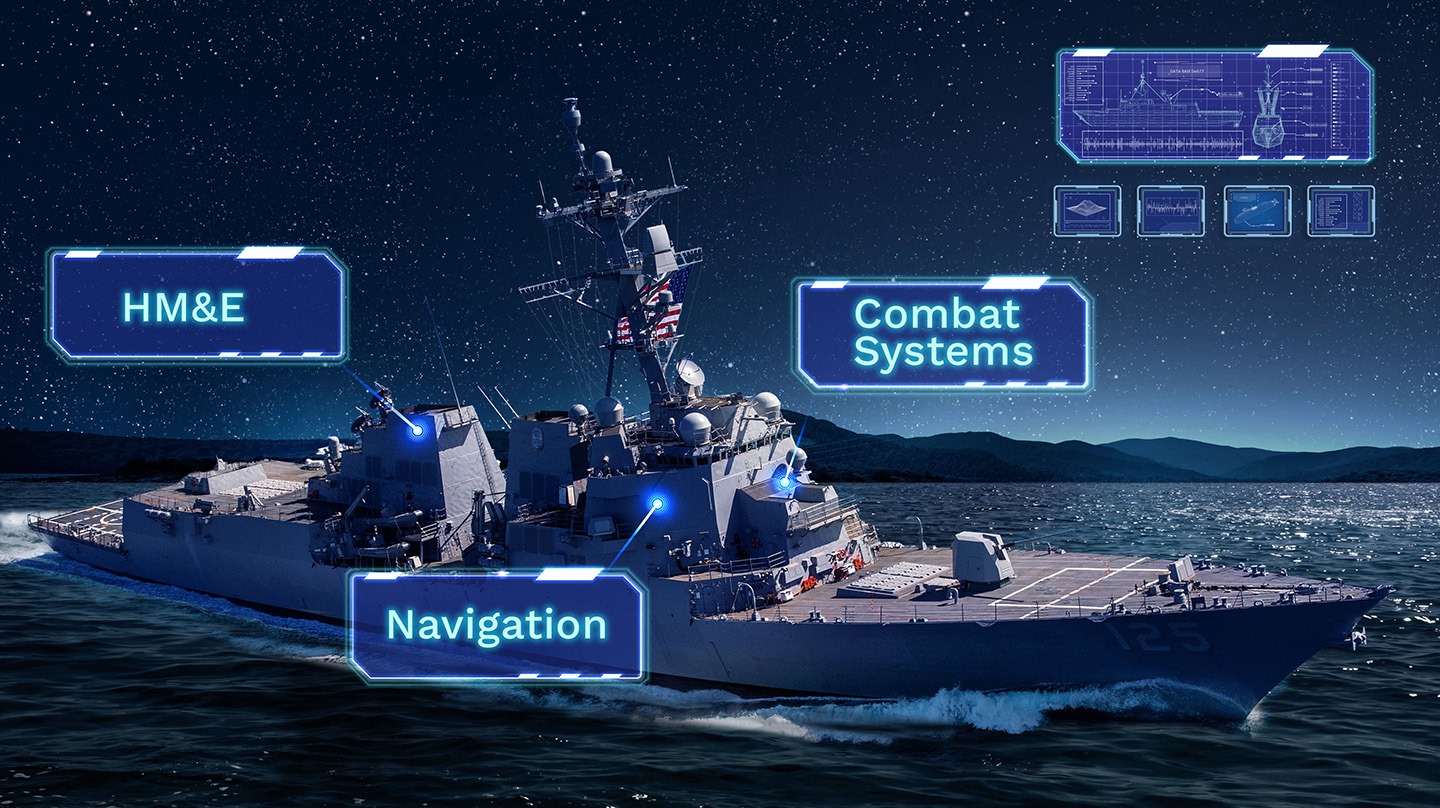
SABER continuously and autonomously monitors a surface ship’s vital systems for signs of a cyberattack, including its hull, mechanical, and electrical (HM&E), navigation, and combat components.
Credit: Johns Hopkins APL
Audio generated using AI voice technology.
The Navy-engineered Situational Awareness, Boundary Enforcement, and Response (SABER) system, with key capabilities developed by the Johns Hopkins Applied Physics Laboratory (APL) in Laurel, Maryland, in collaboration with government and industry partners, has become a vital line of security in protecting Navy ships against cyberattacks.
SABER continuously and autonomously monitors a surface ship’s vital systems for signs of a cyberattack, including its hull, mechanical, and electrical (HM&E), navigation, and combat components. When a potential attack is detected, the system generates alerts that provide crew members with defensive and/or remediation options.
The growing threat of cyberattacks on naval vessels, especially smaller ships such as destroyers and frigates, has made it critical to have a reliable system in place not only to protect the nation’s military infrastructure but also to instill confidence in the readiness of those systems for potential future conflicts.
“With SABER being deployed to the fleet at large, we are creating tools that will enhance mission assurance in a cyber-contested environment,” said Vamsi Maddula, Cyber Resilient Platforms program manager at APL.
Multiple Capabilities, One Mission
The APL capabilities underpinning SABER draw on more than a decade of demonstrative events and innovative technical leadership. Many of these capabilities originated in APL’s SEACHANGE initiative, launched in 2016 with three lines of effort: assess situational awareness technologies, establish a prototype and temporary solution based on the technologies used in fleet experiments, and lead a human-systems engineering working group to develop guidance to better enable cyber warfare on a ship.
SABER integrates tools developed by the government, APL, and industry partners to form the backbone of shipboard, tactical system cybersecurity. As SABER gains traction as a Naval Sea Systems Command (NAVSEA) rapid-development capability focused on a subset of ship systems, APL is working to advance the new Program of Record to scale the capability to multiple shipboard enclaves across the fleet.
The envisioned system represents the culmination of three complementary efforts: a variant focused on HM&E systems; another variant known as the Cyber Backfit Solution (CBS), which focused on defending the Ship Self-Defense System (SSDS) on aircraft carriers and amphibious assault ships; and Afloat Navigation Cyber Hardening, Observation, and Response (ANCHOR), which focused on defending shipboard navigation systems.
“Bringing together technical expertise from existing efforts, the APL team worked collaboratively to develop and mature capabilities and deliver a best-of-breed design to address the needs of the new SABER Program of Record across all major functional domains: navigation, combat systems, and HM&E,” said Jordan Matthews, a program manager in APL’s Theater Defense Mission Area.
Initially, ANCHOR was developed to address a gap in cybersecurity protections for navigation systems and data flows. Later renamed SABER-NAV, the system places APL at the center of prototyping and capability development for SABER.
“SABER-NAV allows a cyber-novice sailor to quickly recognize a cyber incident and execute a consistent response, vastly improving the security posture of these unique systems,” added Matthews.
Deployment Across the Fleet
As SABER matures, it will become the service’s official cybersecurity tool suite for monitoring HM&E, navigation, and combat systems and will be deployed across all Navy surface ships.
To help the Navy replace legacy protections and expand SABER coverage to additional afloat functional domains, such as combat systems and aviation, the program is implementing an APL-created common afloat cybersecurity design consistent with the MOSAICS framework, Maddula said.
He also noted the Navy wants to use this design to implement and release requests for new tool suites to meet any broader future needs and requirements.
“APL, as a trusted adviser to the Navy, is influencing what the program and architecture will look like for the next 10 to 20 years,” Maddula said.
Related Work
MOSAICS: Cyber Defense for Industrial Control Systems