Press Release
NASA Selects Johns Hopkins APL to Investigate Space Radiation Effects on the Lunar Surface
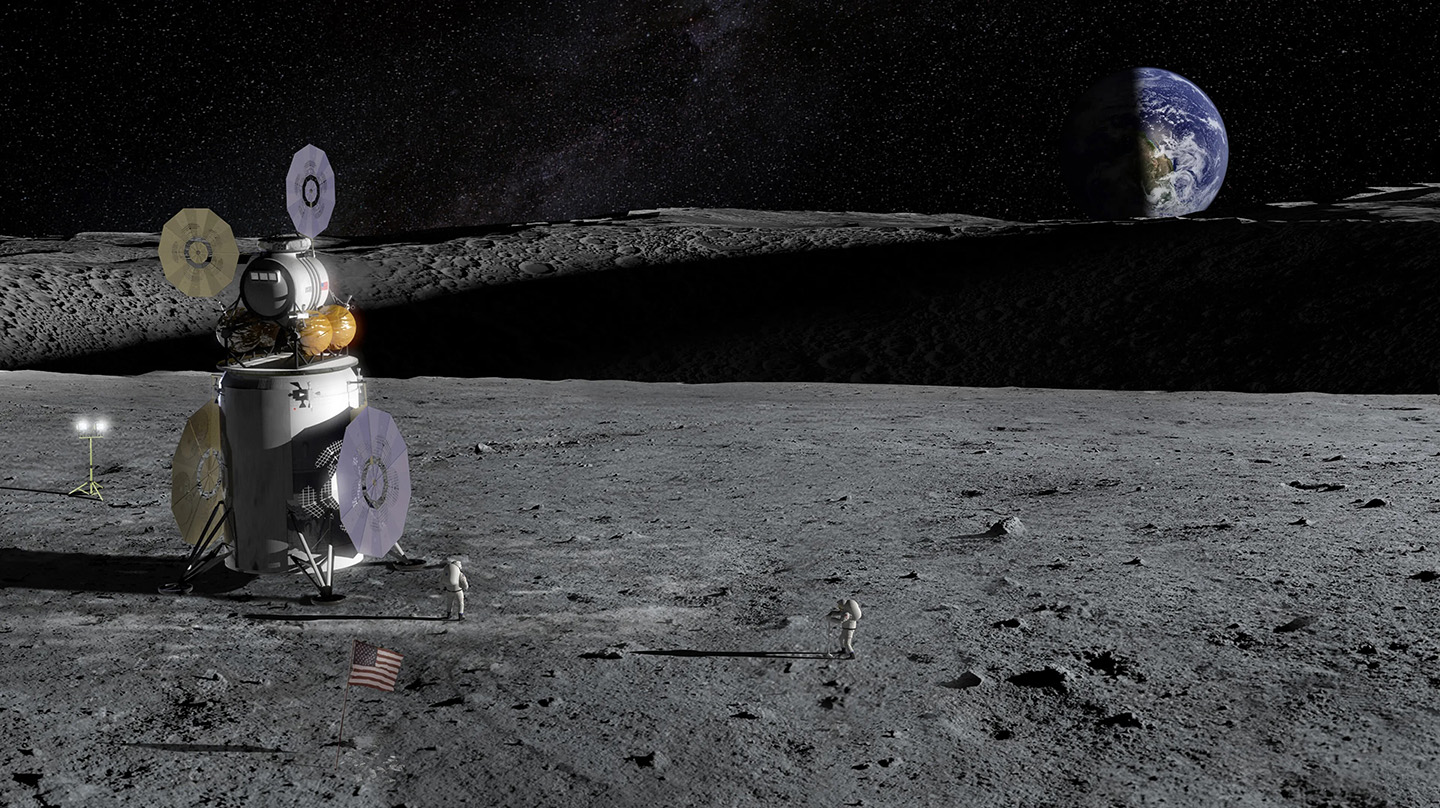
The SELINE payload will study the radiation from galactic cosmic rays and their secondary particles and how this radiation interacts with the lunar surface. The information will be critical to assessing the effects of space weather and ensuring astronaut health and safety on the Moon.
Credit: NASA
Audio generated using AI voice technology.
The Johns Hopkins Applied Physics Laboratory (APL) in Laurel, Maryland, has been awarded one of three new NASA science investigations designed to strengthen humanity’s understanding and exploration of the Moon. The research payloads will be integrated into the agency’s Commercial Lunar Payload Services (CLPS) initiative and Artemis campaign, with delivery to the lunar surface planned for 2028.
Led by APL heliophysicist and planetary scientist Drew Turner, the Site-agnostic Energetic Lunar Ion and Neutron Environment (SELINE) payload will provide insight into the Moon’s radiation environment by studying, for the first time at the lunar surface, the radiation from both galactic cosmic rays and their secondary particles and how this radiation interacts with the lunar regolith — the fine dust on the Moon’s surface.
“We are really excited for the opportunity to comprehensively characterize the lunar radiation environment, diagnose its space weather hazard to astronaut health and safety, and expand the science of how that radiation processes lunar surface materials over time,” Turner said.
Also selected were a University of Arizona-led payload to create 3D thermal models of the lunar terrain and a drilling instrument from Texas Tech University that will measure the heat flow of the Moon’s interior. All three science experiments, selected through NASA’s Payloads and Research Investigations on the Surface of the Moon call for proposals, do not require a specific landing site to gather their data, and NASA will assign them to specific CLPS delivery task orders at a later time.
“With CLPS, NASA has been taking a new approach to lunar science, relying on U.S. industry innovation to travel to the surface of the Moon and enable scientific discovery,” said Joel Kearns, deputy associate administrator for exploration, Science Mission Directorate, NASA Headquarters in Washington. “These selections continue this pipeline of lunar exploration, through research that will not only expand our knowledge about the Moon’s history and environment, but also inform future human safety and navigation on the Moon and beyond.”
NASA uses CLPS to send scientific instruments and technology demonstrations to advance capabilities for science, exploration, or commercial development of the Moon and beyond. By supporting a steady cadence of lunar deliveries, the agency will continue to enable a growing lunar economy while leveraging the entrepreneurial innovation of the space community.
With a broad and distinguished base of lunar experts and a demonstrated ability to work across the civil and national security space domains, APL is uniquely positioned as a trusted partner to implement and integrate critical elements of the nation’s lunar strategy.
“The SELINE investigation is an opportunity for APL to apply our technical strengths and scientific expertise to one of our nation’s highest space exploration priorities,” said Jason Kalirai, APL’s mission area executive for Space Formulation. “We look forward to contributing technology and knowledge critical to establishing, protecting, and sustaining a human presence on the Moon.”