News
Global Partners to Highlight BOLT Hypersonic Experiment Success

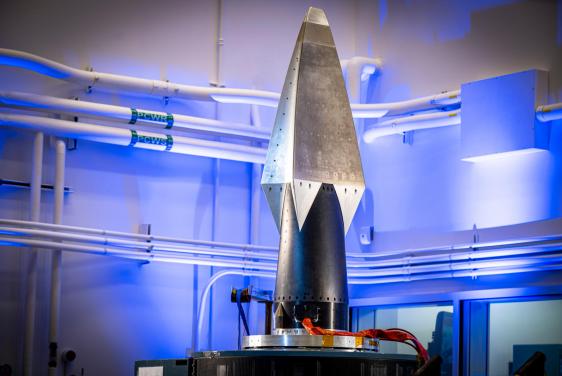
The successful BOLT-1B flight experiment collected hundreds of critical measurements, providing data to advance understanding of complex physics important to hypersonic flight.
Credit: Johns Hopkins APL
Audio generated using AI voice technology.
At this January’s American Institute of Aeronautics and Astronautics (AIAA) SciTech Forum, an international team of researchers will present findings from Boundary Layer Transition (BOLT)-1B, the latest in a series of flight experiments that continue to provide scientists with a wealth of insights into complex physics important to hypersonic flight.
With the Johns Hopkins Applied Physics Laboratory (APL) in Laurel, Maryland, serving as principal investigator, the BOLT-1B flight experiment was a collaborative international effort in partnership with the German Aerospace Center (DLR) and the U.S. Air Force Research Laboratory (AFRL). Sponsored by the U.S. Air Force Office of Scientific Research (AFOSR), the project focused on gathering new data on boundary layer transition, one of the most pressing challenges in hypersonic flight.
Boundary layer transition occurs when airflow over an object’s surface becomes turbulent. Engineers are especially interested in predicting this phenomenon for hypersonic vehicles — which travel at more than five times the speed of sound — because turbulent flow increases drag and aerodynamic heating.
Following an unexpected flight instability during the BOLT-1A flight test in 2021, APL collaborated with its international partners to redesign and re-fly the experiment.
Although boundary layer transition physics are frequently studied in wind tunnels, high-quality real flight data is lacking. Brad Wheaton, chief scientist of APL’s Vehicle Design and Technologies Group and BOLT’s principal investigator, explained that when BOLT-1A launched from the Esrange Space Center in northern Sweden in 2021, the vehicle failed to reach hypersonic speeds because of a then-unknown anomaly. Shortly after first-stage separation, the rocket began to spiral, and it failed to achieve the hypersonic speed or altitude needed for the experiment.
Analyzing an Anomaly
APL scientists and partners analyzed the BOLT-1A launch data and created a detailed model of the vehicle’s flight dynamics to determine what caused the vehicle to spiral, and to develop strategies to avoid similar issues in follow-on flights. Leveraging the Lab’s expertise in aerodynamics, flight dynamics and modeling, and structural dynamics, the BOLT team used high-fidelity models to reveal that the BOLT-1A rocket became unstable from a complex interaction between the asymmetric BOLT geometry and the vehicle’s spin.
Wheaton said the team learned new ways to model the stability of asymmetric sounding rockets with geometries like BOLT, along with important factors to model in trajectory simulations. The extensive testing and analysis of the BOLT-1A anomaly informed the design of the BOLT-1B flight.
APL designed and built the upper part of the BOLT-1B payload, and DLR built the lower half and provided the rocket vehicle and launch services. APL also fabricated the payload support and transition support modules, and AFRL provided the subsystems. Key to APL’s work on BOLT-1B was the experimental forebody, which is shaped like the BOLT geometry, where all the boundary layer and transition measurements were made. Fabricating the forebody took about 14 months and involved more than 100 APL staff members.
“The flight data showed that boundary layer transition behaves differently in real flight than in a conventional wind tunnel,” said Wheaton. He noted that scientists also gleaned other essential information, such as the effect of surface roughness on vehicles in flight, new methods of estimating the rocket’s attitude in flight, and detailed temperature measurements within the payload structure.
“These insights can only be obtained through flight and will be key to refining aerodynamic and thermal models for future designs,” said Wheaton.
Lessons Learned
In September 2024, the team conducted the subsequent successful flight experiment, as BOLT-1B launched from Andøya Space in Norway. The rocket soared over the Norwegian Sea at Mach 7.2 — more than seven times the speed of sound — and collected hundreds of critical measurements, advancing understanding of the complex physics involved in hypersonic flight.
BOLT-1B included hundreds of instrument channels measuring temperature and pressure on smooth and stepped surfaces, characterizing boundary layer transition during ascent and descent and validating improvements to vehicle stability modeling. Researchers will use the data to validate new and more accurate modeling and prediction methods that could improve the design of hypersonic vehicles.
The BOLT effort reflects APL’s role in connecting fundamental research with applied engineering and in working closely with partners across government, academia, and industry. BOLT also builds on the Laboratory’s long-standing contributions to hypersonics research.
APL experts, together with their international partners, will highlight key takeaways from the BOLT-1B flight during four dedicated sessions at the AIAA SciTech Forum in Orlando in January 2026.
Related Work