Press Release
Cassini Helps Redraw Shape of Solar System
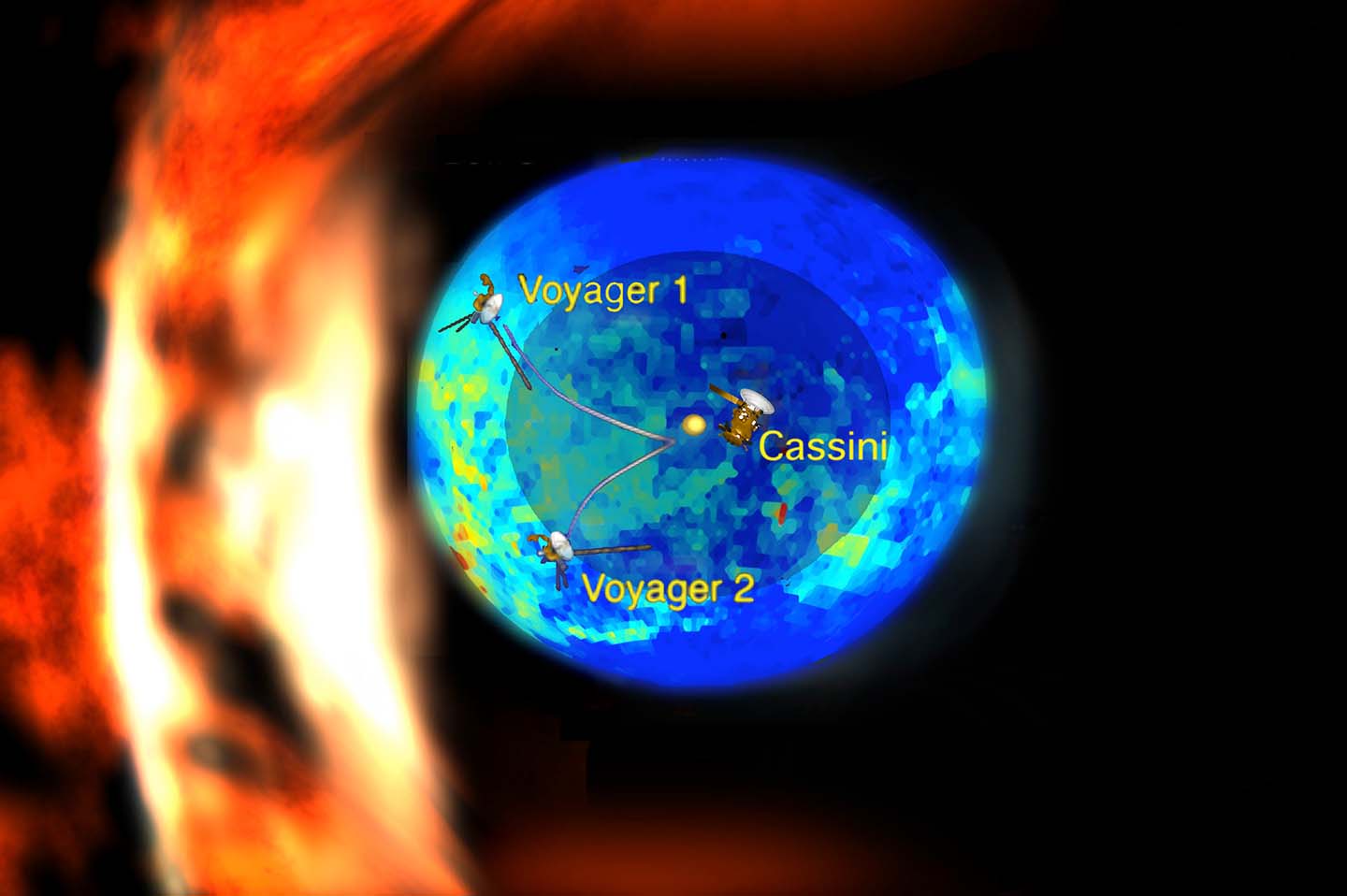
Images from the Ion and Neutral Camera (INCA), part of the Magnetospheric Imaging Instrument on NASA's Cassini spacecraft, suggest that the heliosphere may not have the comet-like shape predicted by existing models. The instrument imaged a population of hot particles that resides just beyond the boundary of where the solar wind collides with the interstellar medium, forming a termination shock.
In a paper published Oct. 15 in Science, APL researchers describe how this population of particles may be more influenced by the interstellar medium's magnetic fields than previously thought, and that the heliosphere is therefore more spherical.
In this graphic, the multicolor bubble represents new measurements of particles called energetic neutral atoms streaming in from the thick boundary known as the heliosheath, between the heliosphere (the region of our sun’s influence) and the interstellar medium (the matter between stars in our corner of the galaxy). The yellow circle is our sun. The two Voyager spacecraft, illustrated with lines showing their path, are currently traveling through the heliosheath, which is the outer layer of the heliosphere where solar wind slows down and heats up as it interacts with the interstellar medium. Cassini is not pictured, but it is still inside our solar system, orbiting Saturn. The dark inner circle represents the volume bounded by the termination shock, formed where supersonic solar wind streaming out from our sun suddenly slows down; the outer boundary of the heliosheath, where the interstellar medium and solar wind pressures balance, is called the heliopause. To the left of this bubble is the curve of the bow shock, where the interstellar medium traveling in the opposite direction slows down as it collides with the heliosphere, like the wave formed in a stream as it flows around a rock.
Credit: Johns Hopkins APL
In a paper published Oct. 15 in Science, researchers from The Johns Hopkins University Applied Physics Laboratory (APL) present a new view of the region of the sun’s influence, or heliosphere, and the forces that shape it. Images from one of the Magnetospheric Imaging Instrument’s sensors, the Ion and Neutral Camera (MIMI/INCA), on NASA’s Cassini spacecraft suggest that the heliosphere may not have the comet-like shape predicted by existing models.
“These images have revolutionized what we thought we knew for the past fifty years; the sun travels through the galaxy not like a comet but more like a big, round bubble” said Stamatios Krimigis, principal investigator for MIMI, which is orbiting Saturn. “It’s amazing how a single new observation can change an entire concept that most scientists had taken as true for nearly fifty years.”
As the solar wind flows from the sun, it carves out a bubble in the interstellar medium. Models of the boundary region between the heliosphere and interstellar medium have been based on the assumption that the relative flow of the interstellar medium and its collision with the solar wind dominate the interaction. This would create a foreshortened “nose” in the direction of the solar system’s motion, and an elongated “tail” in the opposite direction.
The INCA images suggest that the solar wind’s interaction with the interstellar medium is instead more significantly controlled by particle pressure and magnetic field energy density.
“The map we’ve created from INCA’s images suggests that pressure from a hot population of charged particles and interaction with the interstellar medium’s magnetic field strongly influence the shape of the heliosphere,” says Don Mitchell, MIMI/INCA co-investigator at APL.
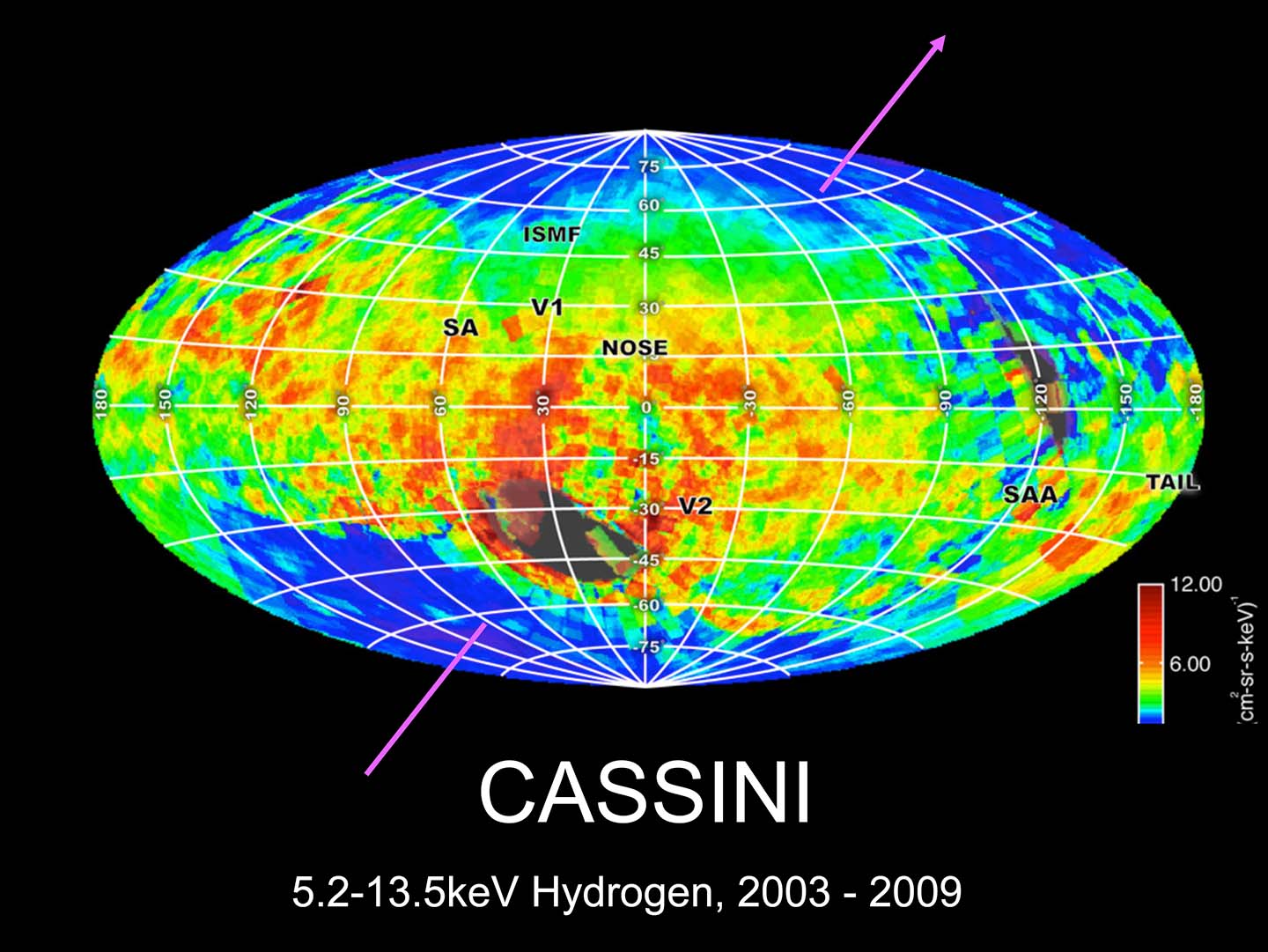
Full sky image of the energetic neutral atom emission from the sheath of hot particles formed in the region where the solar wind collides with the interstellar medium (the heliosheath). The data are shown in galactic coordinates. The emissions are weak in the vicinity of the galactic poles, which suggests that the interstellar magnetic field is strongly influencing the distribution of the hot charged particles in the heliosheath.
Credit: Johns Hopkins APL
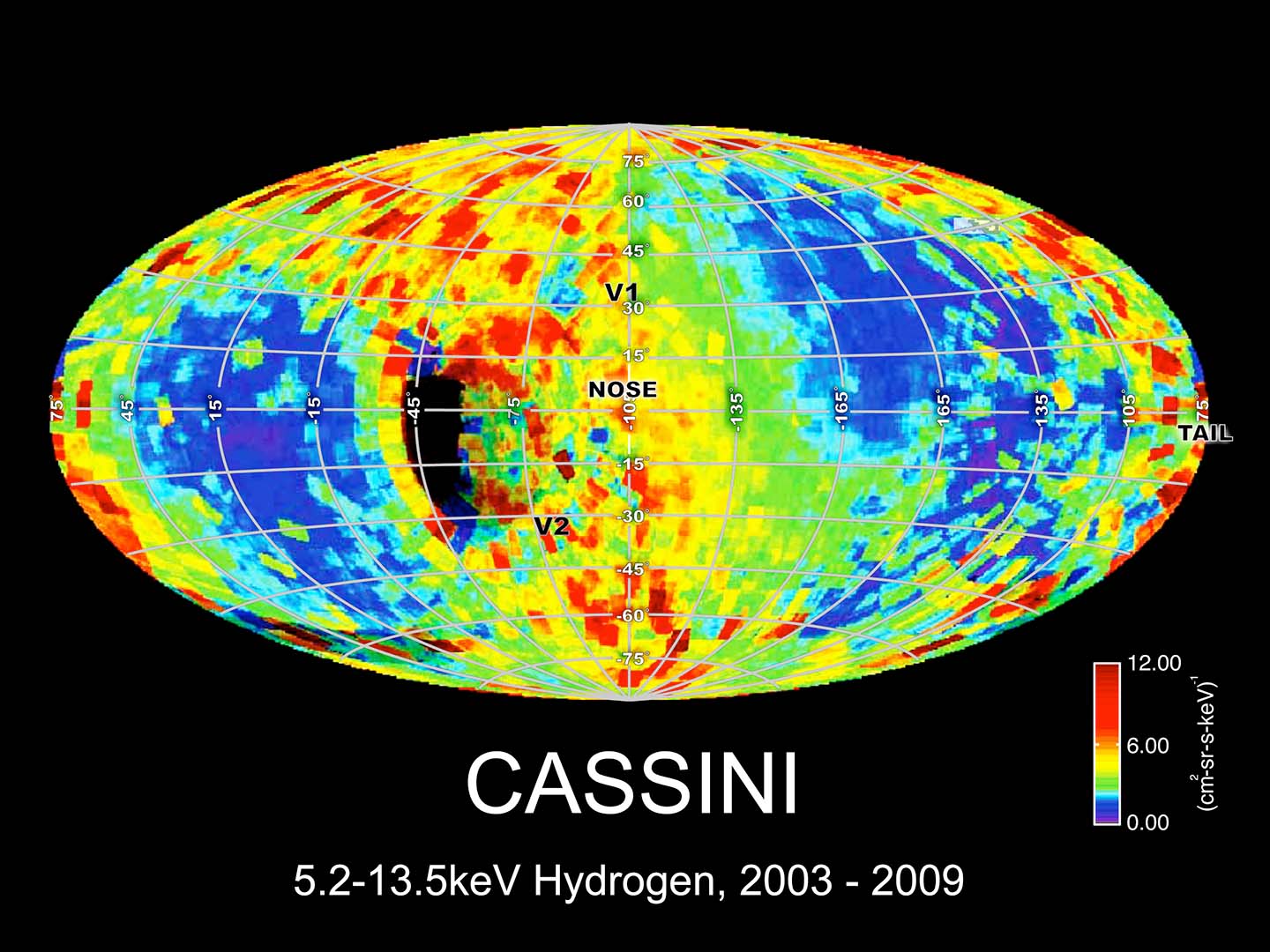
Full sky image of the energetic neutral atom emission from the sheath of hot particles formed in the region where the solar wind collides with the interstellar medium (the heliosheath). The image is shown in a similar coordinate system to that used to display the just-released data from the IBEX mission. The two instruments, one near Earth and the other orbiting Saturn, see very similar images, even though the data from the Cassini instrument is at somewhat higher energy than that from the IBEX instrument.
Credit: Johns Hopkins APL
Since entering into orbit around Saturn in July of 2004, INCA has been mapping energetic neutral atoms near the planet, as well as their dispersal across the entire sky. The energetic neutral atoms are produced by energetic protons, which are responsible for the outward pressure of the heliosphere beyond the interface where the solar wind collides with the interstellar medium, and which interact with the magnetic field of the interstellar medium.
“Energetic neutral atom imaging has demonstrated its power to reveal the distribution of energetic ions, first in Earth’s own magnetosphere, next in the giant magnetosphere of Saturn and now throughout vast structures in space — out to the very edge of our sun’s interaction with the interstellar medium,” says Edmond C. Roelof, MIMI/INCA co-investigator at APL.
Researchers from University of Arizona, Tucson, Southwest Research Institute, and University of Texas at San Antonio contributed to the article. The Cassini-Huygens mission is a cooperative project of NASA, the European Space Agency and the Italian Space Agency. JPL, a division of the California Institute of Technology in Pasadena, manages the Cassini-Huygens mission for NASA’s Science Mission Directorate, Washington. The Cassini orbiter was designed, developed and assembled at JPL. The Magnetospheric Imaging Instrument was developed by APL.
More information on the Cassini mission is available at http://www.nasa.gov/cassini, http://saturn.jpl.nasa.gov and on the Magnetospheric Imaging Instrument Web site at http://sd-www.jhuapl.edu/CASSINI.