News
Johns Hopkins APL Technology Targets Earlier Stress-Fracture Detection
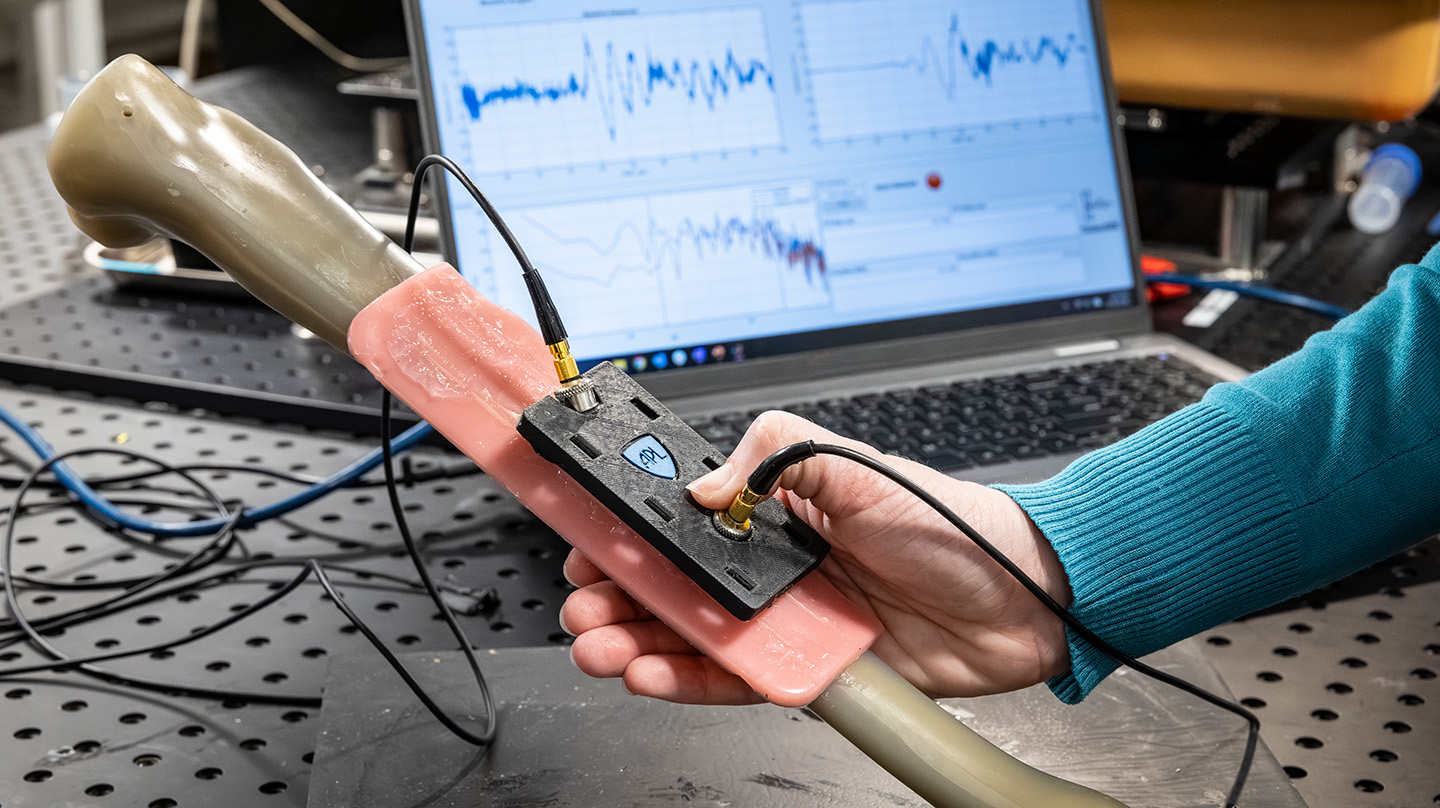
APL researchers test OsteoSEE, an ultrasound-based platform that uses surface acoustic waves traveling along the outer layer of bone to identify signs of microstructural damage and developing stress fractures.
Credit: Johns Hopkins APL/Ed Whitman
Tibial stress fractures are among the most common overuse injuries affecting military personnel, but they can be difficult to identify in their earliest stages. Small stresses in the bone may develop before an injury becomes apparent through conventional diagnostic tools, creating a window of opportunity for earlier detection to enable intervention.
Researchers at the Johns Hopkins Applied Physics Laboratory (APL) in Laurel, Maryland, are developing Osteo Surface Echo Evaluation (OsteoSEE), a noninvasive, ultrasound-based platform that uses surface acoustic waves to identify microstructural changes and early-stage fractures in cortical bone — the dense outer layer of bone — avoiding the use of ionizing radiation. The technology was named a 2026 R&D 100 Award winner, recognizing its innovative approach to early fracture detection.
“One of the most compelling applications is supporting military readiness,” said Anna Knight, OsteoSEE principal investigator and a senior biomechanical engineer at APL. “Fully developed stress fractures can be disabling to individual warfighters, and the prevalence of this overuse injury limits mission readiness across the force.”
Riding the Wave
Conventional X-ray imaging can lack sensitivity to early-stage or hairline stress fractures, while advanced imaging such as MRI is more costly and requires access to specialized facilities. To address these limiting factors, OsteoSEE uses commercial off-the-shelf (COTS) ultrasound transducers to direct sound waves toward the bone at precise angles and frequencies. Rather than sending most of that energy through the middle layer of the bone, the system generates surface acoustic waves that travel along its outer layer.
Because these waves move slower and do not attenuate as fast along the bone surface, they are sensitive to very small changes. OsteoSEE measures how the waves change as they pass across the area being examined, looking for patterns that may indicate accumulating damage or a developing fracture.
“Using commercially available components and real-time analysis will make fracture assessment more practical in training or operational settings, where timely information can make a difference,” said Austin Veith, a biomedical engineer at APL and another member of the research team.
In testing, OsteoSEE has detected fractures smaller than 0.5 millimeters — thinner than a standard credit card — and below the stated resolution of conventional planar X-ray imaging. The team has also verified that those signals correspond to actual structural changes in the bone. The injury model used to develop and test OsteoSEE was verified against micro-CT imaging, providing an independent way to confirm the beginnings of fracture damage.
“OsteoSEE reflects the value of leveraging deep technical expertise from across APL to develop innovative solutions that enhance military performance. In this case, we’re combining our expertise in military injury biomechanics, advanced acoustics, and complex signals processing competencies to formulate a novel way to assess bone health,” said Joan Hoffmann, mission area executive for Research and Exploratory Development at APL. “By investing in early exploratory research to verify the feasibility of our approach, and supporting the work through multiple stages of development, we’ve been able to establish a promising research concept and continue advancing it toward a capability with meaningful potential for the warfighter.”
From Detection Toward Prevention and Healing
The team is also exploring what could come after detection. OsteoSEE has been designed for potential compatibility with low-intensity pulsed ultrasound (LIPUS), which has been studied for supporting bone healing. Future research could examine whether sensing and therapeutic ultrasound capabilities could be combined.
The technology could also have applications beyond military medicine, including sports medicine and pediatric care, where a nonionizing approach could provide a safer alternative in assessing certain bone injuries.