News
Mars-Bound Johns Hopkins APL Instrument to Provide New Look at Martian Moons
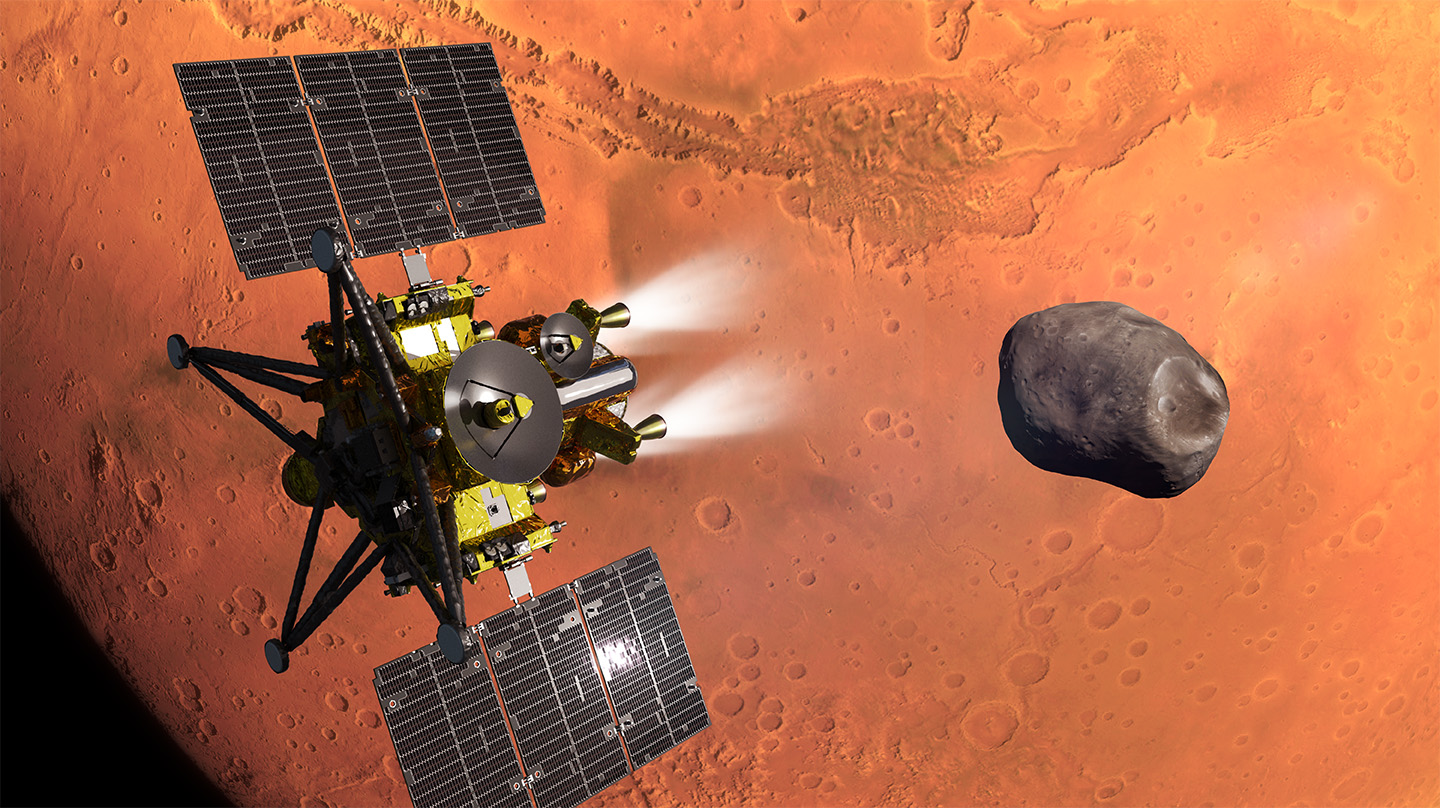
An artist’s impression of the Martian Moons Exploration spacecraft, carrying the Johns Hopkins APL-developed Mars-moon Exploration with GAmma rays and NEutrons (MEGANE) spectrometer.
Credit: JAXA
A sophisticated scientific instrument developed by the Johns Hopkins Applied Physics Laboratory (APL) in Laurel, Maryland, is on its way to Mars, where it will help scientists investigate the origins of the Red Planet’s small potato-shaped moons, Phobos and Deimos.
NASA’s Mars-moon Exploration with GAmma rays and NEutrons (MEGANE) spectrometer launched aboard the Japan Aerospace Exploration Agency’s (JAXA’s) Martian Moons eXploration (MMX) spacecraft from Tanegashima Space Center in Japan at 3:41 p.m. EDT on Oct. 19 (4:41 a.m. JST on Oct. 20).
MEGANE (pronounced meh-GAH-nay, it means “eyeglasses” in Japanese) is one of 13 instruments aboard MMX, an ambitious mission to observe Mars’ moons and collect samples from Phobos and return them to Earth. The APL-built MEGANE instrument will measure naturally occurring gamma rays and neutrons during the observation to reveal the elemental composition of Phobos, effectively allowing scientists to “see” beneath its surface.
Those measurements could help resolve an enduring debate about how the moon formed. One possibility is that Phobos is an asteroid captured by Mars’ gravity, while another is that it coalesced from debris blasted into space by a massive impact on the planet. Determining which scenario is more likely could provide important insights into the formation and evolution of Mars and the early solar system.
“Phobos has long guarded the secrets of its origins, and MEGANE will give us a powerful new way to uncover them,” said David Lawrence, MEGANE principal investigator at APL. “It’s exciting to be part of an international team bringing together so many different capabilities to explore this fascinating world.”
Developed through a partnership between APL and Lawrence Livermore National Laboratory, MEGANE draws on decades of experience designing, building, and testing instruments to investigate the composition of planetary bodies. The instrument consists of a gamma-ray spectrometer, a neutron spectrometer, and an electronics box that processes instrument data and commands.
“From Mercury to the Moon, to asteroids and now Phobos, APL’s depth of planetary instrument experience and expertise is advancing the next generation of gamma-ray and neutron spectroscopy,” said Donya Douglas-Bradshaw, APL’s mission area executive for Civil Space Flight. “APL is proud to support NASA’s role in an international mission that will help answer one of planetary science’s longest-standing questions.”
MEGANE is among several NASA contributions to MMX, which also includes the Pneumatic Sampler (or P-Sampler) technology demonstration to collect regolith samples from Phobos, and communications and navigation support from NASA’s Deep Space Network. NASA has also selected a team of scientists, including APL’s Olivier Barnouin and Terik Daly, to collaborate with international researchers to analyze mission observations and returned samples, seeking new clues to the history of Phobos and the broader Martian system.
The MMX spacecraft is scheduled to arrive at Mars in 2027 and begin surveying both moons. Following a detailed investigation of Phobos, the spacecraft will collect samples from its surface no earlier than 2028, with their return to Earth planned for 2031.
Related Instrument
