Press Release
Johns Hopkins APL’s Yee and Murchie Honored for Lasting Impact in Space Science
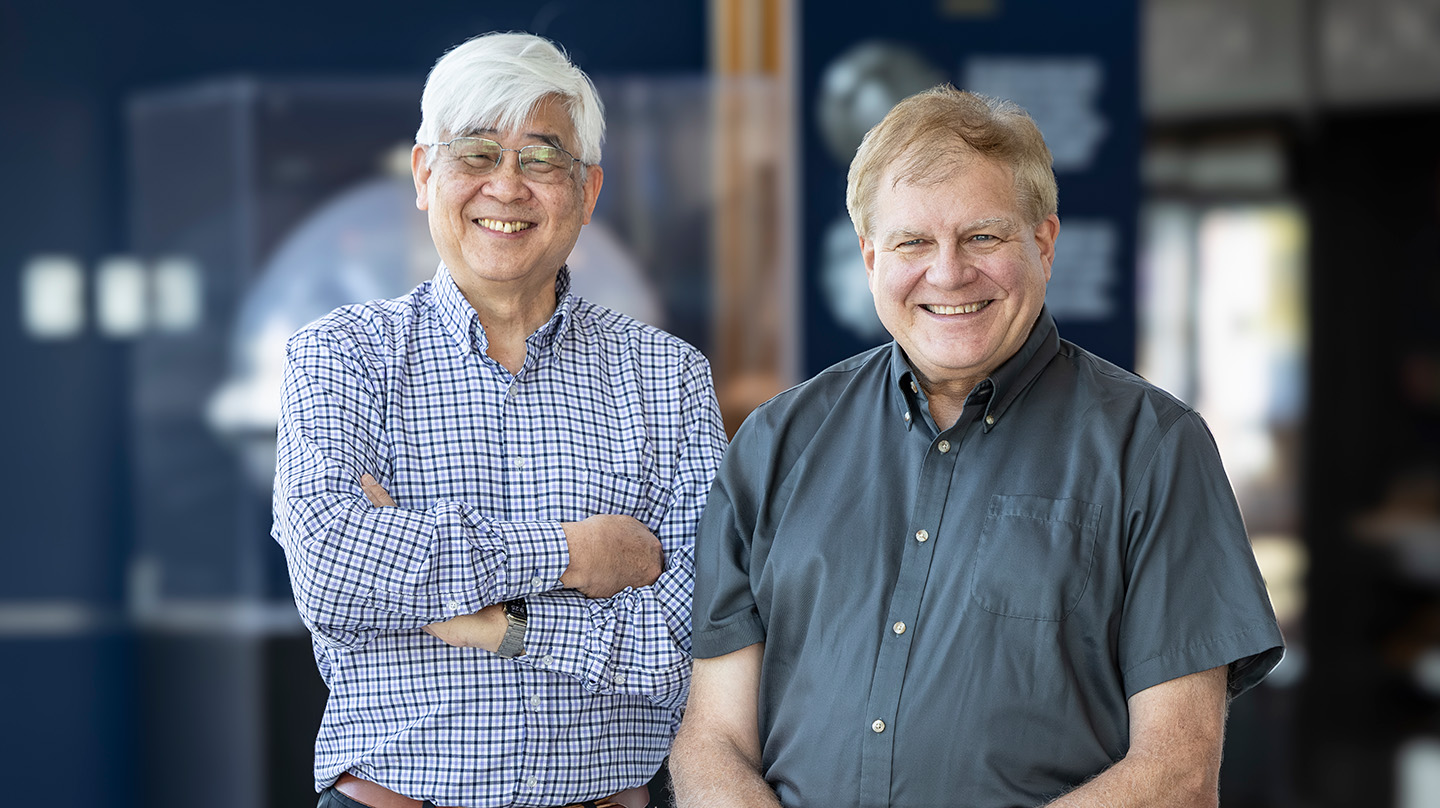
Sam Yee (left) and Scott Murchie received APL’s Lifetime Publication Achievement Award, recognizing decades of contributions to space science and hundreds of impactful publications.
Credit: Johns Hopkins APL/Ed Whitman
Audio generated using AI voice technology.
Sam Yee and Scott Murchie have both built distinguished careers in space science, but their paths into the field reflect its breadth. For Yee, the awe of the 1969 Apollo moon landing launched a lifelong pursuit to understand space and Earth’s upper atmosphere. Murchie’s journey was also inspired by the Apollo program, combined with a childhood fascination with rocks that grew into a passion for geology and ultimately planetary science.
Over decades at the Johns Hopkins Applied Physics Laboratory (APL) in Laurel, Maryland, their paths have followed similar trajectories from early curiosity to leadership on major space missions. Their work has shaped understanding of Earth and the solar system — not only through the missions they supported but also through the publications that extended those discoveries to the broader scientific community.
In April, both scientists received APL’s Lifetime Publication Achievement Award, which recognizes careers defined by extensive, high-impact technical contributions and publications. Together, Yee and Murchie have authored more than 450 scientific papers capturing decades of research and discovery. They join nine other APL researchers who have received this distinction, marking only the second time the award has been presented to two recipients in the same year.
“I’m truly honored to receive this recognition,” Yee said. “Publishing has been an important part of sharing what we’ve learned and contributing to the broader scientific community.”
Murchie echoed his gratitude for this recognition.
“I’m incredibly grateful for this award,” Murchie said. “Publications are how our work reaches the community, so this honor reflects many years of collaboration and team efforts.”
Like many careers in space science, both Yee’s and Murchie’s were shaped by pivotal moments. Yee’s path included development work on the TIMED mission, which has provided more than two decades of insight into the dynamics of the upper atmosphere. Murchie’s trajectory included a transition from geology to planetary science and early work on the NEAR and Mars Pathfinder missions, setting the stage for roles on missions to asteroids, comets, Mercury, and Mars.
Publishing has been central to both of their careers, although in different ways. Yee’s work has evolved from theoretical modeling to measurement techniques and mission development, with publications that trace that intellectual journey. His influential papers in the journals Geophysical Research Letters and Upper Atmosphere Dynamics and Energetics outlining a novel use of the Zeeman effect to measure atmospheric current led to the development of the Electrojet Zeeman Imaging Explorer (EZIE) mission — demonstrating how ideas captured in scientific literature can become new capabilities in space.
“Even if I was wrong, if I publish a paper, that’s part of the learning for me and for the entire community,” Yee said. “The next generation won’t make the same mistakes I made.”
Murchie’s career has been defined by mission-driven science and broad collaboration, with a body of work including numerous planetary missions and hundreds of publications. His work on the CRISM instrument aboard the Mars Reconnaissance Orbiter enabled major discoveries about the history of water on Mars and helped guide landing site selection for rover missions. A key publication summarizing CRISM’s early results influenced the inclusion of Mars sample return in the Planetary Science Decadal Survey.
“The paper ended up playing a role in making collecting and returning samples to Earth a priority,” Murchie said. “Without publishing, our work just doesn’t get out there. So publishing is part of the job description for a scientist.”
Together, Yee’s and Murchie’s careers illustrate the role of publishing in science, as both a record of discovery and a mechanism for advancing the field. Their work has expanded scientific understanding while helping shape mission priorities, attract sponsors, and reinforce APL’s leadership in space exploration.