News
Johns Hopkins Team Models Quantum Noise on Superconducting Processors
Researchers from APL and Johns Hopkins University have developed a practical, comprehensive noise-modeling framework for a popular class of superconducting quantum processors. Developing accurate noise models is key to creating the robust quantum algorithms and resilient error-correction protocols required to build truly fault-tolerant quantum computers.
Credit: Adobe Stock
Audio generated using AI voice technology.
Researchers from the Johns Hopkins Applied Physics Laboratory (APL) in Laurel, Maryland, and Johns Hopkins University in Baltimore have developed a practical, comprehensive noise-modeling framework for a popular class of superconducting quantum processors. Their work, published in the journal PRX Quantum, offers a sevenfold improvement in predictive accuracy over existing approaches.
Quantum bits, or qubits, are intrinsically prone to noise — interference arising from environmental factors such as electrical and magnetic fields or temperature fluctuations — as a result of the extreme sensitivity that makes them so valuable for computing. Developing accurate noise models is key to creating the robust quantum algorithms and resilient error-correction protocols required to build truly fault-tolerant quantum computers.
“To really advance the field, we need models that can predict a wide range of behavior while utilizing a small number of parameters, rather than theoretical models that try to account for all of the fundamental physics at play in quantum interactions,” said project lead Gregory Quiroz, a senior physicist at APL and an associate research professor in the Department of Physics and Astronomy at the Johns Hopkins University Krieger School of Arts and Sciences. “The novelty of our approach lies in a unified and experimentally validated framework that connects multiple noise mechanisms and yields a coherent predictive methodology.”
Characterizing Noise in Cloud-Based Quantum Processors
To study quantum noise in real, multi-qubit systems, the team made use of cloud access to 39 qubits across seven superconducting devices. Specifically, they studied transmons, a type of superconducting qubit prized for its reduced sensitivity to noise from electric charge and therefore popular in mainstream quantum computing architectures. Relying on cloud access presented an opportunity but also a challenge, because the team had to work out how to study and characterize noise on the quantum computers without low-level access to the hardware. That lack of access also reflects increasingly common real-world scenarios involving proprietary systems, Quiroz noted.
“Actual quantum computer users won’t have low-level hardware access either — they’ll just be running applications, and they’ll need to be confident that they’re running correctly,” he said. “Our experiments reflect those conditions.”
Yasuo Oda, the paper’s first author and a postdoctoral researcher who was Quiroz’s student at JHU while contributing to the study, said that working around that limitation required a creative approach.
“Fundamentally, we’re trying to drive a transition in a system of qubits from one state to another — in other words, to perform a quantum computation — and study how noise affects the success of that operation,” Oda said. “That sounds simple, but the specific way you actually drive that transition varies widely from platform to platform. Without low-level access, we had limited insight into the characteristics of the hardware.”
Instead of studying a single operation in detail, the team ran repeated computations on the quantum processors in order to drive an accumulation of errors. By studying how often those accumulated errors occurred and how widely they deviated from the expected result, they were able to glean insights into what was happening in the underlying physical system.
A Simple Yet Comprehensive Model
Significantly, the team’s approach enabled them to characterize two fundamentally different types of errors — often referred to as “incoherent” and “coherent” errors — in a single model. Incoherent errors occur when information is irretrievably lost; coherent errors can, for example, represent flaws in control hardware calibration, and are fixable.
“If you have access to data about coherent errors, you have the option of engineering a system to prevent them or fixing them afterward,” Oda said.
While there is extensive literature about both types of errors, they are typically studied in isolation. To the team’s knowledge, no one has created a single predictive framework that brings both types of errors together for superconducting qubit hardware.
“We were able to put a wide variety of errors together into one model, which is simple in terms of parameters but also comprehensive in the types of phenomena it can describe — even predicting the performance of small quantum algorithms,” he said. “That’s our biggest contribution.”
From Characterization to Correction
Now that the team has created this model, the next step will be to apply it to improving hardware performance, Quiroz said.
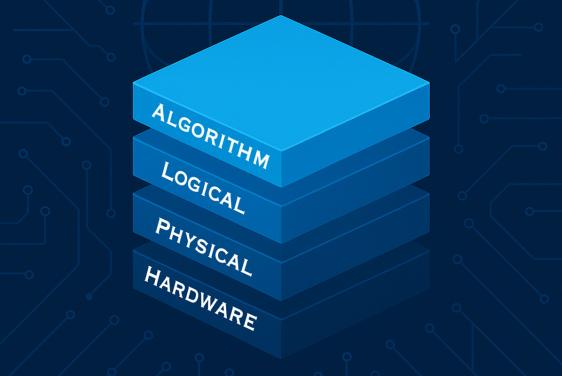
“Now that we have this low-weight noise model, we have the opportunity to apply it across all levels of the quantum computing stack, from hardware design to algorithm design to error correction,” he said. “The information we can get from the model can inform every level of the quantum computing stack.”
This work is a part of SMART Stack, an APL-led project focused on designing quantum software stack components and principles that make error characterization and management more scalable, modular, adaptive across platforms, reconfigurable, and targeted (hence, SMART) in current and near-future quantum processors. APL’s partners in this endeavor include researchers at the University of Chicago, University of Michigan, Unitary Foundation, Lawrence Livermore National Laboratory, and Infleqtion. Funded by a competitive quantum computing award from the Department of Energy, the effort builds on previous successes in quantum error management and is part of APL’s larger quantum computer science portfolio.
“APL is committed to characterizing and mitigating quantum noise and errors at every level of the quantum computing stack, including hardware, software, and hybrid computing systems combining quantum and classical computers,” said Kevin Schultz, assistant program manager for Alternative Computing Paradigms in APL’s Research and Exploratory Development Mission Area and a co-author on the paper. “This noise model represents a significant step toward achieving those goals.”
Related Work