News
NASA’s Parker Solar Probe Makes a Model Debut at National Air and Space Museum
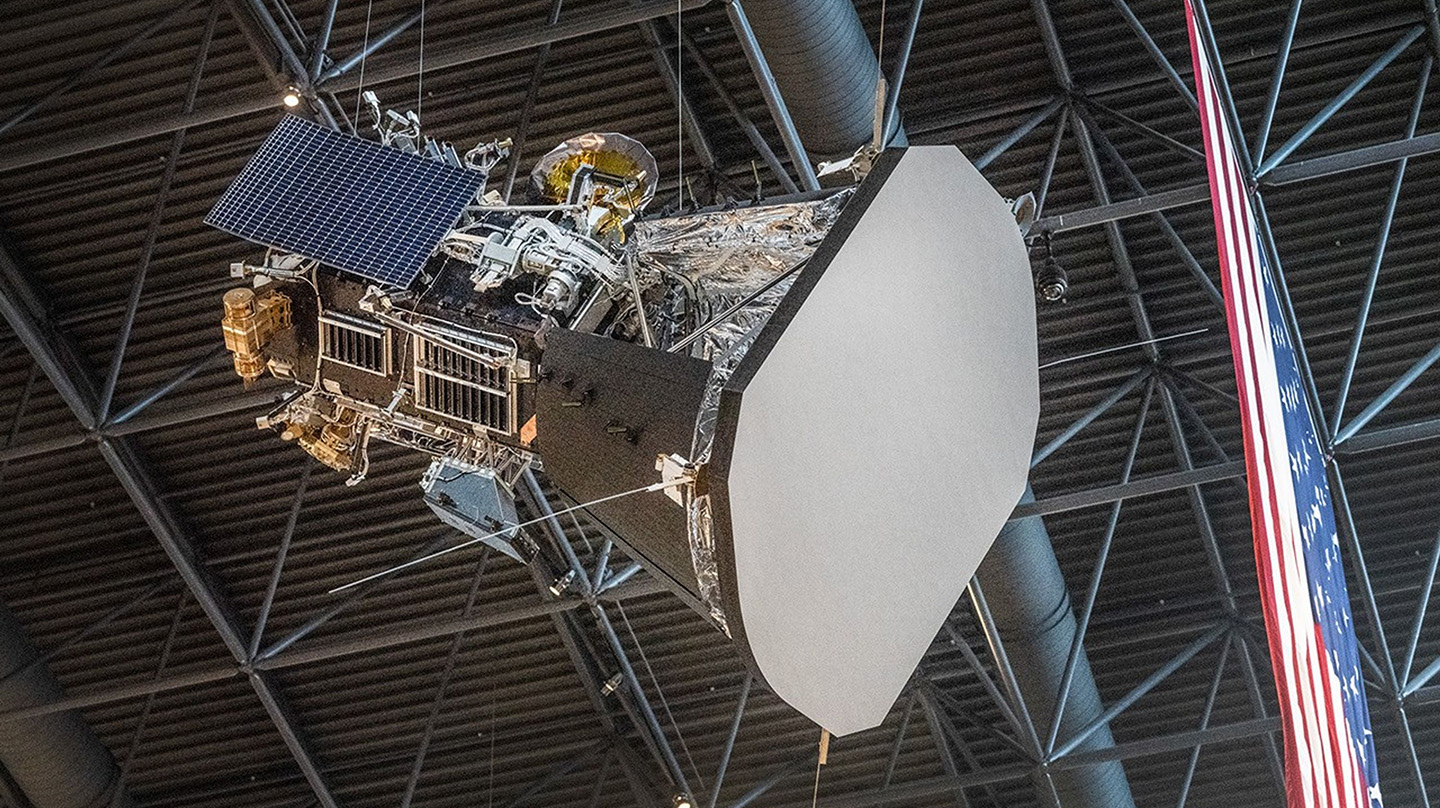
A full-scale model of Parker Solar Probe, the history-making Johns Hopkins APL-built spacecraft that has flown closer to the Sun than any human-made object, is now on display at the Smithsonian National Air and Space Museum’s Steven F. Udvar-Hazy Center.
Credit: Smithsonian’s National Air and Space Museum/Mark Avino
Audio generated using AI voice technology.
A replica of the spacecraft at the center of the groundbreaking, award-winning NASA mission that “touched the Sun” is now on public display.
A full-scale model of Parker Solar Probe — the history-making spacecraft designed, built, operated, and managed at the Johns Hopkins Applied Physics Laboratory (APL) that has traveled closer to the Sun than anything else humans have ever made — is on display at the Smithsonian National Air and Space Museum’s Steven F. Udvar-Hazy Center in Chantilly, Virginia.
The exhibit gives visitors a real-life view of the spacecraft’s unique design and innovative technology, while also showcasing APL’s ingenuity and expertise and inspiring the next generation of space exploration.
APL constructed the full-scale model, which stands at 21.5 feet long, 8.5 feet wide, and 10 feet high — the same size as the real spacecraft orbiting the Sun. The replica includes many flight-model and engineering-model spare parts — some of which were tested and could have been flown on the actual spacecraft, said APL’s Bryan Rupert, deputy mission systems engineer for Parker Solar Probe who led the model’s development.
The National Air and Space Museum display makes use of Parker’s flight-spare heat shield that was made during spacecraft development. Known formally as the Thermal Protection System, Parker’s novel heat shield protects the probe from temperatures nearing 2,000 degrees Fahrenheit (1,093 degrees Celsius) and radiation equivalent to about 500 times the Sun’s radiation on Earth.
Other spare parts used in the replica include the truss, or the scaffolding that connects the spacecraft body to the heat shield; the Wide-Field Imager for Solar Probe (WISPR), the camera that views and records solar activity; and the magnetometer boom, the deployable 11.5-foot arm that enables Parker to collect ambient magnetic field data without interference from the spacecraft.
“Flight spares are exact copies of what’s on the spacecraft,” Rupert said. “If an actual part had failed during our testing of the real flight system, these spares would have been swapped in and be in space right now.”
The model also includes a 3D-printed replica of the solar array cooling system, which circulates water through Parker’s two solar panels and then radiates the heat — one of the novel designs that allows the spacecraft to survive and operate despite the exceptionally high temperatures. The innovative technologies have allowed the spacecraft to thrive in every extreme scenario it has faced, even sailing directly through a historic coronal mass ejection (CME) — an event during which the Sun expels large amounts of plasma and magnetic energy — in 2022.
Helene Winters, the Parker Solar Probe project manager at APL, said the opportunity to see the model in person will spark the imaginations of museum visitors, especially tomorrow’s engineers and scientists.
“I hope that seeing the state-of-the-art technology that has enabled Parker Solar Probe to fly closer to a star than any other human-made object before it — and deliver data that is changing what we know about our Sun — not only excites people about space exploration, but inspires the next generations to see where their curiosity and creativity can lead them,” she said.
Launched in 2018, Parker Solar Probe holds the record for traveling closest to the Sun, just 3.8 million miles from the solar surface, while traveling at 430,000 miles per hour, making it the fastest human-made object in history. Parker’s findings, made during its 26 solar encounters to date, have revolutionized our understanding of the Sun’s solar wind and corona — its outermost layer — helping scientists better understand and predict the star’s behavior, which will inform ways to protect people and technology against potentially dangerous space weather.
The mission’s pioneering discoveries and robust spacecraft performance led to the Parker team winning the National Aeronautic Association’s prestigious 2024 Robert J. Collier Trophy, an annual award for the greatest achievement in aeronautics or astronautics in America.
Related Mission