Press Release
MDA, Johns Hopkins APL Demonstrate Low-Cost Approach to Missile Defense Testing
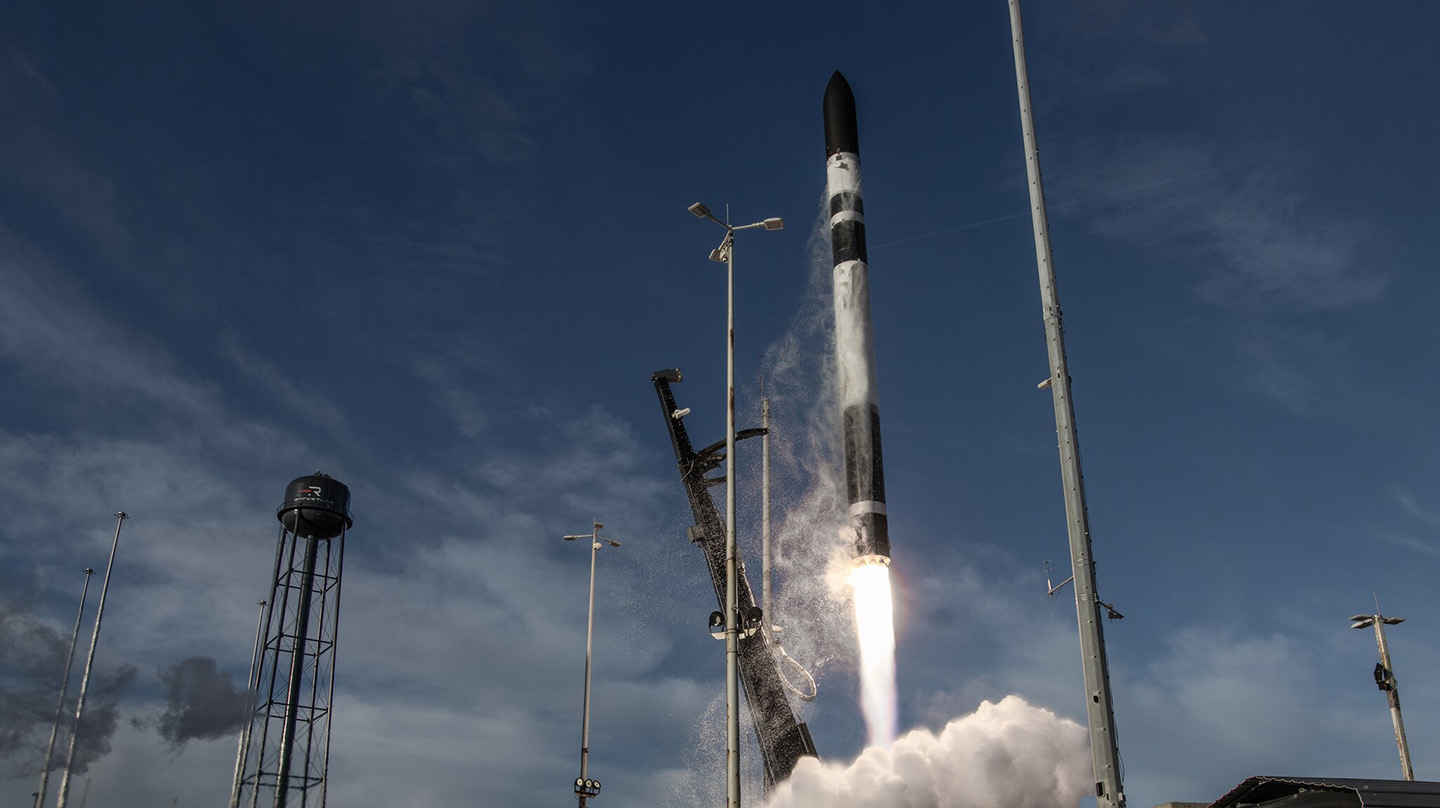
A Rocket Lab Electron vehicle lifts off from Wallops Island, Virginia, on Nov. 18, 2025, carrying a government payload developed and integrated by Johns Hopkins APL for a first-of-its-kind Missile Defense Agency demonstration.
Credit: Rocket Lab
Audio generated using AI voice technology.
The Missile Defense Agency (MDA) and the Johns Hopkins Applied Physics Laboratory (APL) in Laurel, Maryland, successfully demonstrated a new, lower-cost approach to national missile defense testing and evaluation with the Nov. 18 launch of a payload aboard Rocket Lab’s Electron vehicle in the HASTE configuration.
The suborbital mission, developed under an MDA-funded effort known as Project Budget Launch of Affordable Suborbital Targets, or BLAST, marks the first time a payload of this type has flown on a commercially operated launch vehicle.
The launch took place at 8 a.m. EST from NASA’s Wallops Flight Facility on Virginia’s Eastern Shore. Electron carried an APL-designed and -integrated payload, along with secondary experiments from Aurex (formerly Concordia Technologies). The vehicle achieved its planned trajectory and met all objectives involving payload deployment, telemetry, and flight performance, validating that commercially available launch systems can be adapted for government test missions traditionally requiring custom-built boosters.
The development cycle for missile defense test vehicles traditionally stretches several years. The BLAST team compressed end-to-end development to 18 months — and delivered the full mission including launch vehicle, payload development, integration, and launch operations.
The savings and speed align with MDA’s push to increase testing cadence and deliver relevant payloads more rapidly.
“Commercial launch companies are opening up our access to space, and this demonstration shows how missile defense can capitalize on that momentum,” said Vishal Giare, head of APL’s Air and Missile Defense Sector. “By partnering with MDA and Rocket Lab, APL proved that a government–industry team can execute flight testing at a fraction of the traditional time and cost. This is a model for how we can accelerate innovation, strengthen deterrence, and deliver more capability to the nation.”
APL played a central technical role in the effort, designing and building the full payload section housed inside Electron’s new extended-length fairing, establishing mechanical and electrical interfaces with the Electron, integrating subcontractor-supplied avionics, and managing government–commercial interaction. APL engineers also conducted space-environment testing and verified system performance prior to shipment to Wallops.
Once on site, a small APL team worked alongside Rocket Lab and NASA range personnel to integrate the payload with the launch vehicle and range, and rehearse the test execution prior to launch. APL assumed full technical authority for the government payload — an approach more typical of commercial space operations than missile defense launch campaigns.
“BLAST marked a different way of doing business,” said Joshua Wolk, program manager for APL’s Targets program. “Using an existing commercial propulsion system lets us ‘hitch a ride’ instead of building a car, and the results show how quickly we can move when we combine government rigor with commercial speed.”
The success opens the door to demonstrations that include more-advanced test vehicles as part of larger missile defense exercises, Wolk said, adding that APL is already preparing follow-on concepts informed by lessons from the BLAST campaign.
“This flight shows what’s possible when we rethink traditional approaches,” he said. “It’s a first step toward a faster, more affordable future for missile defense testing.”
Collaborate With Us
APL solves complex research, engineering, and analytical problems that present critical challenges to our nation. Contact us to learn more or discuss collaboration opportunities.