Press Release
NASA’s IMAP Reaches Orbit to Start Study of Heliosphere and Space Weather
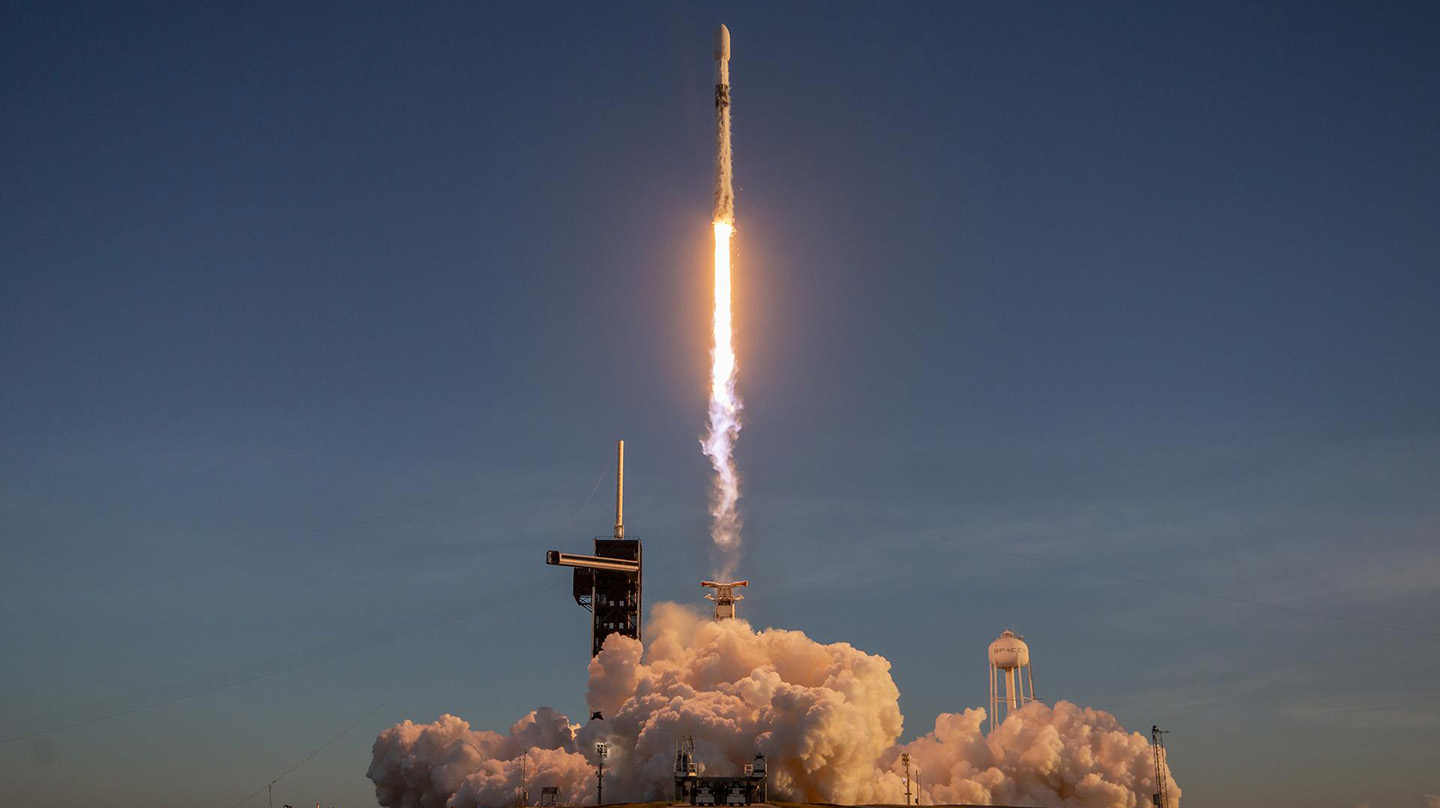
A SpaceX Falcon 9 rocket with NASA’s Interstellar Mapping and Acceleration Probe (IMAP) and two other spacecraft launches from NASA’s Kennedy Space Center in Florida.
Credit: SpaceX
Audio generated using AI voice technology.
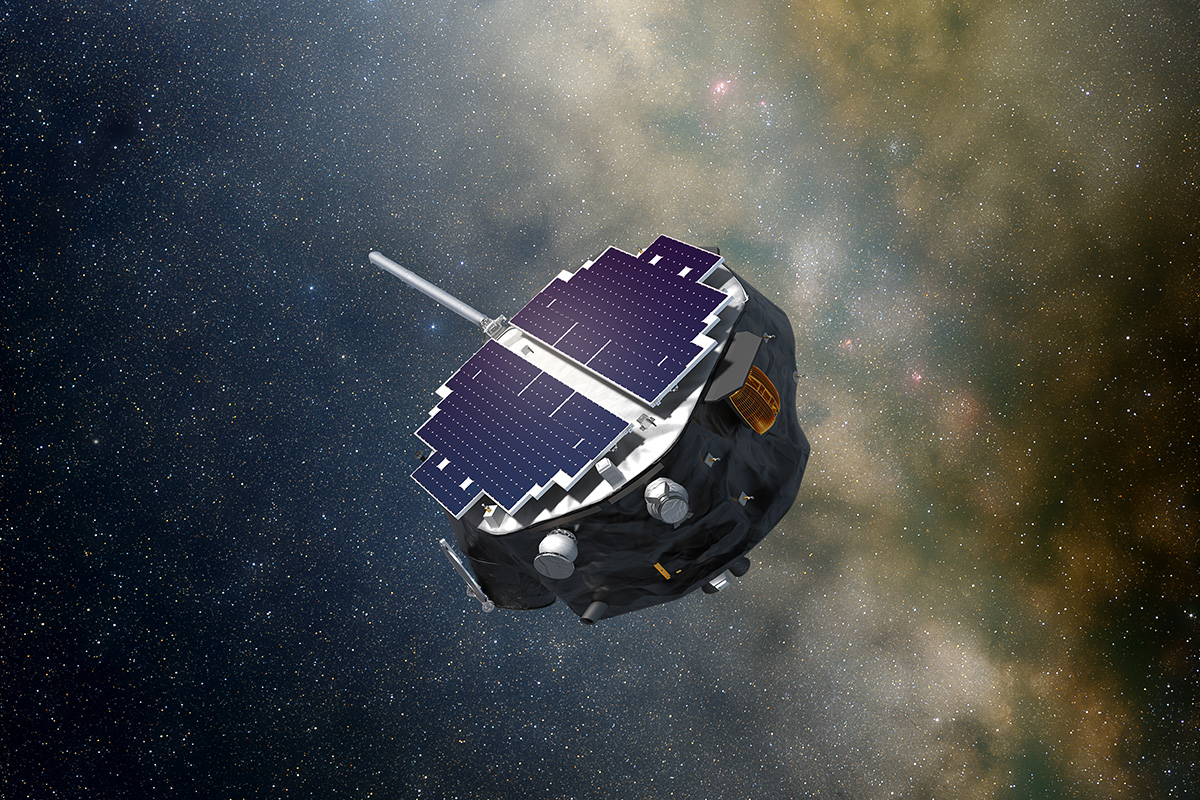
After a three-and-a-half-month journey, NASA’s Interstellar Mapping and Acceleration Probe (IMAP) has finally reached its destination, a strategic location between the Sun and Earth where it will begin its groundbreaking mission to study the edge of our solar system and advance our knowledge of space weather on Feb. 1.
Launched on Sept. 24 aboard a SpaceX Falcon 9 rocket from NASA’s Kennedy Space Center, IMAP studies our heliosphere, the Sun’s magnetic bubble that shields our solar system, and helps scientists develop a better understanding of space weather. Equipped with advanced sensors, IMAP’s payload samples particles streaming toward Earth from the edge of our solar system and beyond. The spacecraft also samples and analyzes particles from the Sun that could impact Earth. This data is analyzed and translated into a three-dimensional time-varying map of our heliosphere by the IMAP science team.
On Jan. 10, IMAP team members in the Mission Operations Center at the Johns Hopkins Applied Physics Laboratory (APL) in Laurel, Maryland, confirmed the spacecraft had successfully completed the last of the maneuvers to position itself in orbit around the first Sun-Earth Lagrange point (L1), which provides heliophysics missions like IMAP with an unobstructed view of solar activity. This was the end of a series of maneuvers that began on Jan. 9.
During the journey — a trip of roughly 1 million miles (1.6 million kilometers) from Earth toward the Sun — IMAP’s 10 science instruments collected their first measurements of the solar wind, interstellar dust, and energetic neutral atoms. These energetic neutral atoms form at the heliosphere’s edge and let scientists map the boundary region from afar.
“With IMAP now in position, we’re ready to begin the exciting work of mapping our heliosphere and learning more about how space weather impacts our planet,” said IMAP principal investigator and Princeton University professor David McComas, who leads the mission and its international team of 27 partner institutions.
Mission data also supports the IMAP Active Link for Real-Time (I-ALiRT) system, which will broadcast near-real-time and reliable information that enhances space weather predictions.
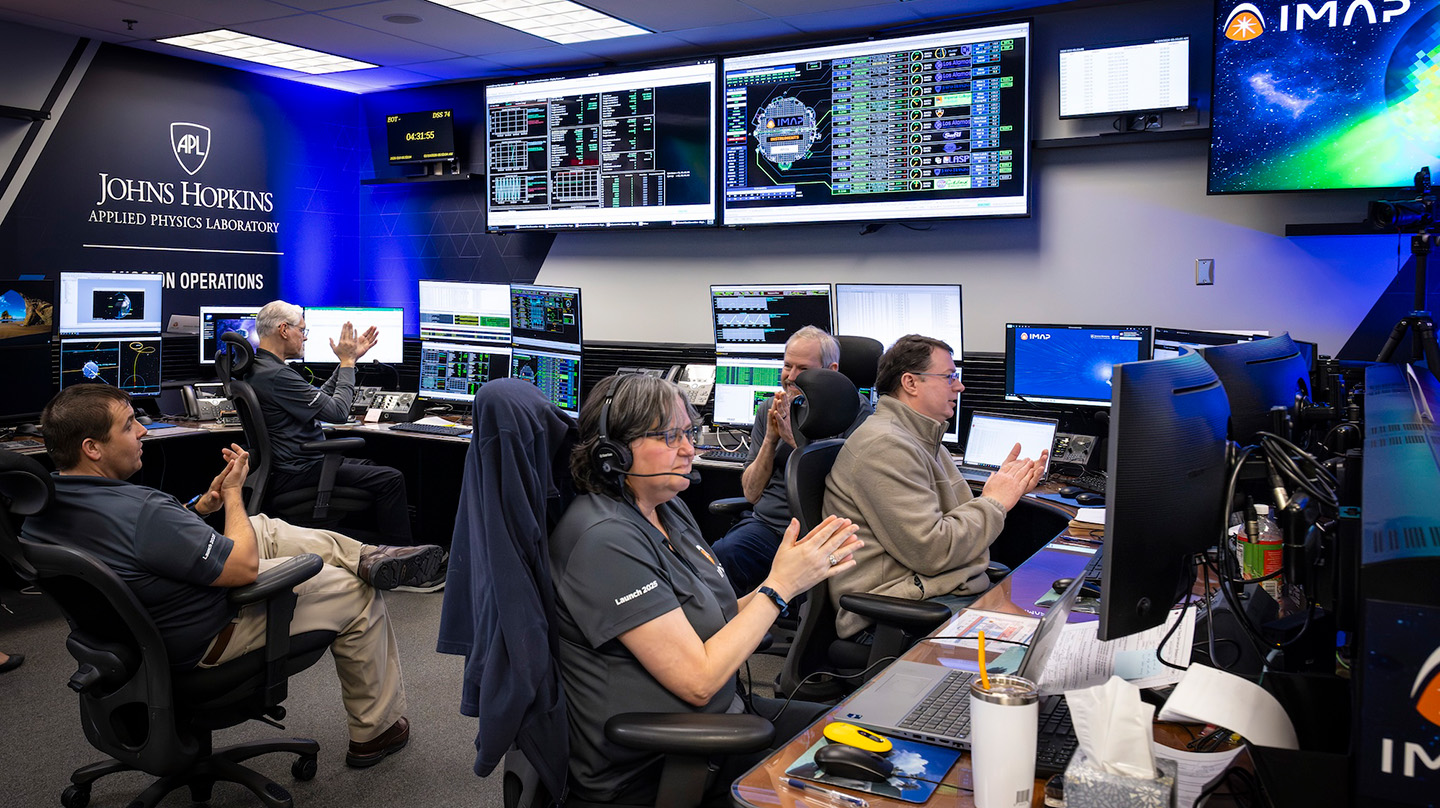
On Jan. 10, 2026, flight controllers and spacecraft team members celebrate in the Mission Operations Center at the Johns Hopkins Applied Physics Laboratory in Laurel, Maryland, as IMAP completes the last of the maneuvers to position itself in orbit around the first Sun-Earth Lagrange point (L1).
Credit: NASA/Johns Hopkins APL/Princeton/Ed Whitman
APL managed the mission design and development phases, built the spacecraft, and operates the IMAP Mission Operations Center. Collaborating with institutions across the mission team, APL integrated IMAP’s instruments, subsystems, and components, running them through a series of tests to ensure they would perform successfully in space. Princeton University will manage the mission during the operations phase.
“We at APL are proud that we could leverage our space science and engineering capabilities, in partnership with others, to help bring IMAP to life and get it to this critical milestone,” said Andy Driesman, mission area executive for Civil Space Flight at APL. “Now comes the payoff. We’re excited to see the scientific insights that IMAP delivers, and how they’ll help us advance our understanding of the solar system, space weather, and its impact on our world.”
IMAP is the fifth mission in NASA’s Solar Terrestrial Probes (STP) Program portfolio. The Explorers and Heliophysics Projects Division at NASA’s Goddard Space Flight Center in Greenbelt, Maryland, manages the STP Program for the Heliophysics Division of NASA’s Science Mission Directorate. NASA’s Launch Services Program, based at NASA Kennedy, managed the mission’s launch.
Related Mission