Press Release
Johns Hopkins APL-Led Team Releases Predictive Space Weather Model to Public

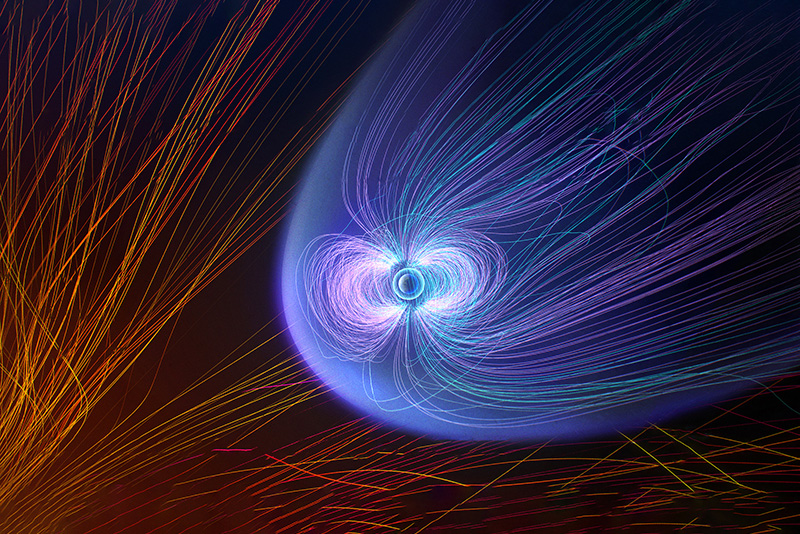
A scientific visualization of the MAGE simulation of the “SpaceX” storm performed by the CGS team. The SpaceX storm resulted in the loss of 38 Starlink satellites between February 3 and 7, 2022.
Credit: NASA Goddard Space Flight Center and Scientific Visualization Studio
Audio generated using AI voice technology.
A predictive space weather model designed to simulate how solar storms affect Earth has been publicly released for researchers in the broader scientific community — as well as the general public — to use for their own research.
The physics-based Multiscale Atmosphere-Geospace Environment (MAGE) model — one of the most comprehensive suites of space weather models — simulates solar activity to study how events generated by the Sun impact the planet and helps NASA achieve its strategic goals for exploring the Moon, Mars, and beyond.
The model, available now under a permissive open-source license, is being developed at the NASA-supported Center for Geospace Storms (CGS), which launched in 2020 and is headquartered at the Johns Hopkins Applied Physics Laboratory (APL) in Laurel, Maryland.
“The public release of MAGE represents a major milestone for CGS and the space science community,” said Slava Merkin, director of CGS at APL. “Our team is looking forward to working with heliophysics researchers on making scientific discoveries and helping to better predict space weather.”
Why Space Weather Matters
Space weather events impact everyday life, with the potential to damage power grids; hamper global positioning systems for pilots, farmers, and other users; and affect rail systems.
This activity stems from solar events such as flares and coronal mass ejections releasing charged particles and radiation into geospace, a roughly one-million-mile region around Earth that includes the magnetosphere, ionosphere, and upper atmosphere.
Monitoring and forecasting space weather storms is even more critical as plans to maintain a sustained presence on the Moon, Mars, and beyond accelerate. For example, NASA’s Artemis campaign will send humans to live and work on the Moon in preparation for missions to Mars and potentially other worlds.
Interactions in geospace produce stunning auroras but can also harm key assets both on and above Earth. Space weather can disrupt communications, increase radiation risk to astronauts and hardware, and elevate drag on low‐Earth-orbit satellites.
In August 1972, a massive solar storm destabilized satellites and communications. Apollo astronauts who would have been in orbit or on the Moon’s surface during the heightened solar activity would have sustained dangerous levels of radiation.
Summon the MAGE
The MAGE model developed by CGS will help space weather experts better predict how solar events impact Earth.
MAGE pulls together several smaller predictive models — such as the GAMERA magnetosphere model and TIEGCM for the upper atmosphere — that study complex physical processes in geospace and their effects on space weather across the near-Earth space environment to provide a comprehensive picture of how geospace reacts to solar disturbances.
Since May 2024, MAGE has been available to researchers, educators, and students worldwide for runs-on-request through NASA’s Community Coordinated Modeling Center. Last year, it was used to simulate the reaction of geospace to the May 10-11 geomagnetic storm.
“With this public release, anybody can download the source code, run it, and make modifications in the spirit of NASA’s Open Science initiative,” said Merkin.
Access to the MAGE model is available through GitHub. The CGS team has also developed an analysis and visualization package to allow scientists to process results of MAGE simulations. This package is also openly available via GitHub.
CGS is part of NASA’s Diversify, Realize, Integrate, Venture, Educate (DRIVE) Science Centers program, which aims to encourage collaborative science by establishing multi-institutional centers that can address major research challenges in space and solar physics.
“The NASA DRIVE Science Centers program is unique in its ability to support transformative large-scale efforts like MAGE development and the scientific discovery that it enables,” Merkin said. “We are very grateful for the support that we have received and strive every day to deliver on our promises.”
APL leads CGS, partnering with multiple institutions including the U.S. National Science Foundation National Center for Atmospheric Research, the University of New Hampshire, Rice University, Virginia Tech, University of California, Los Angeles, and Syntek Technologies.
Established Expertise
APL has established itself as a leading authority on space weather through multiple spacecraft missions, instruments, and exercises.
On Sept. 24, NASA launched the Interstellar Mapping and Acceleration Probe (IMAP), led by Princeton University in collaboration with APL, to study the heliosphere and provide space weather information.
Data from some of IMAP’s instruments will support the IMAP Active Link for Real-Time (I-ALiRT) system, which will broadcast frequent and reliable information that enhances space weather predictions and warnings.
In May 2024, APL hosted the nation’s first end-to-end Space Weather Tabletop Exercise (TTX), convening space weather experts with leaders in emergency management and response and recovery to engage in a hypothetical scenario simulating a series of solar events with wide-ranging effects on Earth and beyond. An After-Action Report highlighting key findings was published in March 2025.
Also in March, NASA launched the APL-led Electrojet Zeeman Imaging Explorer (EZIE) mission, which will study Earth’s auroral electrojets — electrical currents flowing near Earth’s poles — to better understand the impacts of space weather.
Parker Solar Probe, launched in 2018, is revolutionizing what we know about the Sun and events like CMEs by flying closer to the solar surface than any other spacecraft. On Dec. 24, 2024, Parker completed the first of multiple closest approaches to the Sun, flying at a record-breaking 3.8 million miles (6.1 million kilometers) from the surface.
Related Expertise
Space Weather and Heliophysics
APL is a leader in space weather science, observations, and modeling—particularly in understanding the drivers of solar activity, the role Earth’s magnetosphere plays in protecting us, and the response of the upper atmosphere to solar variability.