Press Release
NASA Selects Johns Hopkins APL-Developed CINEMA Mission to Study Space Weather
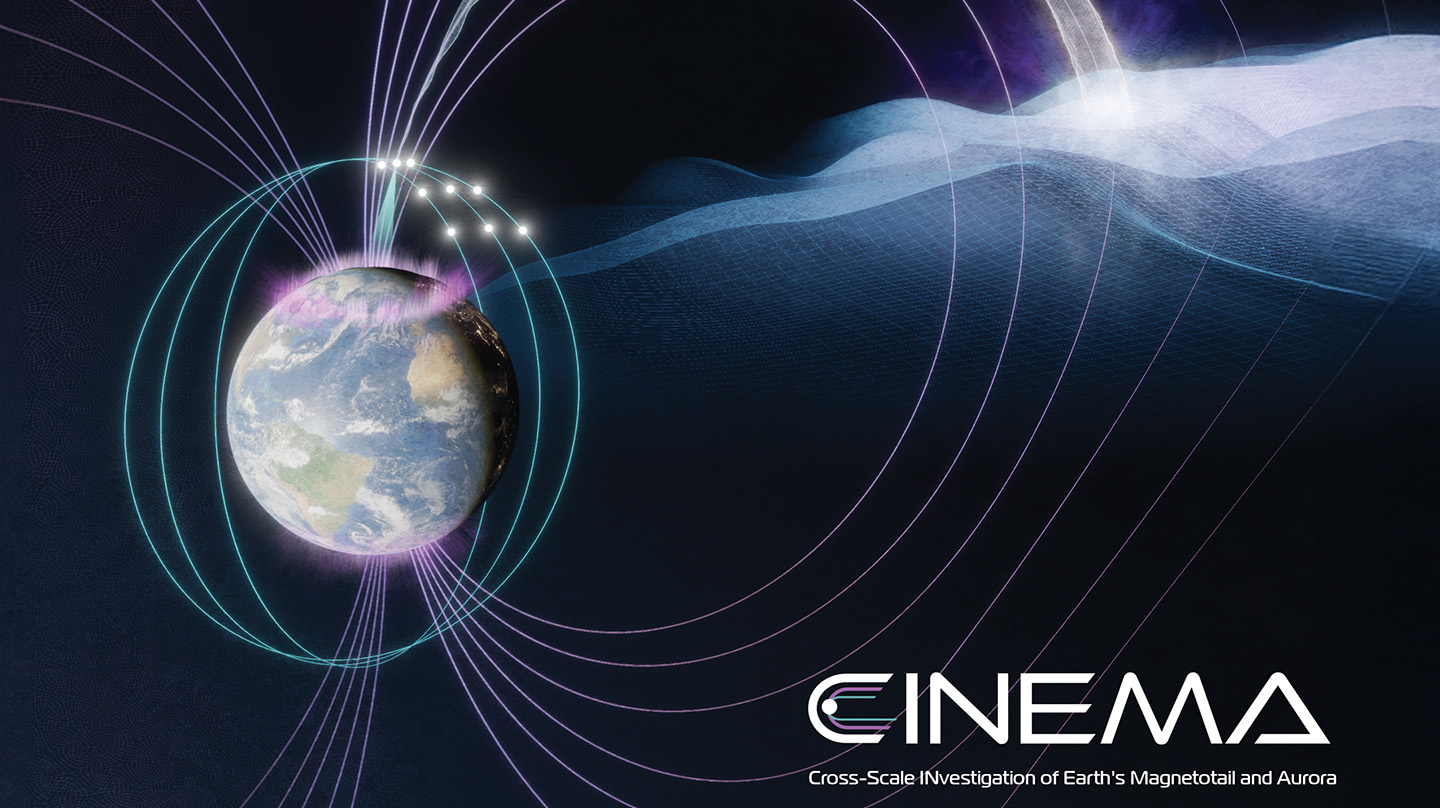
CINEMA, a mission to improve understanding of the growing impacts of space weather, has been competitively selected by NASA for development.
Credit: Johns Hopkins APL
Audio generated using AI voice technology.
NASA has selected Dartmouth College and the Johns Hopkins Applied Physics Laboratory (APL) in Laurel, Maryland, to begin developing a mission that will shed more light on the growing impacts of space weather.
The Cross-scale Investigation of Earth’s Magnetotail and Aurora (CINEMA) mission will unlock the secrets of the energy circulation through Earth’s magnetotail. The magnetotail is an extension of our planet’s magnetic field created by solar wind streamed from the Sun. As energy accumulates, the magnetotail releases the energy, sometimes explosively, powering intense geomagnetic storms and substorms.
That energy contributes to the phenomenon of space weather, the set of events fueled by solar activity that range from mesmerizing auroral displays at Earth’s poles to disruptive releases of energy that can affect satellite safety, air travel, and ground infrastructure.
Employing nine small satellites, each carrying three science instruments, CINEMA will provide the most comprehensive view yet of the magnetotail and aurora, and their role in how the magnetosphere functions. CINEMA will study what causes the magnetosphere to explosively release energy, and how particles from the Sun steadily move through the magnetic field.
“We’re thrilled that NASA has selected CINEMA as the next SMEX mission. This is an exciting moment for our team and our partners, whose creativity, dedication, and expertise shaped a mission designed to answer some of the most compelling questions in heliophysics,” said Robyn Millan, principal investigator for the mission and an experimental physicist at Dartmouth. “CINEMA’s innovative multi-spacecraft approach will give us a perspective on Earth’s magnetotail that we’ve never had before, opening the door to discoveries that will meaningfully advance our understanding of the Sun–Earth system.”
The mission will significantly improve what we know about the energetic connection between the Sun and Earth while providing deeper insight into how similar environments in space impact plans for human exploration.
“CINEMA provides a critical tool to aid our understanding of space weather,” said Bobby Braun, head of APL’s Space Exploration Sector. “We’re thrilled that NASA recognizes the scientific value CINEMA will deliver and we’re excited to start working with our partners to implement this mission.”
Dartmouth College in Hanover, New Hampshire, is the CINEMA principal investigator institution. APL will manage the mission, provide critical instrumentation, and integrate the payload. University of California, Berkeley, in partnership with Space Dynamics Laboratory, will provide auroral imaging instrumentation. Blue Canyon Technologies, based in Lafayette, Colorado, will provide the small spacecraft and operate the mission.
Related Expertise
Space Weather and Heliophysics
APL is a leader in space weather science, observations, and modeling—particularly in understanding the drivers of solar activity, the role Earth’s magnetosphere plays in protecting us, and the response of the upper atmosphere to solar variability.