Although the ice giants, Uranus and Neptune, remain the least-explored planets in the solar system—each visited just once by NASA’s Voyager 2 in the mid- to late 1980s—APL researchers and engineers have worked to highlight the scientific value of exploring these worlds to gain a better understanding not only of their origins and evolution but also of planetary magnetospheres, life beyond Earth, and planets outside our solar system.
APL researchers and engineers have led or significantly participated in the development of five conceptual missions to explore the ice giant systems, including the Uranus Orbiter and Probe mission on which the Decadal Survey’s mission recommendation was based.
In partnership with NASA’s Goddard Space Flight Center, APL is advancing the field by convening workshops that keep specialists informed of new developments in ice giant science. These workshops have produced instrument and spacecraft concepts that address cross-disciplinary scientific investigations.
APL is at the forefront of ice giant research, with scientists investigating many topics, from ice giant interiors and magnetospheres to moon surfaces and ring systems.
APL scientists are investigating Uranus’s highly unusual atmosphere and the processes that shape it. With an axial tilt of 98°, Uranus experiences extreme seasonal contrasts, with each pole spending four decades in sunlight during summer and then four decades in winter darkness. Its middle and upper atmosphere are significantly hotter than solar heating alone can explain, which is part of a mystery across the solar system’s giant planets known as the “energy crisis.” Uranus’s magnetic field is also unusual, offset from the planet’s center and highly tilted relative to its rotation axis.
Using observations from Voyager 2’s encounter, APL scientists are establishing a reference state for Uranus’s atmosphere that can inform future investigations and mission planning. This analysis is producing important new constraints on the energy balance, photochemistry, vertical mixing, and dynamics of Uranus’s atmosphere. APL scientists are also analyzing Voyager 2 Ultraviolet Spectrometer (UVS) occultations to determine how Uranus’s atmosphere evolves throughout its year, which is roughly 84 Earth years long.
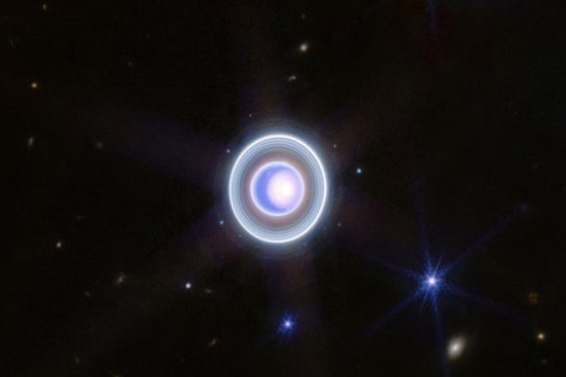
An image of Uranus taken by NASA’s James Webb Space Telescope’s NIRCam (Near-Infrared Camera) vividly shows the planet and its rings, as well as many of its moons. JWST images have now revealed a 29th moon orbiting the planet that is not visible here.
Credit: NASA/European Space Agency/Canadian Space Agency/Space Telescope Science Institute
APL scientists are using the James Webb Space Telescope (JWST) to investigate auroral and ionospheric physics at the ice giants, Uranus and Neptune. Using JWST’s Near-Infrared Spectrograph Integral Field Unit (NIRSpec IFU), they are mapping faint infrared emissions from H₃⁺, the trihydrogen cation, to remotely trace where charged particles, magnetic fields, and atmospheres interact in gas/ice giant systems.
Notable discoveries:
These observations have confirmed unique auroral forms (e.g., “spots”) at Uranus
First vertical profile of the Uranian ionosphere
First confirmed auroral activity on Neptune
APL investigations extend to ice giant moons and their potential as ocean worlds. Uranus’s four largest moons, Ariel, Umbriel, Titania, and Oberon, may have subsurface saline oceans, while their surfaces are rich in CO2 ice. That CO2 could originate from the moons’ interiors or form through irradiation chemistry at their surface. Both processes are predicted to form exospheres. Using JWST, APL scientists are studying Ariel’s exosphere to test these two CO2 origin scenarios and determine whether the moon is actively venting carbon oxides that are picked up and ionized by Uranus’s magnetosphere.
APL scientists are using Voyager 2 imagery and data to analyze and model the geologic processes shaping the ice giant systems. The moons of Uranus and Neptune preserve evidence of past—and potentially ongoing—cryovolcanic activity.
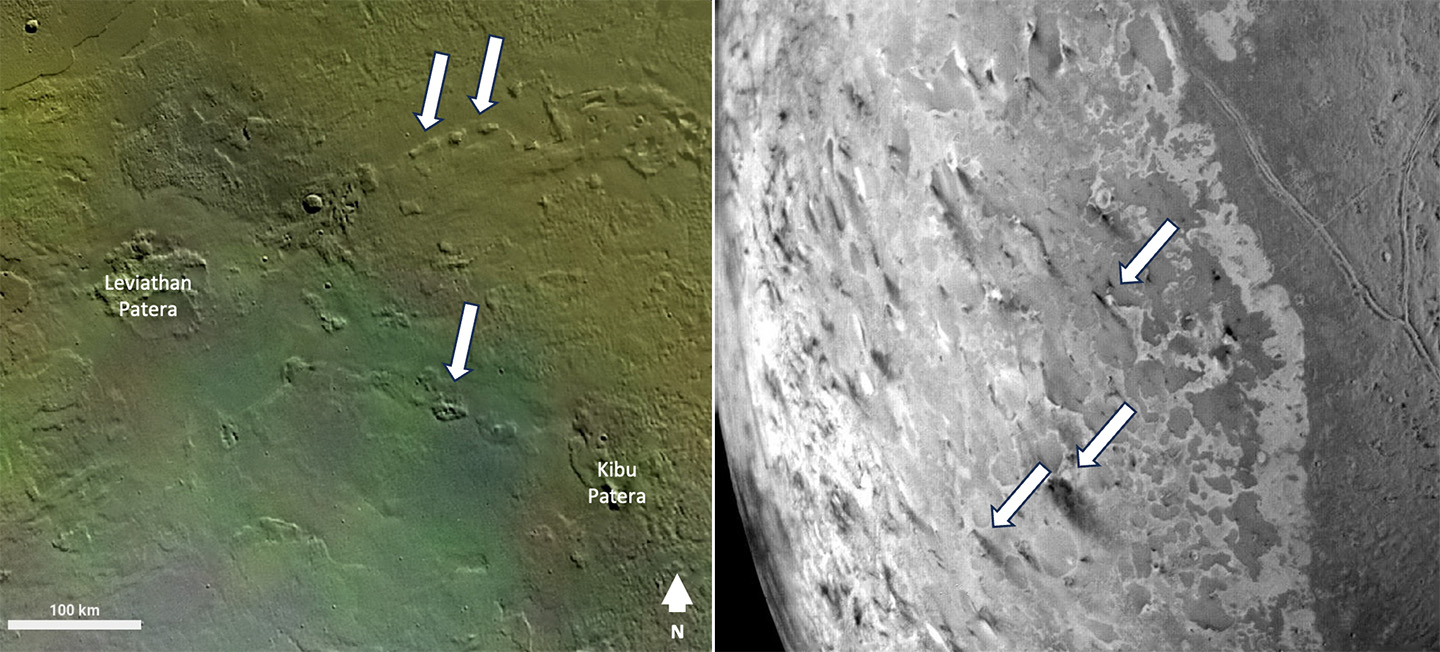
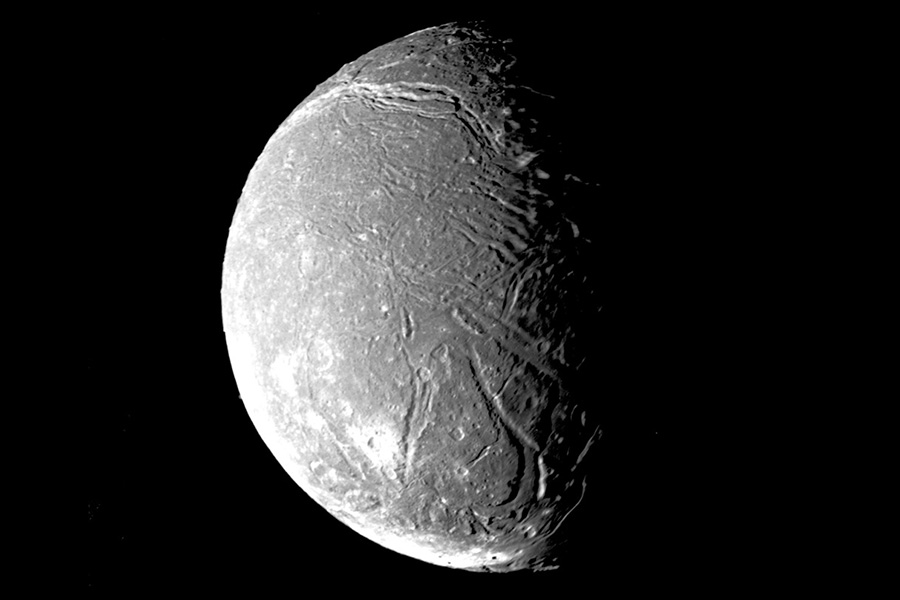
On Uranus’s moon Ariel, kilometers-deep canyons called “chasmata” crisscross the surface and are characterized by smooth, bowed floors. Similarly, the surface of Triton, Neptune’s largest moon, also bears evidence of sinuous pits. APL scientists are modeling whether these features could have formed through cryovolcanic thermal erosion, in which erupting material erodes the icy surface to create channels analogous to rilles (long, narrow, trench-like depressions) on the Moon and Venus.
Also at Triton, APL scientists are investigating what drives the moon’s geyser-like plumes. Voyager 2 captured images of twelve geyser-like features erupting in Triton’s southern hemisphere, including the confirmed Hili and Mahilani plumes that extend 8 kilometers above the surface. APL scientists are modeling whether the outgassing from Triton’s icy mantle could drive explosive cryovolcanism to produce these eruptions.
Features of interest on Triton’s surface. Regions of Triton’s (left image) surface that may be the result of channelized cryoflow are indicated by arrows. Plumes and plume material seen by Voyager 2 on Triton’s surface are denoted by arrows (right image).
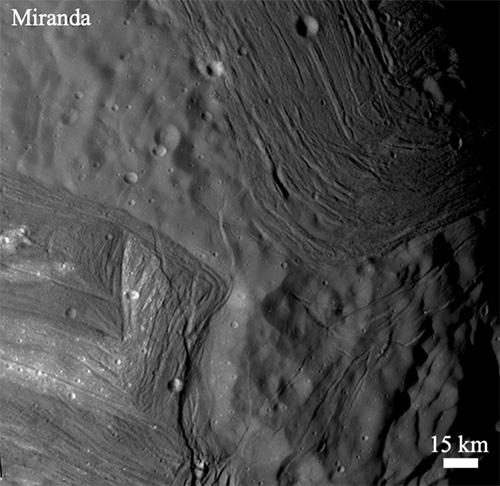
Scientists at APL are analyzing tectonic structures, craters, mass-wasting features, and regolith across Uranus’s moons to uncover their geologic evolution and interior properties. Spanning Miranda, Ariel, Umbriel, Titania, and Oberon, APL scientists are helping to create a comprehensive data archive of new and restored data products and tools using Voyager 2 Imaging Science Subsystem images. This archive will provide a framework for future studies designed to better understand geologic processes on the Uranian moons and support planning activities for a future Uranus mission.
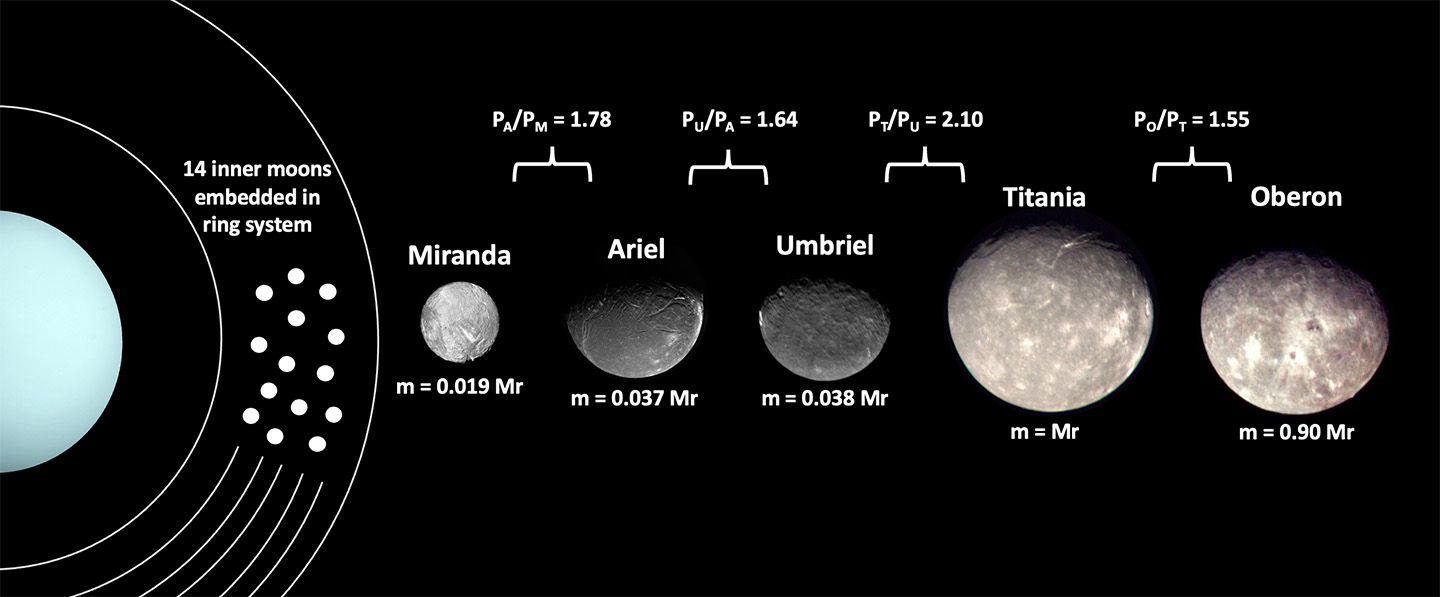
APL scientists are combining orbital mechanics with advanced simulations to reconstruct how Uranus’s system of moons formed and evolved. The large, regular moons of the giant planets formed roughly 4.5 billion years ago, and their cratered surfaces serve as a pristine window into the history and global evolution of our solar system. But the Uranian system presents a puzzle: While it closely resembles a scaled-down version of Jupiter’s system, the Uranian moons orbit perfectly within the plane of Uranus’s 98° inclined equator—pointing to a complex and potentially violent history.
Understanding the origin of that extreme tilt and the history recorded on the moons’ cratered surfaces is central to APL’s investigation. The resulting models can help researchers use future in-orbit observations to rule out competing formation models—maximizing the scientific return of a potential mission to the ice giant.
Dynamical properties of Uranus’s satellite system. The ratio of neighboring satellite orbital periods, as well as each large moon’s mass (in units of Titania’s mass, Mr) are listed.
APL scientists are investigating the complex dynamics of the Uranian and Neptunian magnetospheres, how they interact with the solar wind, and how these interactions drive auroral activity and energy inputs into the planets’ ionospheres and upper atmospheres.
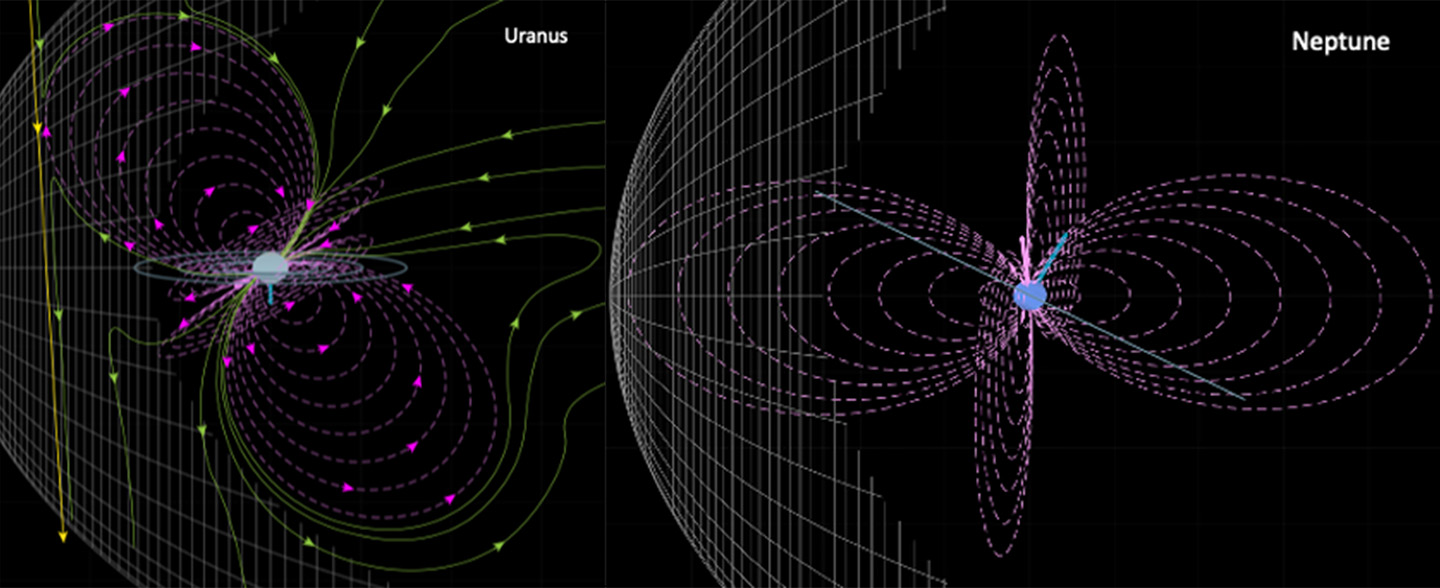
Unlike the relatively well-ordered magnetic environments of Earth or Jupiter, the magnetospheres of Uranus and Neptune are highly complex, asymmetric, and non-dipolar, featuring large offsets between their rotational and magnetic axes. This extreme geometry, combined with their vast distance from the Sun, creates an unusual, highly dynamic interaction with the solar wind that remains largely unexplored.
APL scientists are reanalyzing archival data from the historic Voyager 2 encounters and pairing it with sophisticated multi-fluid magnetohydrodynamics and advanced particle tracing models.
At Neptune, APL researchers are investigating the forms of solar wind coupling into the Neptunian magnetosphere, and at Uranus, they are developing a full 3D, parameterized (solar wind conditions, diurnal phase, and season) model to explain why the Uranian magnetosphere is relatively devoid of thermal plasma density.
A key aspect of APL’s ice giant research is investigation of the striking difference between Uranus’s and Neptune’s radiation belts. Voyager 2 found intense electron radiation belts at Uranus, while Neptune has among the weakest planetary radiation belts yet observed. Using a combination of theoretical models and spacecraft data analysis, APL scientists are exploring how charged particles can get trapped, accelerated, and ultimately lost in the unusual ice giant magnetospheric environment.
Uranus’s and Neptune’s asymmetric and tilted magnetospheres interact with their moons in ways that are not seen elsewhere in the solar system. At Uranus, APL scientists are exploring how several of its major moons host surface volatiles that may have originated either from their interiors or from interactions with the planet’s magnetosphere. Understanding these interactions and the distribution of surface volatiles is key to understanding whether these moons may have recently been, or still are, geologically active.
Similarly, at Neptune, APL scientists are investigating how input from the planet’s magnetosphere may contribute to Triton’s unexpectedly intense ionosphere. Combining data from Voyager 2 with sophisticated particle transport and ion-neutral chemistry models that were previously developed for Saturn’s moon Titan and for Pluto, they are working to understand the processes connecting Neptune’s magnetosphere to its largest moon.
Uranus’s (left) and Neptune’s (right) modeled magnetospheres.
Credit: Johns Hopkins APL/Drew Turner
Ice Giant Systems Seminar Series
APL leads the Ice Giant Systems Seminar Series, a bimonthly meetup that covers developments in the study of ice giants, including those pertaining to their atmospheres, satellites, rings, magnetic field, interiors, origins, and evolution. The series is led by APL’s Jodi Berdis and Stephanie Menten, and each session is hosted by a guest speaker who discusses recent research into ice giant systems.
Uranus’s Moons Collided Their Way Through Their Youth
APL-led computer modeling demonstrates that the five large moons of Uranus likely experienced two distinct episodes of self-destruction: the first due to the giant planets themselves being in close proximity to one another shortly after their formation and the second resulting from the massive impact that tilted Uranus on its side.
New Study Suggests Trench-Like Features on Uranus’ Moon Ariel May Be Windows to Its InteriorFeb 3, 2025
In a new study, Johns Hopkins APL researchers suggest that trench-like grooves on Uranus’ moon Ariel may be conduits for exchanging materials between the moon’s surface and interior, possibly even from a subsurface ocean.
Uranus’ Moon Miranda May Have an Ocean Beneath Its Surface, New Study FindsOct 28, 2024
Scientists have discovered that Uranus’ moon Miranda may have a hidden ocean beneath its surface. The surprising finding, based on a study of the moon’s surface features and computer modeling, suggests Miranda’s interior may still be warm and harbor liquid water even today, challenging assumptions about its composition and history.
Carbon Oxides on Uranus’ Moon Ariel Hint at Hidden Ocean, Webb Telescope RevealsJul 24, 2024
A new Johns Hopkins APL-led study using NASA’s Webb telescope suggests carbon dioxide and similar molecules on Uranus’ moon Ariel may be emerging from inside the moon, raising questions about the moon’s geologic activity and potential as an ocean world.
Two of Uranus’ Moons May Harbor Active Oceans, Radiation Data SuggestsMar 16, 2023
New research using Voyager 2’s nearly 40-year-old particle data from Uranus suggests at least one of the planet’s moons is actively spewing material into the nearby space environment, possibly from a liquid water ocean beneath the surface.