News
Industrial Torch Fuels Faster Development of Materials for Extreme Environments
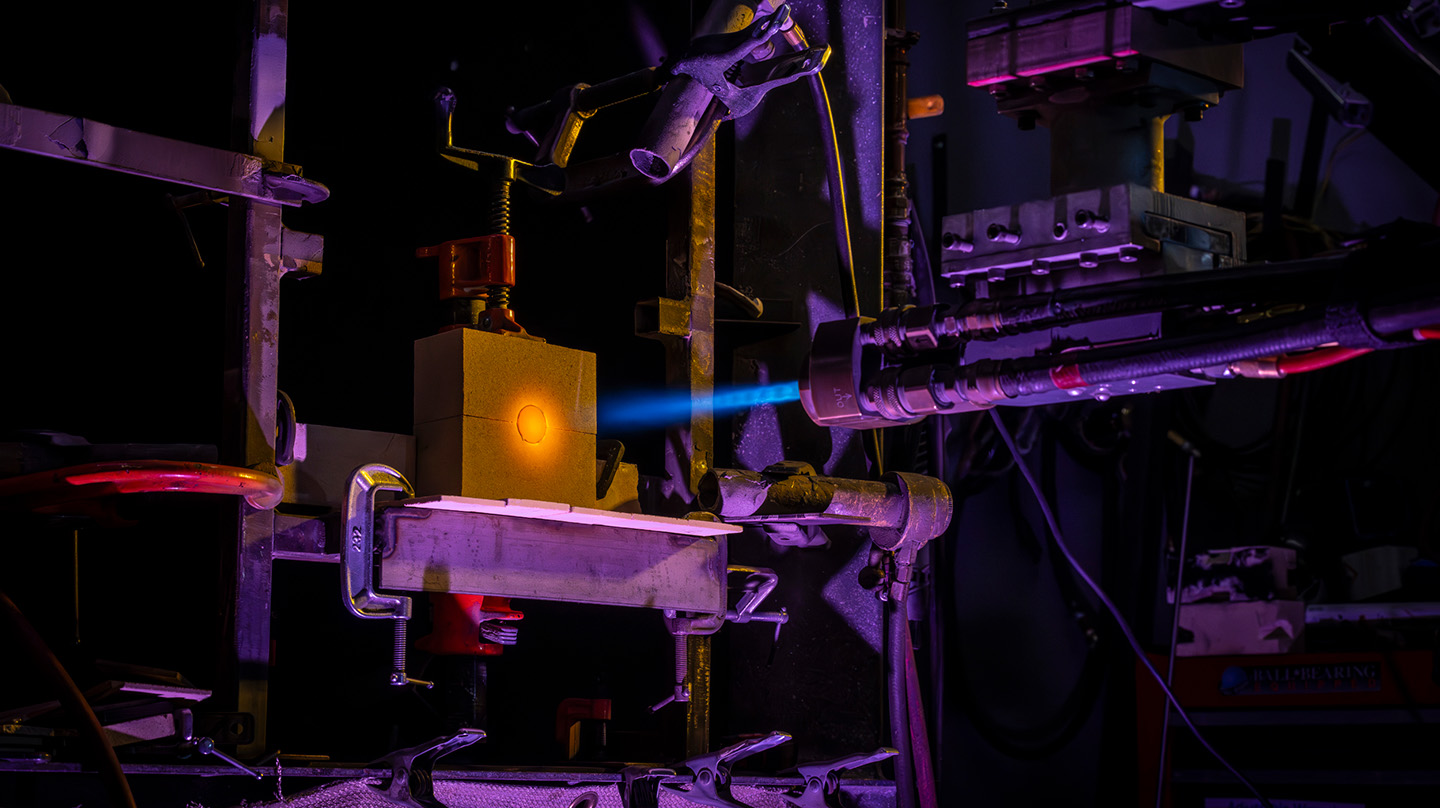
The blue flame of a high-velocity oxygen-fuel (HVOF) torch can reach temperatures above 3,600 degrees Fahrenheit (around 1,982 degrees Celsius), according to a new APL study, and blast them to supersonic speeds. The system offers a fast, low-cost way to screen potential materials for high-speed, high-temperature aerospace applications.
Credit: Johns Hopkins APL/Ed Whitman
New work from engineers at the Johns Hopkins Applied Physics Laboratory (APL) in Laurel, Maryland, shows a technology normally used to spray protective coatings onto industrial parts could help address a costly problem in hypersonics: deciding which materials deserve time in the nation’s scarce high-end test facilities.
In a study published online Aug. 12 in the Journal of Testing and Evaluation, the APL team presents the first comprehensive characterization of a high-velocity oxygen-fuel (HVOF) test environment for screening materials exposed to extreme heat, high-speed flow, and oxygen-rich conditions.
Why it matters: Limited and aging high-end test infrastructure across the nation has created long wait times that threaten to slow the development of materials for hypersonic flight and other extreme aerospace applications. Shifting some evaluation earlier can help materials developers make better use of this limited infrastructure, reserving costly higher-end testing for the most promising candidates. It also helps them focus those tests around the questions that matter most.
- “HVOF has given the Glide Phase Interceptor Program that I manage at APL a fast, easy way to prescreen materials before we take them to larger, more expensive facilities,” said Yo-Rhin Rhim, a study co-author. “That lets us go into those tests with a much better idea of which materials we need to focus on and what the test matrix should look like.”
The tool: HVOF is like a kitchen torch’s industrial cousin; it burns a mix of fuel and oxygen to produce a bright blue flame that can melt metal or ceramic powders and blast them up to supersonic velocities. This thermal spray process is used to apply protective coatings, including onto components that need to withstand wear, corrosion, or extreme environments.
The twist: Instead of using HVOF to apply a coating, researchers can use the torch itself to test materials. Its hot, fast-moving plume exposes candidates to extreme conditions to see how they respond.
The benchmark: But to determine what those test results reveal about real-world performance, researchers first need to characterize the environment created by the HVOF plume. Using a combination of physical experiments and computer modeling, an APL team led by materials engineer Gehn Ferguson set out to build a comprehensive picture of the conditions created by the torch — including heat, aerodynamic loading, and oxidizing conditions — and determine which aspects of hypersonic environments it can approximate well enough for materials screening.
- The team mounted the rig to a robotic arm to precisely adjust its distance and angle from a sample material.
- Researchers measured the plume’s temperature, the amount of heat transferred to the sample, and the forces generated as the high-speed gas flowed across the material’s surface.
- Anchored by those real-world measurements, the computer model filled in the harder-to-measure details — the plume’s speed, pressure, and oxygen distribution — that influence how aggressively gases interact with a material’s surface. It also provided a better picture of any variation across a sample’s surface.
The payoff: The HVOF plume reached temperatures above 3,600 degrees Fahrenheit (around 1,982 degrees Celsius), enough to produce material responses relevant to several hypersonic applications, although not the full range of thermal loads seen in flight. Its dense, fast-moving gas also packed a heavy punch, producing aerodynamic loads comparable to high-end ground-test facilities and surface heating on par with a projectile reentering Earth’s atmosphere.
- The team argues HVOF offers a fast, low-cost way to test how materials respond when exposed to high temperatures, speeds, and oxygen-rich environments, helping programs reduce risk early in material development.
- “It’s not a one-to-one mapping, but high-velocity oxygen fuel is another tool in our toolbox to help us accelerate materials development and reduce risk when picking materials to further produce or mature,” Ferguson said.
A proof of concept: The team demonstrated the method by reinjecting a ceramic powder into the flame and blasting it against four candidate materials for rocket launch systems, which are exposed to conditions where tiny micron-sized particles combine forces with scorching temperatures to rapidly wear them down. CT scans after testing showed clear differences in how each material responded and offered instructive results for their improvement.
- “We’ve been building toward this capability for a long time, and it’s exciting to see the pieces finally come together into another tool people can use as they develop these crucial materials,” said Leslie Hamilton, manager of APL’s Science of Extreme and Multifunctional Materials program.
What’s next: HVOF systems still require manually adjusting the torch angle and gas flow. The APL researchers see opportunities to automate the setup, expand its diagnostic capabilities, and tailor test conditions more precisely so HVOF becomes an even faster, more capable screening tool.